
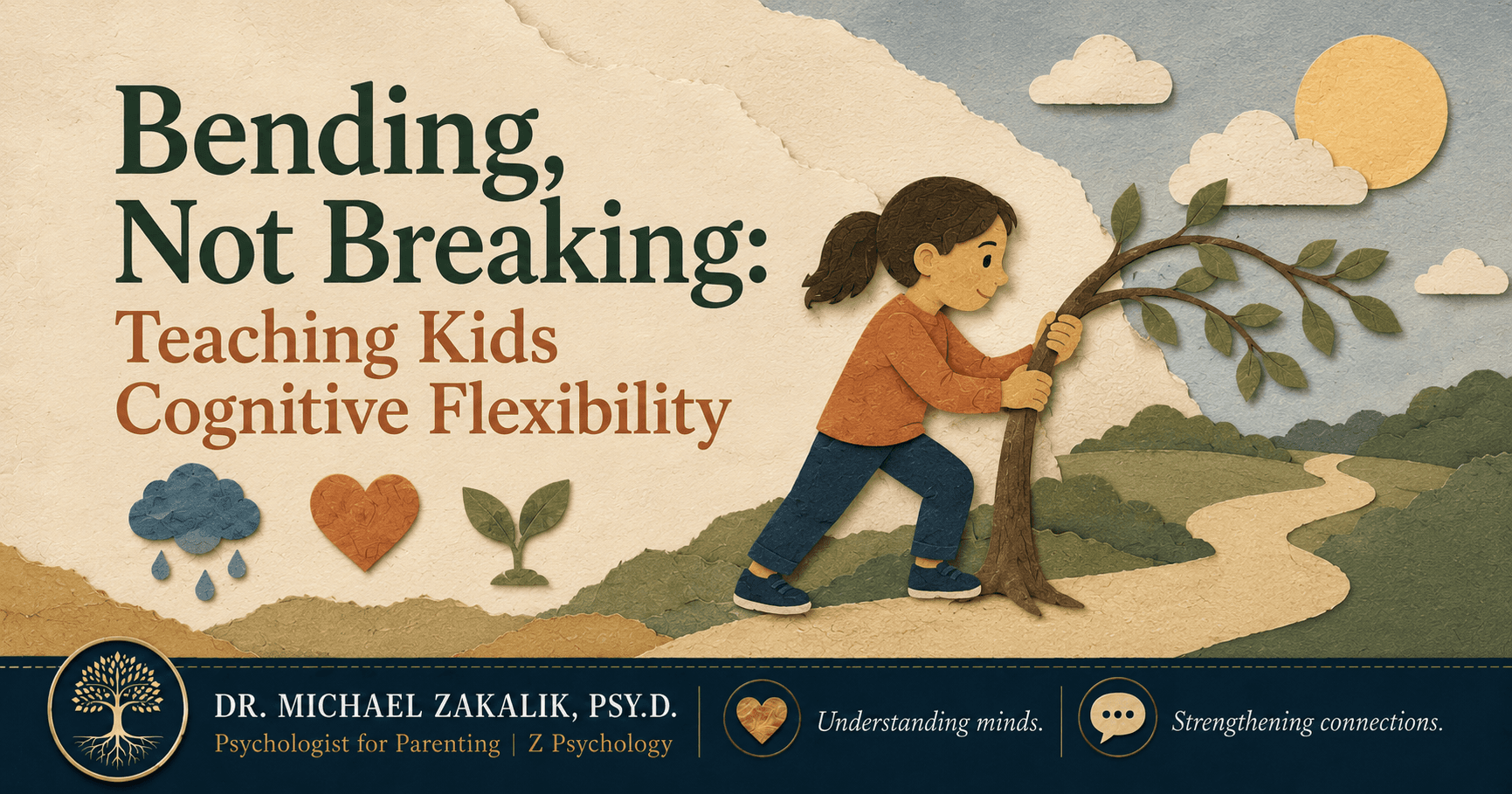
A stiff branch snaps. A living tree bends, sways, and stands right back up. We are going to practice being the tree.
(Disclaimer: The articles provided on this website are for informational and enhancing mental health awareness purposes only. They are not intended to be clinical interventions or provide medical advice. If you have any concerns about your well-being and/or well-being of others, please seek guidance from a qualified professional, such as a physician, psychologist, or counselor. If you are experiencing a clinical emergency please call 911 or 988 or go to the nearest emergency room. Here are some national and international helplines.)
By Dr. Michael Zakalik, Licensed Clinical Psychologist
Part of Dr. Z's Toolbox.
Cognitive Flexibility for Kids: A Parent's Guide
You promised the park. Then it started raining. To you, this is a minor reroute. To your six year old, it can be the collapse of civilization: tears, a slammed door, the whole production. It is tempting to chalk it up to being dramatic. It is usually something more specific, and more fixable: a brain that has not yet learned how to bend.
That ability to bend has a name. Psychologists call it cognitive flexibility, and it might be one of the most useful things you can help a child build, because life, as we all eventually learn, is mostly plan B.
What is cognitive flexibility?
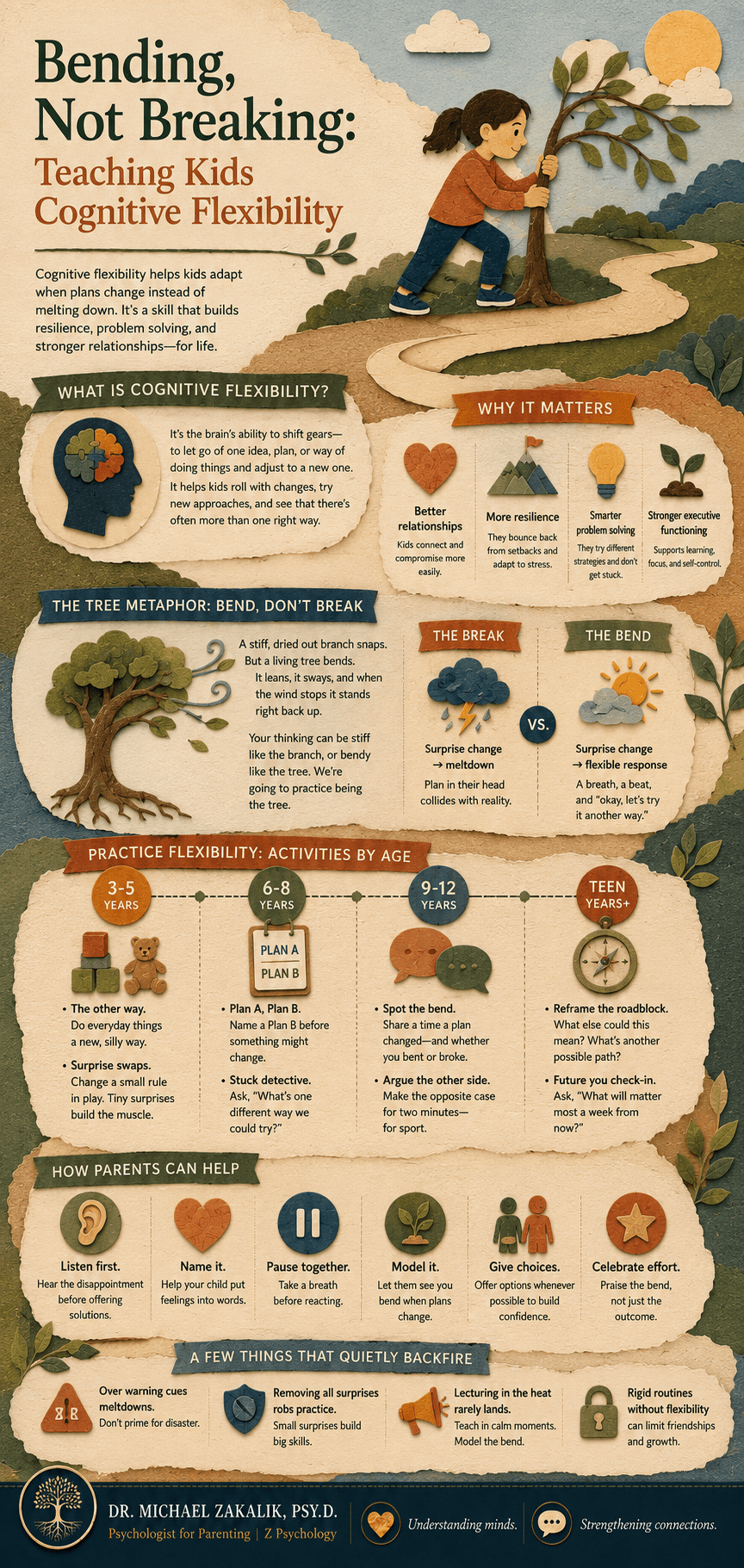
Cognitive flexibility is the brain's ability to shift gears, to let go of one idea, plan, or way of doing things and adjust to a new one. In kids, it is what lets them roll with a change of plans, try a different approach when the first one fails, and see that there is usually more than one right way. It is one of the three core executive functions, alongside working memory and impulse control, the mental management skills that run quietly behind everything a child does. When cognitive flexibility is strong, surprises are interesting. When it is weak, surprises feel like threats.
Why it matters
A child who can't bend pays for it all day long. Transitions become battles. A small change to a routine derails the morning. Friendships strain, because play requires constant compromise and rule changing. Schoolwork suffers, because getting stuck on one approach to a problem, and being unable to try another, is the definition of being stuck. Flexible thinking is also one of the better predictors of resilience. The research here is consistent: kids who can shift their thinking adapt to stress, setbacks, and disappointment far more smoothly than kids who can't. They are not feeling less. They are recovering faster, because they have somewhere to put the feeling besides everything is ruined. The encouraging news is that flexibility is built, not born. The brain regions involved keep developing well into the twenties, which means every okay, let us try it another way you model is a real deposit.
"Same surprise. Completely different evening. The difference is not how much the child cares. It is whether they can let the first plan go."
How to explain it to your child
Reach for a picture, not a definition. The one that works best with kids: Think about a tree in a big wind. A stiff, dried out branch snaps. But a living tree bends. It leans way over, it sways, and when the wind stops it stands right back up. Your thinking can be stiff like the branch, or bendy like the tree. We are going to practice being the tree. Bend, don't break. Kids remember it because they can see it.
What it looks like in real life
It is pizza night. Everyone knows it is pizza night. Then a grown up announces it is tacos. The break: a meltdown, because the plan in their head got contradicted by reality and the head plan loses. The bend: a breath, a beat, and okay, I like tacos too, pizza can be tomorrow. Same surprise. Completely different evening. The difference between those two outcomes is not how much the child cares about pizza. It is whether they can let the first plan go. Your job in that moment is smaller than it feels. You do not have to prevent the disappointment. You just have to narrate the bend: I know you had pizza in your head, let us see if our brain can be bendy about it. You are handing them the move.
Try it together: activities by age
Build the skill in small, everyday moments. By age:
- Ages 3 to 5. The other way: do an everyday thing, walking to the car, brushing teeth, a brand new silly way, planting the seed that there is more than one way to do almost anything. Surprise swaps: during play, gently change a small rule mid game (now the blocks are food), so tiny, safe surprises build the bending muscle in a setting that is already fun.
- Ages 6 to 8. Plan A, Plan B: before something that might not go as hoped, name a Plan B out loud together, so when the change comes the bend is already loaded and ready. Stuck detective: when they hit a wall on a puzzle or task, resist solving it and ask what is one different way we could try, teaching the search for option two.
- Ages 9 to 12. Spot the bend: at dinner, everyone shares a moment today when a plan changed, and whether they bent or broke, since noticing is most of the skill and no judgment is required. Argue the other side: pick something they feel sure about and have them make the opposite case for two minutes, for sport, because holding two views at once is flexibility at its most grown up.
A few things that quietly backfire
Over warning (now don't freak out, but the plan changed) tends to cue the very meltdown you are bracing for. So does removing every surprise to keep the peace: a child who never practices bending in small, safe doses has no muscle for the big ones. And lecturing in the hot moment rarely lands. The bend gets taught in the calm afterward, and most of all by watching you bend.
Try this: before your next outing that might not go as planned, name a Plan B out loud together, "if the park is too wet, Plan B is hot chocolate and a movie." When the change comes, the bend is already loaded and ready.
Frequently asked questions
Is cognitive flexibility the same as just being easygoing?
Not quite. An easygoing temperament helps, but flexibility is a skill even intense, particular kids can build. Plenty of strong willed children become highly flexible thinkers with practice.
My child is rigid about routines. Is that a problem?
Loving routine is normal and often healthy, because predictability feels safe. It becomes worth attention when small, ordinary changes regularly cause big distress, or when rigidity is closing off friendships and learning. If that sounds familiar, the activities here help, and a conversation with a professional can too.
At what age should I expect more flexibility?
It grows gradually. Preschoolers are naturally rigid; early elementary kids can start to bend with coaching; by the tween years many can do it more independently. The whole system keeps maturing into early adulthood.
How is this different from giving in?
Flexibility is not caving on limits. You can hold a boundary firmly and still help your child think flexibly about it. Screen time is done stays true. You are just helping them find a bendy way to handle that it is true.
Free download: Cognitive Flexibility Family Discussion Guide
A kid friendly explainer of bend, don't break plus three no-materials activities to build flexible thinking at home.
Download the guide (PDF)Enjoyed this? Explore more of Dr. Z's Toolbox