
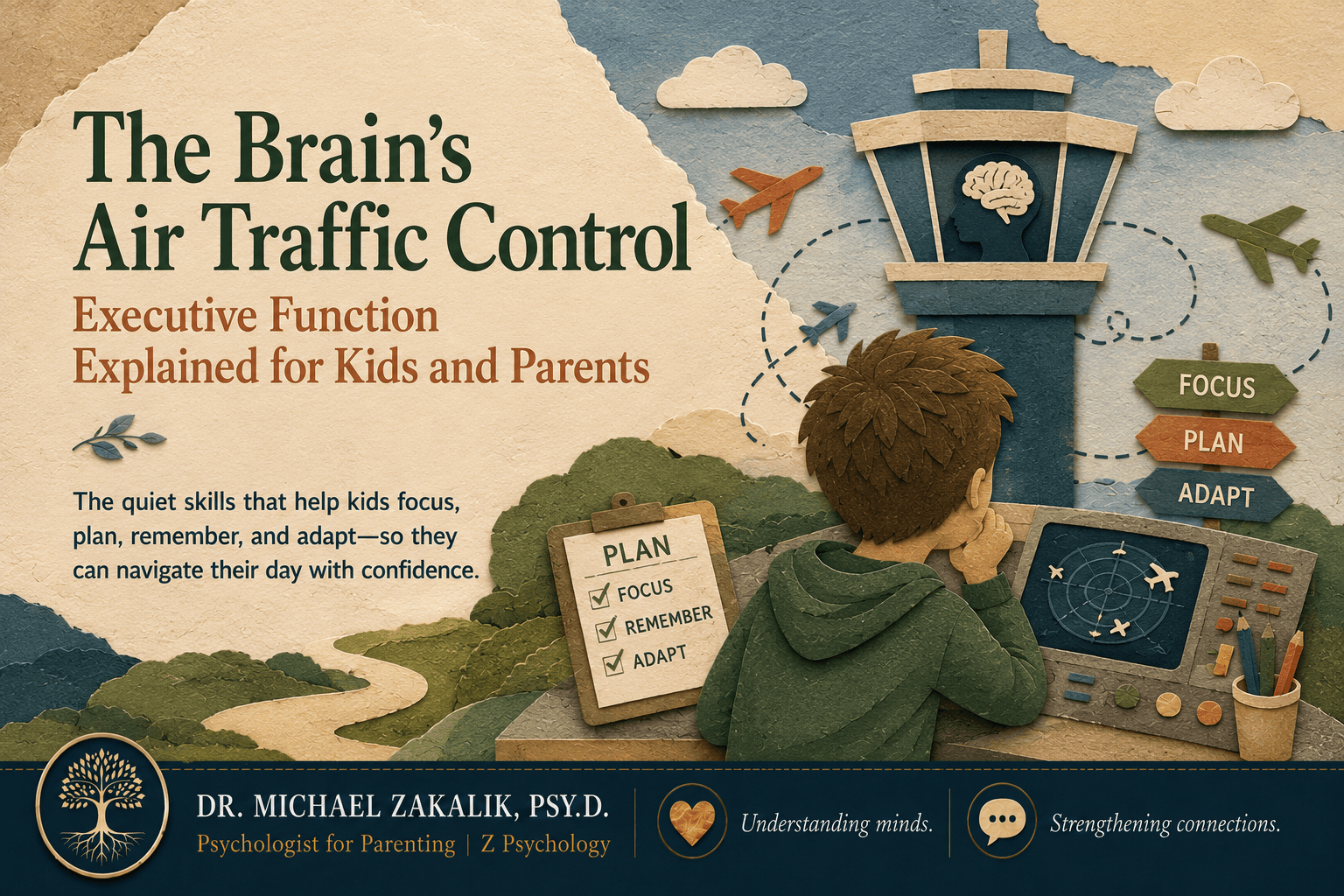
It is not character. It is not effort. It is a set of brain skills still under construction, and that changes how you respond to almost everything.
(Disclaimer: The articles provided on this website are for informational and enhancing mental health awareness purposes only. They are not intended to be clinical interventions or provide medical advice. If you have any concerns about your well-being and/or well-being of others, please seek guidance from a qualified professional, such as a physician, psychologist, or counselor. If you are experiencing a clinical emergency please call 911 or 988 or go to the nearest emergency room. Here are some national and international helplines.)
By Dr. Michael Zakalik, Licensed Clinical Psychologist
Part of Dr. Z's Toolbox.
Executive Function in Children: A Parent's Guide
If you have ever watched your child stand in the middle of the room holding one sock, having completely forgotten that getting dressed was the assignment, you have met executive function. Or rather, you have met it taking a coffee break.
Executive function is the quiet machinery behind getting things done, and it is the reason a bright, capable kid can still lose a water bottle every week, blurt out answers, or fall apart when the worksheet has four steps instead of one. It is not character. It is not effort. It is a set of brain skills that are still very much under construction, and knowing that changes how you respond to almost everything.
What is executive function?
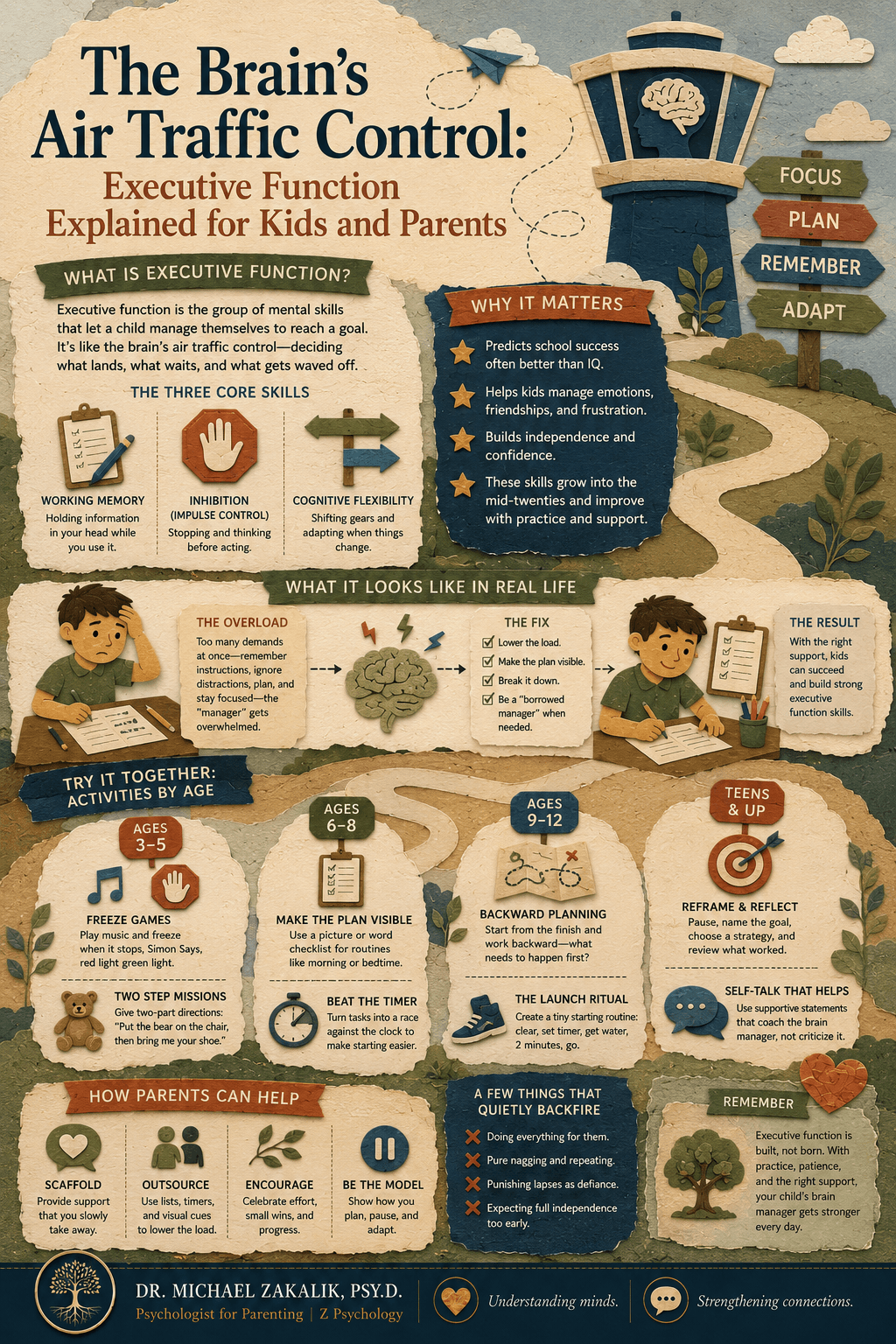
Executive function is the group of mental skills that let a child manage themselves to reach a goal: holding information in mind, resisting the first impulse, and adjusting when things change. Think of it as the brain's air traffic control, deciding what lands, what waits, and what gets waved off. Psychologists usually group it into three core skills. Working memory is holding information in your head while you use it. Inhibition, or impulse control, is the ability to stop and think before acting. Cognitive flexibility is shifting gears when the situation changes. Almost everything we call being organized or paying attention is some blend of those three.
Why it matters
Executive function predicts an enormous amount about how a child's day goes. Some research suggests it forecasts school success even better than IQ. It is the difference between a child who can start their homework and one who stares at it, between a child who packs their bag and one who arrives with nothing in it. It matters socially too. Waiting your turn, not grabbing, letting a friend change the game, recovering when you lose: all executive function. A child who struggles here is often a child who badly wants to do well and keeps tripping over their own wiring. Here is the part worth holding onto. These skills develop slowly, all the way into the mid twenties, and they respond to practice and support. Your scaffolding today is not babying. It is how the skill gets built.
"It is not character. It is not effort. It is a set of brain skills still under construction, and your scaffolding today is how the skill gets built."
How to explain it to your child
Kids do well with the manager idea. Inside your brain there is a manager whose whole job is to help you do what you are trying to do. It reminds you what comes next, it tells your body to wait when you want to grab, and it helps you switch plans when something changes. Sometimes the manager is still learning the job, so we are going to give it some practice. Naming the manager takes the shame out of the struggle. The problem is not your child. It is a manager who is still in training, and managers get better at their jobs.
What it looks like in real life
Your son sits down to a math worksheet and within a minute he is on the floor under the table. The story we tell ourselves is lazy or not trying. The truer story is usually that the page asked his manager to hold the instructions, ignore the dog, plan the first step, and tolerate the boredom all at once, and the manager got overloaded and walked off the job. The fix is rarely more pressure. It is lowering the load. Break the four problems into one problem at a time. Put the instructions where he can see them instead of inside his memory. Sit nearby as a borrowed manager until his own catches up. You are not lowering the bar. You are handing him a ramp to reach it.
Try it together: activities by age
Build the skill in small, everyday moments. By age:
- Ages 3 to 5. Freeze games: play music and freeze when it stops, or Simon Says, or red light green light, because stopping a body in motion is impulse control in its purest and most joyful form. Two step missions: give playful directions with two parts, like put the bear on the chair, then bring me your shoe, since holding the second step while doing the first is working memory at work.
- Ages 6 to 8. Make the plan visible: build a simple picture or word checklist for a routine that always falls apart, like the morning, because outsourcing memory to a list is exactly what organized adults do. Beat the timer: turn a dreaded task into a race against a visible timer, so the clock becomes the manager and starting gets easier when there is a game attached.
- Ages 9 to 12. Backward planning: for a project or a Saturday goal, start from the finish and work back, what has to happen the night before, the morning of, an hour before, training the planning muscle directly. The launch ritual: getting started is often the hardest part, so build a tiny starting routine, clear the desk, fill the water bottle, set a two minute timer, go, because lowering the cost of beginning is half the battle.
A few things that quietly backfire
Doing it all for them feels efficient and quietly teaches that the manager never has to show up. Pure nagging does the opposite of building the skill, because the reminder lives in you instead of in them. And treating executive function lapses as defiance turns a wiring problem into a relationship problem. The aim is to be the scaffolding you slowly take down, not the crutch that never leaves.
Try this: pick the one routine that always falls apart, usually the morning, and build a short picture or word checklist for it together. Hang it where your child can see it. You are moving the plan out of their memory and onto the wall, which is exactly what organized adults do.
Frequently asked questions
Is weak executive function the same as ADHD?
No, though they overlap. Every child has executive function that is still developing, and many kids are simply on the later end of normal. ADHD involves executive function challenges that are more intense, more persistent, and that get in the way across different settings. If the struggle is significant and lasting, an evaluation can bring clarity and a real plan.
My child is so smart but so disorganized. How is that possible?
This is one of the most common things parents say, and it makes sense once you separate the skills. Intelligence and executive function are different systems. A child can reason brilliantly and still have a manager who cannot locate the homework. The mismatch is real, and it is not a character flaw.
Can executive function actually be improved?
Yes. It builds through practice, through routines that carry some of the load, and through an adult who scaffolds and then steps back. Progress is gradual, since the underlying brain systems mature over years, but the trajectory genuinely bends with support.
At what age should my child manage all of this on their own?
Later than most of us expect. Expecting full independence in the elementary years sets everyone up for frustration. These skills are still maturing deep into the teens and beyond, so the role to play is coach and scaffold, not hands off.
Free download: Executive Function Family Discussion Guide
A kid-friendly explainer of your brain's manager plus simple, age-by-age activities to build focus, planning, and self-control at home.
Download the guide (PDF)Enjoyed this? Explore more of Dr. Z's Toolbox