
Noticing, understanding, and managing feelings: the everyday skill behind a happy, connected child.
(Disclaimer: The articles provided on this website are for informational and enhancing mental health awareness purposes only. They are not intended to be clinical interventions or provide medical advice. If you have any concerns about your well-being and/or well-being of others, please seek guidance from a qualified professional, such as a physician, psychologist, or counselor. If you are experiencing a clinical emergency please call 911 or 988 or go to the nearest emergency room. Here are some national and international helplines.)
By Dr. Michael Zakalik, Licensed Clinical Psychologist
Part of Dr. Z's Toolbox.
Emotional Intelligence in Children: A Parent's Guide
Most of us were raised to treat feelings as weather, something that happens to you, that you wait out, that you do not talk about too much. So when our own kids melt down over a green cup instead of a blue one, we can feel a little lost. Do I fix it? Ignore it? Is something wrong?
Here is the reassuring part. Those moments are not a problem to be solved so much as a skill to be built. That skill has a name, emotional intelligence, and unlike height or eye color, it is almost entirely teachable. You are already doing it, in the kitchen, in the car, in the hundred small exchanges that make up a day. This guide is about doing it on purpose.
What is emotional intelligence?
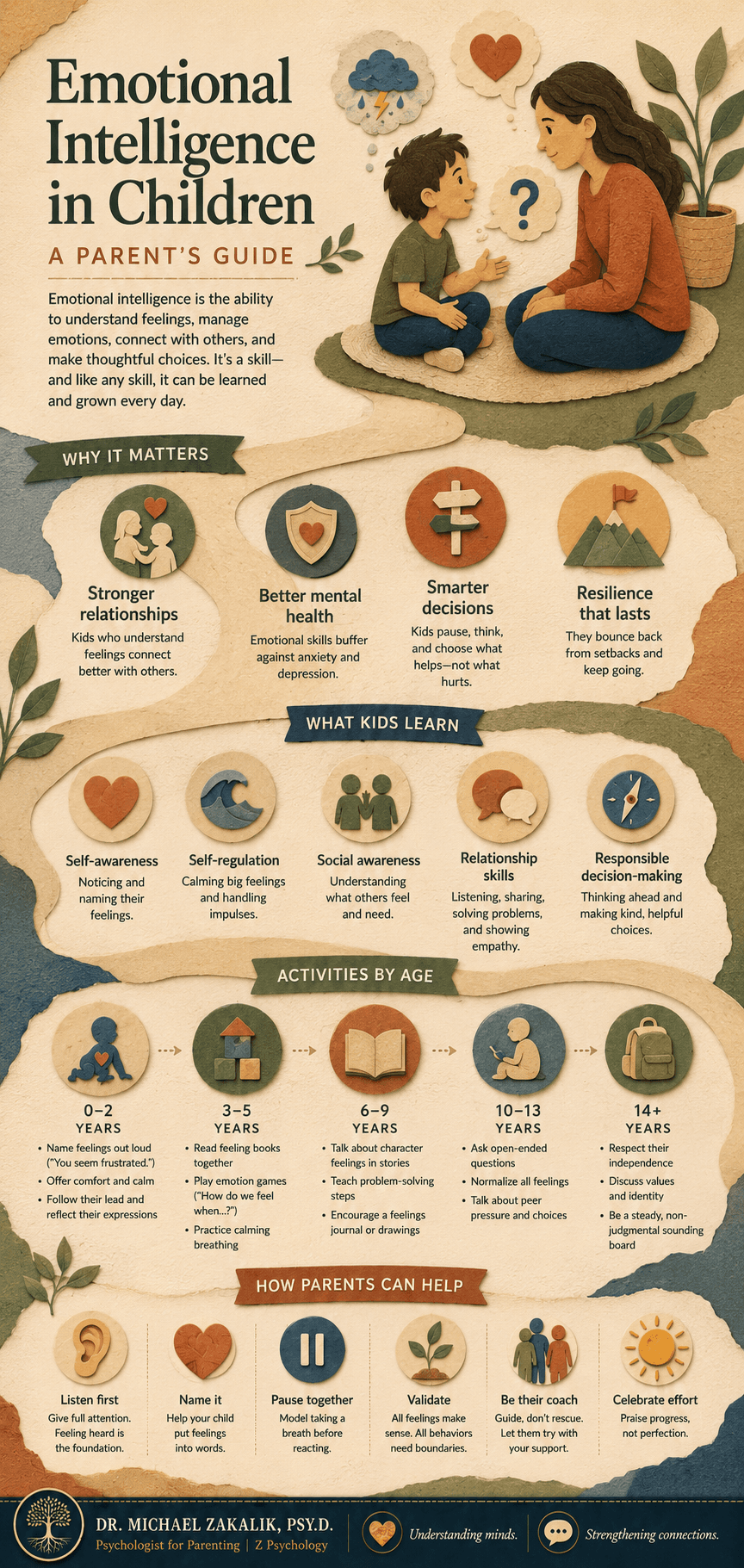
Emotional intelligence is the ability to notice feelings, your own and other people's, understand what they are telling you, and use that information to make good choices. In kids, it shows up as being able to name what they feel, calm down after getting upset, read the room, and care about how someone else is doing. It breaks down into four everyday abilities: noticing feelings, understanding them, managing them, and using them to connect with others. None of these is fixed at birth. They grow the way a vocabulary grows, through exposure, practice, and a patient adult nearby.
Why it matters more than most parents expect
For a long time we assumed that how smart a child was, their IQ, their grades, would decide how their life went. The research of the last few decades has complicated that nicely. A child's ability to manage frustration, bounce back from a hard moment, and get along with others turns out to predict a remarkable amount: friendships, classroom success, and mental health down the road. That is not because feelings are nicer than thinking. It is because a child who can settle a wave of anger has a brain that is actually available for learning, problem solving, and connection. Big unmanaged feelings hijack everything else. Emotional intelligence is what keeps the driver in the seat. And it is protective. Kids who can name and work through emotions are better buffered against anxiety and depression, partly because a feeling you can name is a feeling you can do something about. The nameless ones are the ones that swallow us.
"Feelings are messengers. The trick is not to slam the door on the messenger. It is to listen to what it says, and then you decide what to do."
How to explain it to your child
You do not need the term emotional intelligence for this. In fact, drop it. Try this instead, in your own words. Feelings are like messengers. They knock on the door to tell you something. Mad might be saying that is not fair. Scared might be saying I am not sure I am safe. The trick is not to slam the door on the messenger. It is to listen to what it says, and then you decide what to do. That single idea, the feeling is information and you are the decider, is the whole thing in a sentence a five-year-old can hold.
What it looks like in real life
Your daughter loses a board game and flips the board off the table. The low emotional intelligence response from us is to punish the behavior and move on. The emotionally intelligent move is to do two things at once: hold the line on the behavior and coach the feeling underneath it. You can not throw the board. And losing when you tried hard is one of the worst feelings. Let us sit with it for a second. Notice you did not fix the feeling or talk her out of it. You named it, allowed it, and stayed. Over hundreds of these, she internalizes a quiet voice that says, this is big, but I can handle it. That voice is emotional intelligence.
Try it together: activities by age
Build the skill in small, everyday moments. By age:
- Ages 3 to 5. Feelings check-in at dinner: each person names one feeling from their day and what caused it, so feelings get names and reasons. Name it in books: pause during stories and ask how the character feels and how you can tell.
- Ages 6 to 8. The body detective: when a big feeling hits, get curious about where it lives, the tummy or the chest, linking feeling to body sensation. Feelings have sizes: rate feelings 1 to 5, so a spilled drink might be a 2 and a lost pet a 5, which helps kids stop overreacting to small ones.
- Ages 9 to 12. The redo: after a blow-up cools, replay it calmly together and pick a different move for next time, with no shame, just rehearsal. Read the room: in a show or at a gathering, quietly guess what someone else might be feeling and why, growing the empathy that fuels real friendship.
A few things that quietly backfire
Rushing to fix it, saying do not cry, it is fine, teaches kids their feelings are too much for you. Dismissing it, saying you are okay, does the same. And so does the opposite, drowning in the feeling right alongside them. The sweet spot is calm company: you are steady, the feeling is welcome, and you trust them to come through it.
Try this: tonight at dinner, everyone names one feeling from their day and what caused it, grown-ups included. Two minutes. You are teaching your child that feelings have names, reasons, and a place at the table.
Frequently asked questions
At what age does emotional intelligence start developing?
From infancy. Babies are already reading your face and borrowing your calm. The toddler and preschool years are prime time for naming feelings, and the skill keeps maturing into the teens as the brain's regulation centers come online.
Can emotional intelligence actually be taught, or are some kids just born with it?
Temperament varies, and some children feel things more intensely from day one. But the skills of emotional intelligence are learned, and intense kids often become the most emotionally skilled adults precisely because they got the most practice.
Is emotional intelligence the same as being sensitive?
No. A sensitive child feels deeply. An emotionally intelligent one knows what to do with deep feeling. Sensitivity is the raw material, and emotional intelligence is the skill that puts it to work.
How is emotional intelligence different from IQ?
IQ is about reasoning and knowledge. Emotional intelligence is about managing feelings and relationships. They are separate, and the second one does a lot of the quiet work behind a happy, functioning life.
Free download: Emotional Intelligence Family Discussion Guide
Simple, age-by-age conversation starters to build your child's emotional intelligence at home.
Download the guide (PDF)Enjoyed this? Explore more of Dr. Z's Toolbox