
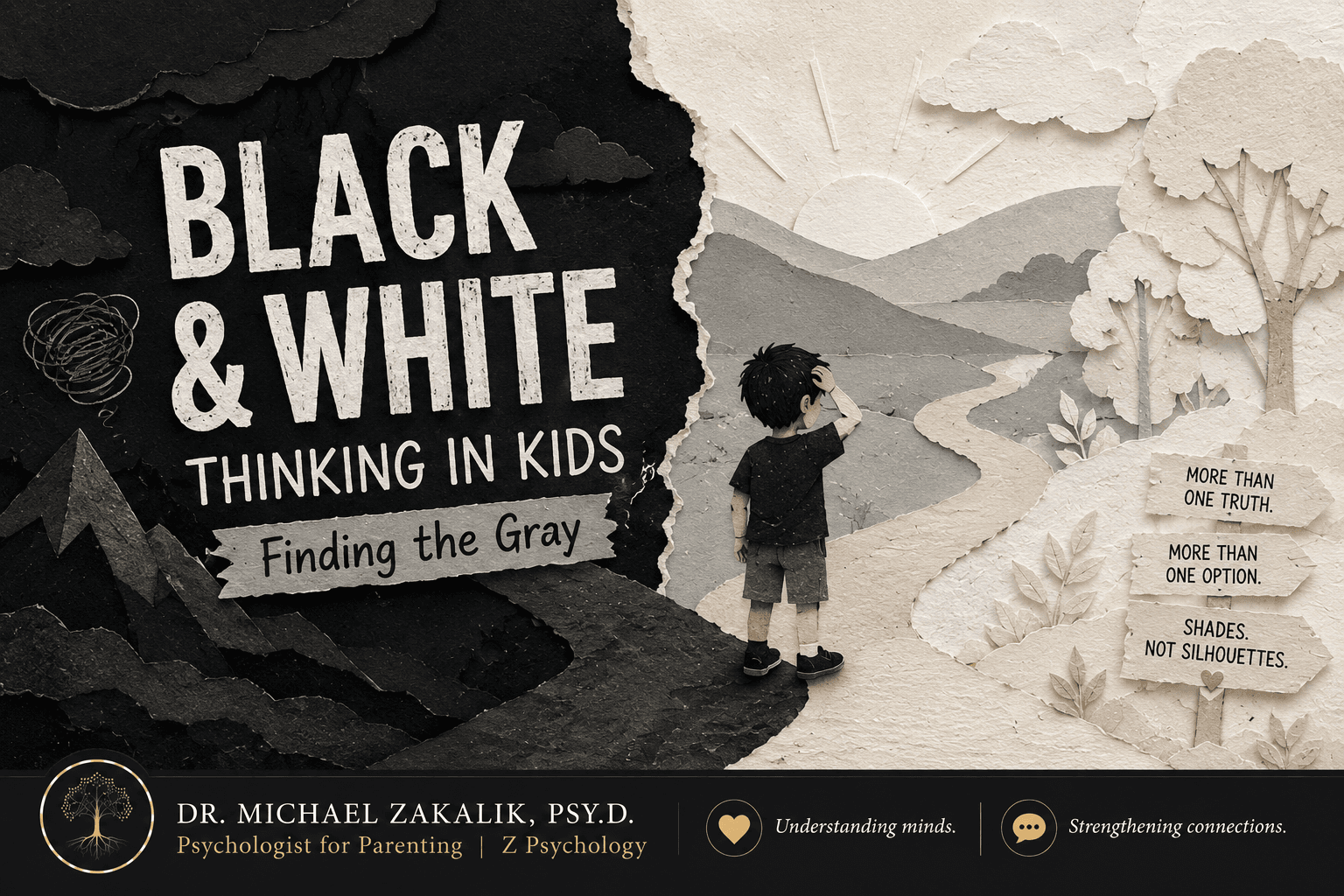
Where flexible thinking bends, black and white thinking snaps to one extreme or the other. The middle can be taught.
(Disclaimer: The articles provided on this website are for informational and enhancing mental health awareness purposes only. They are not intended to be clinical interventions or provide medical advice. If you have any concerns about your well-being and/or well-being of others, please seek guidance from a qualified professional, such as a physician, psychologist, or counselor. If you are experiencing a clinical emergency please call 911 or 988 or go to the nearest emergency room. Here are some national and international helplines.)
By Dr. Michael Zakalik, Licensed Clinical Psychologist
Part of Dr. Z's Toolbox.
Black-and-White Thinking in Kids: Finding the Gray
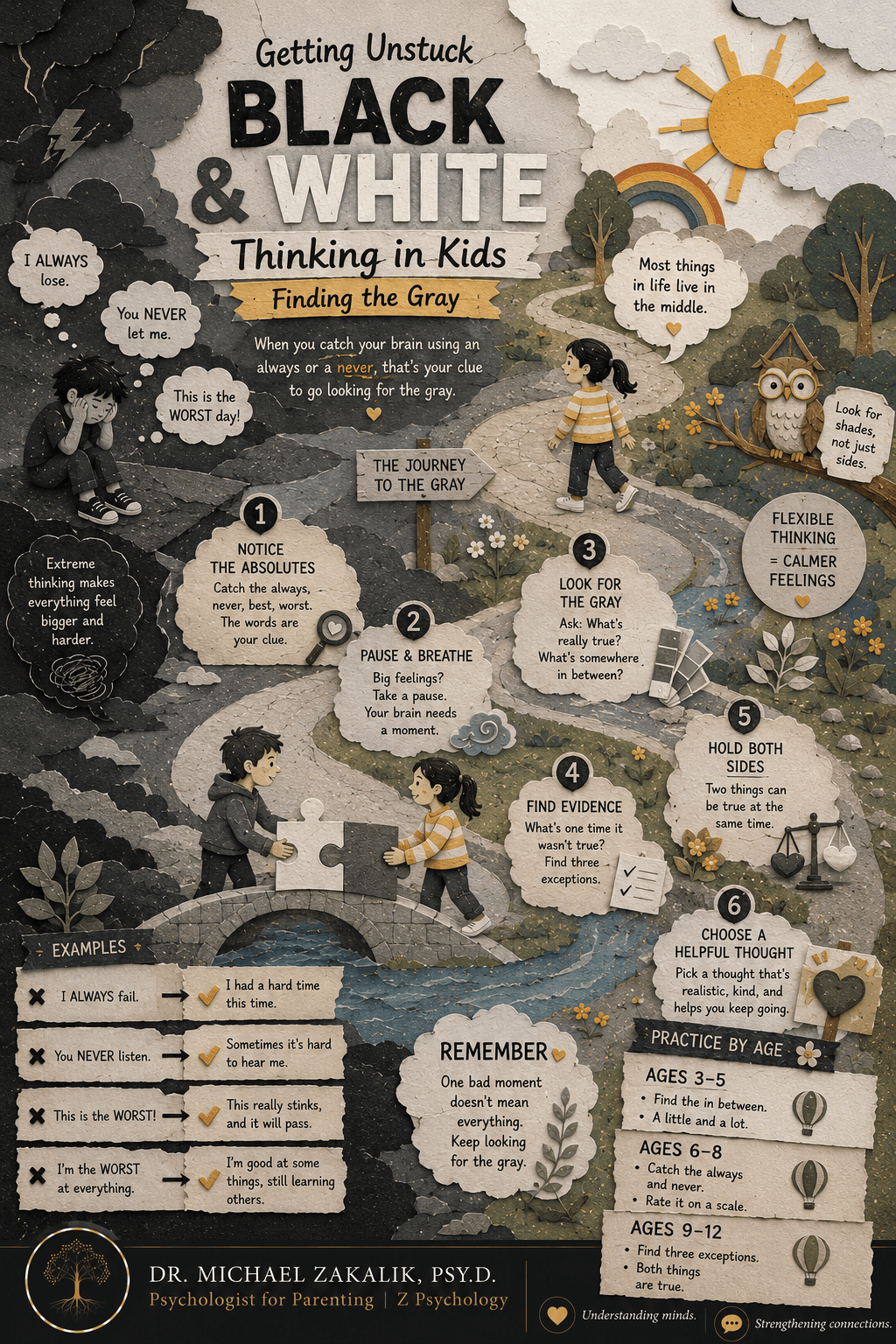
"I ALWAYS lose." "You NEVER let me." "This is the WORST day of my entire life," declared over a snack that came in the wrong shape. If your child speaks in absolutes, in alwayses and nevers and total disasters, you are hearing black and white thinking. It is a normal stage of a developing mind, and also a habit worth gently loosening, because rigid thinking makes everything feel bigger and harder than it is.
Black and white thinking is the close cousin of the cognitive flexibility we want to build. Where flexibility bends, black and white thinking snaps to one extreme or the other, with nothing in between. The good news is that the middle can be taught.
What is black and white thinking?
Black and white thinking, sometimes called all or nothing thinking, is the tendency to see things in extremes: all good or all bad, perfect or ruined, always or never, with no shades in between. In kids it sounds like "I'm the worst at everything" after one mistake, or "nobody likes me" after one hard day. It is a thinking habit, not the truth, and it can be softened.
Why it matters
Extreme thinking makes feelings more extreme. If one bad grade means "I am stupid," the feeling that follows is crushing. If a single conflict means "she is not my friend anymore," a friendship gets thrown away over a fixable moment. Teaching a child to find the gray, the middle ground between the extremes, takes the air out of a lot of distress and is closely tied to managing anxiety and low mood.
"When you catch your brain using an always or a never, that is your clue to go looking for the gray."
How to explain it to your child
Sometimes our brain likes to use only two words: always and never, best and worst. But most things in life live in the middle, in the gray part. You did not fail everything, you missed one. She is not gone forever, she is just mad right now. When you catch your brain using an always or a never, that is your clue to go looking for the gray.
What it looks like in real life
Your daughter bombs one spelling test and announces she is "terrible at school." Arguing the opposite ("You're great at school!") just trades one extreme for another. Instead, go hunting for the gray together: "You found this test hard. Let's see, what about reading? What about the last test?" You are not talking her out of the feeling. Like any big feeling running hot, it needs room, not a rebuttal. You are widening the lens until the one bad moment stops standing in for everything.
Try it together: activities by age
Loosen the all or nothing habit in small, everyday moments. By age:
- Ages 3 to 5. Find the in between: play with words that live between opposites, not just hot and cold but warm, not just happy and sad but okay, since noticing the middle is the seed of the skill. A little and a lot: practice sizing things, a little mad, very mad, somewhere in between, because kids who can find the middle of a feeling overreact less.
- Ages 6 to 8. Catch the always and never: make a gentle game of noticing when an "always" or "never" sneaks into a sentence, then checking whether it is really true, since the words themselves are the clue. Rate it on a scale: when something feels like a total disaster, rate it 1 to 10 together, because almost nothing is a true 10 and finding the real number shrinks it.
- Ages 9 to 12. Find three exceptions: when they declare an absolute, hunt together for three times it was not true, since evidence is the natural enemy of black and white thinking. Both things are true: practice holding two facts at once, the day had a hard part and a good part, so older kids learn that life is usually a mix, not a verdict.
Try this: next time your child uses an "always" or a "never," turn it into a gentle treasure hunt, "Let's find one time that wasn't true." One real exception is often enough to loosen the grip of the absolute.
Frequently asked questions
Why does my child think in such extremes?
Some black and white thinking is a normal part of cognitive development, since young minds reach for simple categories before they can hold nuance. It also tends to spike with big feelings. Most children naturally develop more flexible thinking with age and gentle coaching.
Is all or nothing thinking a sign of a problem?
On its own, no. It is common and usually softens with maturity. If rigid, extreme thinking is intense, persistent, and tied to significant anxiety or low mood, it can be worth talking with a professional, since learning to find the gray is also a core skill in therapy for these struggles.
How do I respond without dismissing their feelings?
Avoid arguing the opposite extreme, which can feel invalidating. Instead, acknowledge the feeling and then gently widen the lens together, looking for exceptions and middle ground. You are validating the emotion while questioning the all or nothing story attached to it.
Free download: Look for the Gray Family Discussion Guide
Simple, age-by-age ways to help your child catch the always and never and find the middle ground at home.
Download the guide (PDF)Enjoyed this? Explore more of Dr. Z's Toolbox