
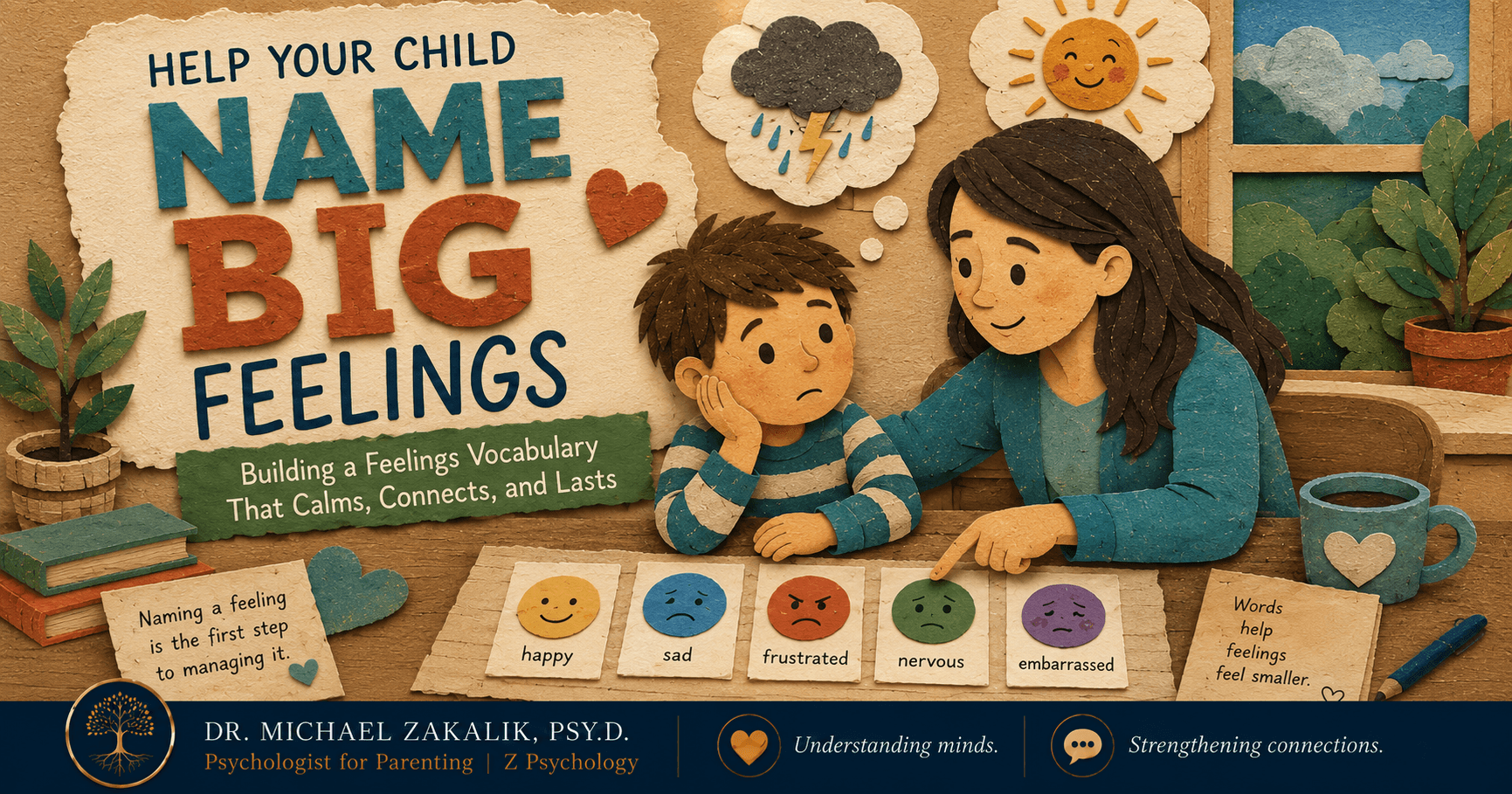
Naming a feeling is the first step to managing it, even on the kitchen floor.
(Disclaimer: The articles provided on this website are for informational and enhancing mental health awareness purposes only. They are not intended to be clinical interventions or provide medical advice. If you have any concerns about your well-being and/or well-being of others, please seek guidance from a qualified professional, such as a physician, psychologist, or counselor. If you are experiencing a clinical emergency please call 911 or 988 or go to the nearest emergency room. Here are some national and international helplines.)
By Dr. Michael Zakalik, Licensed Clinical Psychologist
Part of Dr. Z's Toolbox.
Teaching Kids to Name Feelings: A Parent Guide
There is a reason one of the first things a good therapist asks is "What are you feeling?" Naming a feeling is the first step to managing it. The same is true for a four-year-old on the kitchen floor. A child who can say "I'm frustrated" is in a very different position from one who can only scream, even when the feeling underneath is identical.
Psychologists sometimes call this "name it to tame it." Putting a word on a big feeling actually quiets the alarm part of the brain a little. Before a child can calm a feeling, they have to know what it is, and that starts with vocabulary you can build at home.
Why naming feelings works
When a feeling has no name, it runs the show from the shadows. When it has a name, the thinking part of the brain gets involved, and the feeling becomes something the child can look at instead of just be swept away by. Kids are not born knowing these words. "Mad" and "sad" come early and cover a lot of ground, but the space between them, frustrated, disappointed, nervous, embarrassed, lonely, is where the useful detail lives. Your job is to lend them those words until they own them. It is the first building block of emotional intelligence, and nearly every other emotional skill grows out of it.
"Feelings are like colors. If the only colors you have are red and blue, it is hard to paint what you really see."
How to explain it to your child
Feelings are like colors. If the only colors you have are red and blue, it is hard to paint what you really see. But when you have lots of colors, like orange and green and purple, you can show exactly what you mean. Feeling words work the same way. The more of them you know, the better you can tell people what is going on inside you.
What it looks like in real life
Your son is stomping and snapping at everyone after school. Instead of "Stop being rude," you narrate a guess: "You seem really frustrated. Did something happen today that did not go the way you wanted?" You might be wrong, and he might correct you, which is wonderful, because now he is reaching for the accurate word himself. Either way, you have shown him that the storm inside him has a name, and that a big feeling underneath the behavior is worth getting curious about.
Try it together: activities by age
Build the skill in small, everyday moments. By age:
- Ages 3 to 5. Feelings faces: make different feeling faces in a mirror together and name each one, so the word connects to the expression from the outside in. Story check-ins: while reading, pause to ask how a character feels and how you can tell, since books are a safe, low-pressure place to practice spotting feelings.
- Ages 6 to 8. Upgrade the word: when they say "good" or "bad," gently offer a more specific option, "Bad like sad, or bad like worried?", widening the palette one conversation at a time. Feelings weather report: at dinner, everyone gives their inner weather, sunny, stormy, foggy, which makes naming feelings playful and routine.
- Ages 9 to 12. Name the mix: talk about how two feelings can show up at once, like excited and nervous before a big day, since older kids are ready for the truth that feelings often come in blends. Feelings behind the behavior: when something happens, wonder together what feeling was underneath an action, theirs or someone else's, which links naming to understanding.
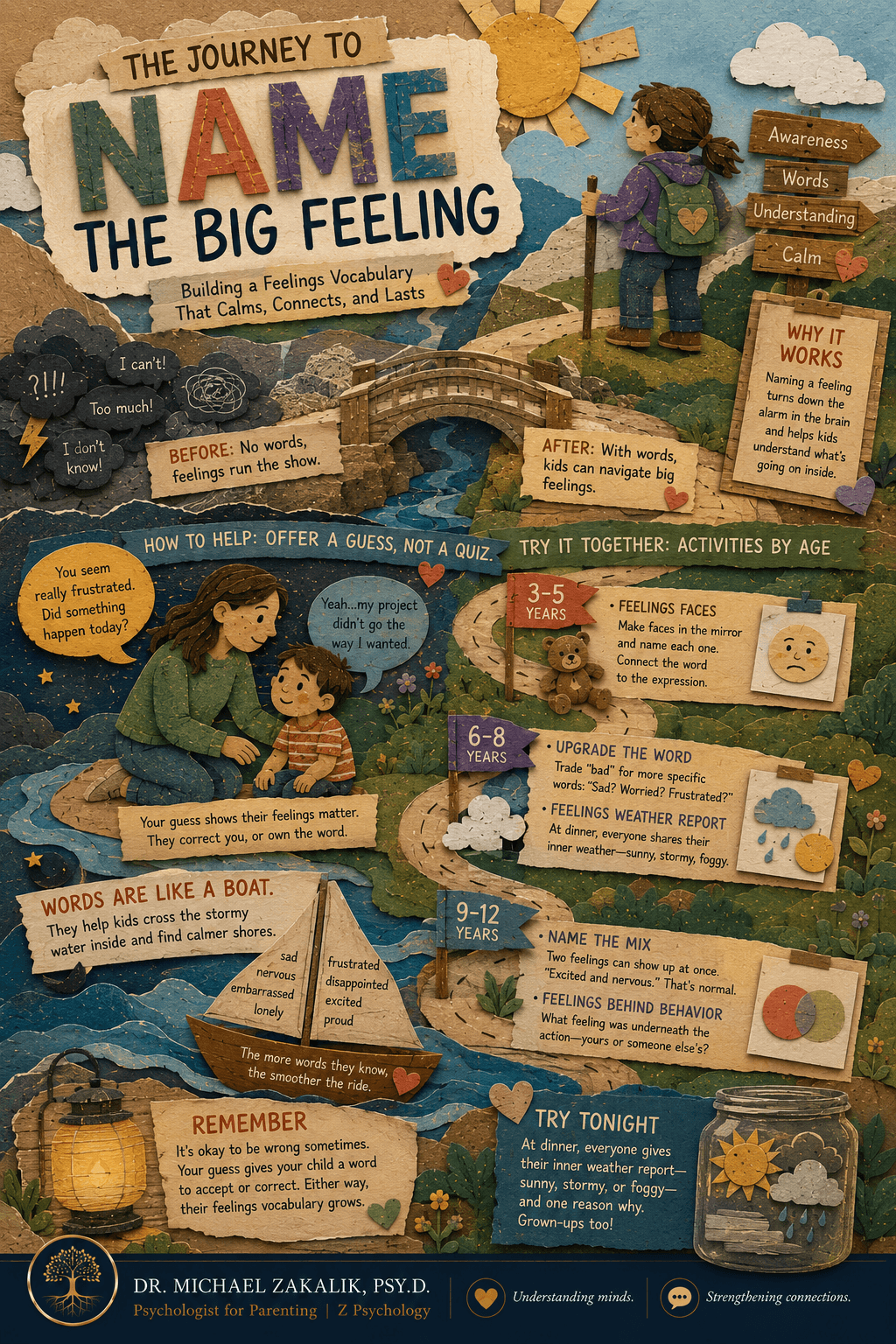
Try this: tonight at dinner, everyone gives their inner weather report, sunny, stormy, or foggy, and one reason why. Grown-ups too. You are turning feeling words into a warm, ordinary part of family life.
Frequently asked questions
Why is naming feelings important for kids?
Naming a feeling helps calm the brain's alarm system and gives a child something they can work with rather than just be overwhelmed by. It is the first step in emotional regulation and the foundation for nearly every other emotional skill.
What if my child does not know how they feel?
That is normal and common. Offer a guess rather than demanding an answer: "I wonder if you feel disappointed." Being slightly wrong is fine, because it gives your child a word to accept or correct, and either way the vocabulary grows.
How many feeling words should a child know?
There is no magic number. What matters is moving beyond "good," "bad," "mad," and "sad" toward more specific words over time. Each new word gives your child a more precise handle on their inner world.
Free download: Help Your Child Name Big Feelings Family Discussion Guide
Simple, age-by-age conversation starters to grow your child's feelings vocabulary at home.
Download the guide (PDF)Enjoyed this? Explore more of Dr. Z's Toolbox