

Most shy kids do not lack the desire for friends. They lack a way in, and that can be taught.
(Disclaimer: The articles provided on this website are for informational and enhancing mental health awareness purposes only. They are not intended to be clinical interventions or provide medical advice. If you have any concerns about your well-being and/or well-being of others, please seek guidance from a qualified professional, such as a physician, psychologist, or counselor. If you are experiencing a clinical emergency please call 911 or 988 or go to the nearest emergency room. Here are some national and international helplines.)
By Dr. Michael Zakalik, Licensed Clinical Psychologist
Part of Dr. Z's Toolbox.
Helping Shy Kids Make Friends: A Gentle Guide
There is a special kind of ache in watching your child stand at the edge of the playground, wanting in but unable to take the step. Shyness is not a flaw to fix, and it is not the same as being unfriendly. It is a very common temperament, and the goal is never to turn a shy child into a loud one. It is to give them a few concrete tools so the wanting can turn into joining.
Most shy kids do not lack the desire for friends. They lack a way in, a specific move for that nerve-racking moment of approach. This is one of the core skills behind what makes a good friend: being able to start. Teach the move, rehearse it where it is safe, and the wall gets a lot lower.
What is shyness, really?
Shyness is a tendency to feel nervous or hesitant in new social situations, especially around unfamiliar people. It is a normal temperament, not a problem, and many warm, wonderful people are shy. What a shy child usually needs is not a personality transplant but practice with the small, specific skills of approaching and joining others.
Why the right kind of help matters
Pushed too hard, a shy child digs in and the nerves grow. Left entirely alone, they may miss the practice that builds confidence. The sweet spot is gentle, low-pressure coaching: small steps, rehearsed in advance, in settings that are not overwhelming. The same patient, no-alarm approach helps any child who finds making friends hard. And one important caution: try not to label them "shy" out loud in front of others, because a label can quietly become an identity the child lives up to.
How to explain it to your child
Lots of people feel nervous butterflies when they want to play with someone new. The butterflies do not mean stop. They just mean this matters to you. You do not have to make the butterflies go away. You just need one little thing to say or do to get started, and then it usually gets easier. We can practice that one little thing together.
"The hardest part for a shy child is not the playing. It is the opening line. Give them one ready sentence and frozen turns into moving."
What it looks like in real life
At the park, your daughter hovers near a group, wanting to join, frozen. Instead of "Go play with them!" which only adds pressure, give her a specific, tiny script beforehand: "You can ask, can I play too?" Rehearse it in the car. Having one ready sentence is the difference between frozen and moving, because the hardest part for a shy child is not the playing, it is the opening line.
Try it together: activities by age
Build the skill in small, everyday moments. By age:
- Ages 3 to 5. Practice with stuffed animals: role-play meeting and asking to play using toys, since a rehearsal with no real stakes makes the real thing less scary. One on one first: arrange short playdates with a single child rather than groups, because friendships are built in pairs and pairs are far less overwhelming.
- Ages 6 to 8. The one ready line: practice a single opening together, like "Can I play too?" or "What are you building?", since having the words ready removes the scariest part. Arrive early: get to the party or playdate before the crowd, so your child joins a small group instead of breaking into a big one, for easier entry and lower nerves.
- Ages 9 to 12. Find the shared interest: coach them to look for someone who likes what they like, since shared interests make conversation easy, and a club or activity hands them this for free. The interested question: practice asking another kid about themselves and listening, which takes the spotlight off your shy child and puts it on being curious, which feels much safer.
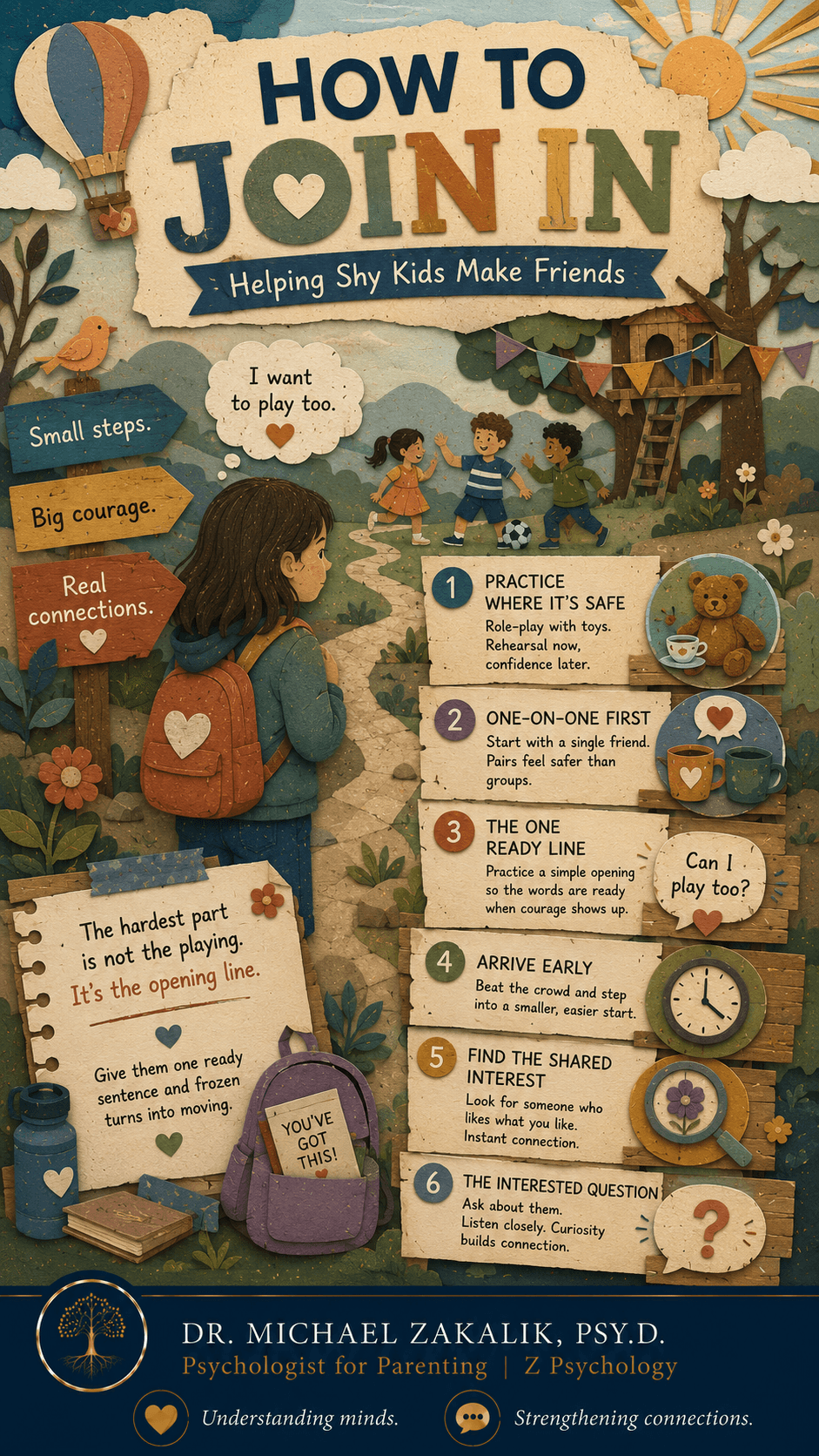
Try this: before the next playdate or park trip, pick one ready line together, like "Can I play too?", and rehearse it in the car. One sentence, practiced where it is safe, is often all a shy child needs to get started.
Frequently asked questions
Is it bad for my child to be shy?
Not at all. Shyness is a normal temperament, and many thoughtful, kind people are shy. The aim is not to erase it but to give your child skills so shyness does not stop them from connecting when they want to.
Should I push my shy child to socialize more?
Gentle encouragement helps; hard pushing usually backfires and increases the nerves. Offer small, manageable steps and plenty of preparation, and let your child move at a pace that stretches them a little without overwhelming them.
When should I be concerned about my child's shyness?
If the fear is intense, causes real distress, or keeps your child from doing things they genuinely want to do, it may be worth talking to a professional, since some children struggle with social anxiety that goes beyond typical shyness. A pediatrician is a good place to start.
Free download: One Ready Line Family Discussion Guide
A gentle, age-by-age set of opening lines and tiny steps to help your shy child join in.
Download the guide (PDF)Enjoyed this? Explore more of Dr. Z's Toolbox