
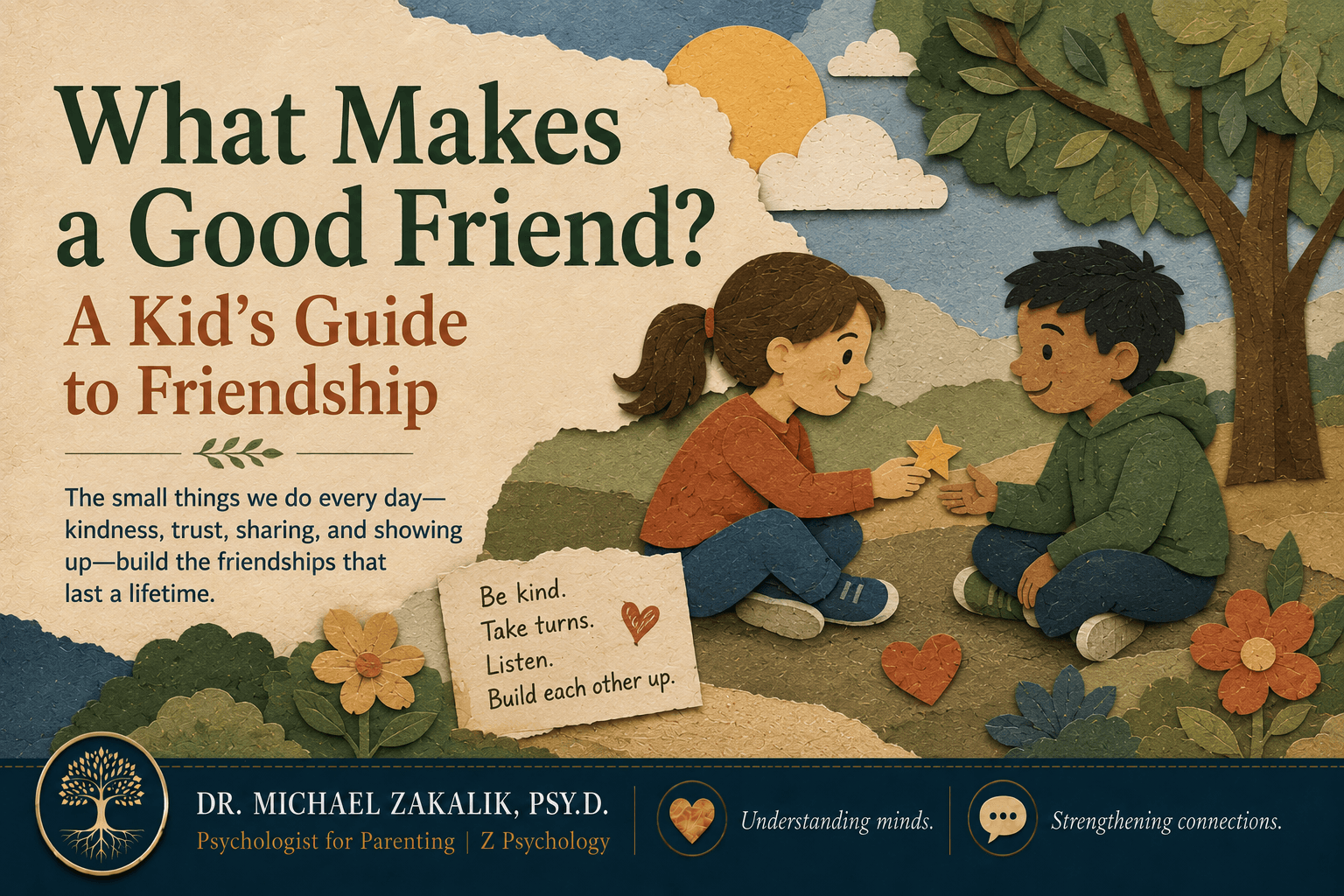
Friendship is not a feeling you have. It is a set of small things you do, over and over.
(Disclaimer: The articles provided on this website are for informational and enhancing mental health awareness purposes only. They are not intended to be clinical interventions or provide medical advice. If you have any concerns about your well-being and/or well-being of others, please seek guidance from a qualified professional, such as a physician, psychologist, or counselor. If you are experiencing a clinical emergency please call 911 or 988 or go to the nearest emergency room. Here are some national and international helplines.)
By Dr. Michael Zakalik, Licensed Clinical Psychologist
Part of Dr. Z's Toolbox.
What Makes a Good Friend? A Kid's Guide
Ask a child what makes someone a good friend and you get wonderfully concrete answers: they share their snacks, they don't tattle, they let you play. Ask a grown up and the answers get vaguer. The truth is closer to the child's version. Friendship is not a feeling you have. It is a set of small things you do, over and over.
That is good news for any parent worried about a child who is struggling socially, because things you do can be taught. A child who finds friendship hard is almost never broken. They usually just need coaching in the specific steps, the same way they would need coaching to ride a bike.
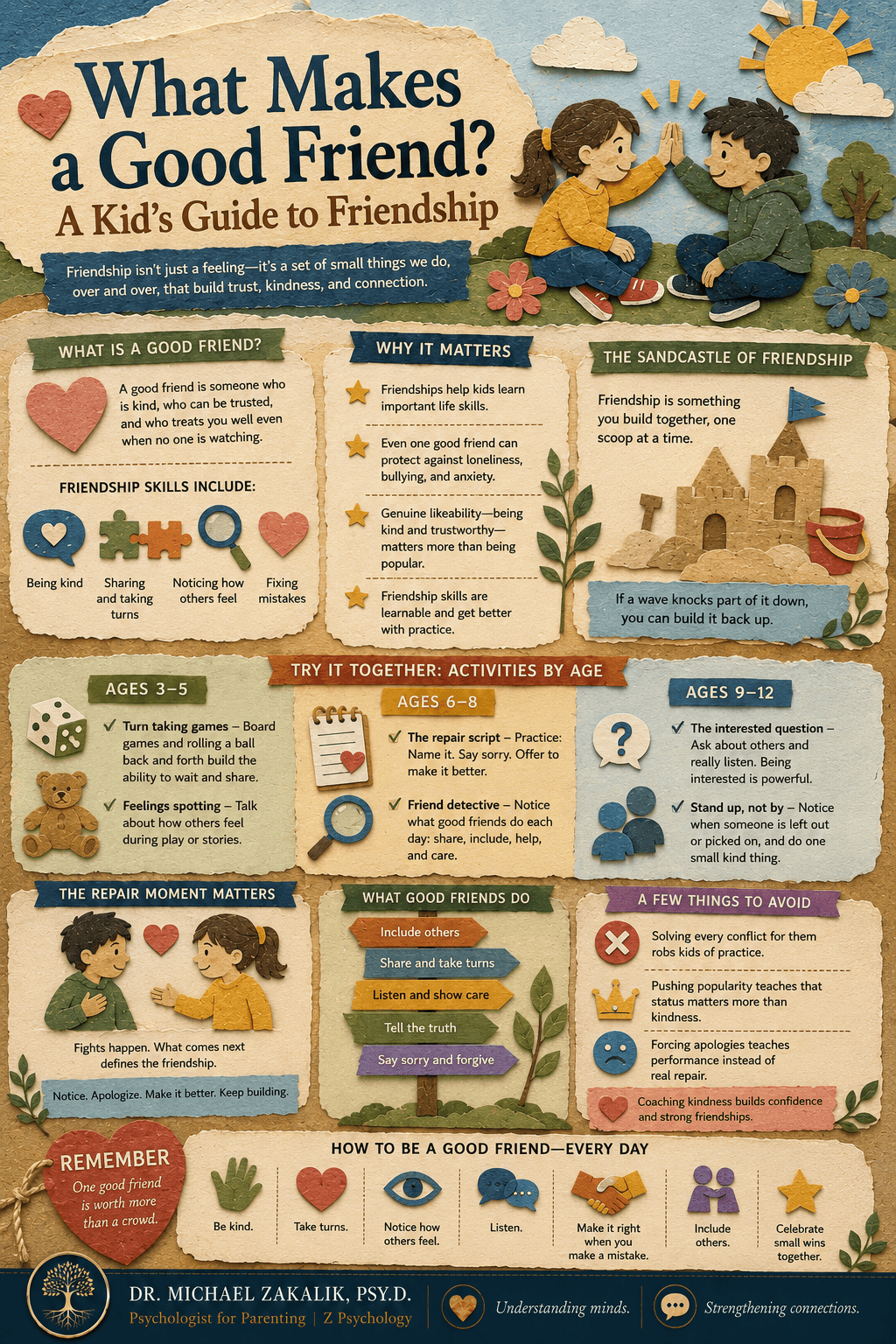
What is a good friend?
A good friend is someone who is kind, who can be trusted, and who treats you well even when no one is watching. For kids, friendship skill is the bundle of small abilities that make those things happen: taking turns, sharing, noticing how someone else feels, and making up after a fight. Notice that none of those is about being popular. There is a real difference between being liked and being high status, and the research is consistent that genuine likeability, not popularity, is what protects kids and predicts happier relationships later. The goal is not a child everyone knows. It is a child who knows how to be a good friend to a few.
Why it matters
Friendship is where children rehearse nearly every social and emotional skill they will use for the rest of their lives: cooperating, resolving conflict, reading other people, recovering from hurt. Kids with even one solid friendship are buffered against loneliness, bullying, and anxiety. One real friend does more good than a crowd of acquaintances. And these skills are learnable. A child who struggles to make or keep friends is not headed for a lonely life. They typically need specific practice in the specific moves, offered patiently and without alarm.
"The goal is not a child everyone knows. It is a child who knows how to be a good friend to a few."
How to explain it to your child
Try framing friendship as something you build, not something you find: Friends are not something you just have, like brown hair. Friendship is more like a sandcastle you build together, one scoop at a time. Every time you share, take a turn, or check on how someone feels, you add a scoop. And if a wave knocks part of it down, which happens to everyone, you can always build it back up. The build it back part matters most. Kids often believe one fight ends a friendship. Teaching them that friendships are repaired rather than thrown away is one of the most useful lessons you can give.
What it looks like in real life
Two kids are playing and one grabs the toy. The friendship test is not whether the grab happens, because it always happens. It is what comes next. Does anyone notice the other felt hurt? Does anyone offer a turn, say sorry, or find a way to share? Those repair moments, small and unglamorous, are where friendship actually lives. Your job is usually not to swoop in and solve it. It is to slow it down and narrate: it looks like she wanted a turn too, what could we do so you both get to play? You are coaching the move, not making it for them. The same patient coaching helps at home between siblings, where the stakes feel higher but the skills are identical.
Try it together: activities by age
Build the skill in small, everyday moments. By age:
- Ages 3 to 5. Turn taking games: simple board games and rolling a ball back and forth are friendship in training, since waiting for your turn is one of the first and hardest social skills there is. Feelings spotting: during play or stories, wonder aloud how the other child or character feels, because noticing other people is the seed every friendship skill grows from.
- Ages 6 to 8. The repair script: when everyone is calm, practice a simple way to fix a mistake, name what happened, say sorry, offer to make it better, since having the words ready makes using them far easier in the heat of the moment. Friend detective: talk about what good friends actually do, using examples from their day, kept concrete, who shared, who included someone, who noticed a kid was left out.
- Ages 9 to 12. The interested question: coach the skill of asking someone about themselves and then actually listening, because being interested is more magnetic than being interesting, and it is a habit anyone can learn. Stand up, not by: talk through what to do when someone is left out or picked on, since a good friend is someone who notices and does one small kind thing, even when it is a little uncomfortable.
A few things that quietly backfire
Solving every conflict for them robs the practice. Pushing popularity (why don't you sit with the cool kids) aims at the wrong target and quietly teaches that status matters more than kindness. And forcing an apology the child does not feel teaches performance instead of repair. Real friendship skills grow from coached practice, not from being managed.
Try this: tonight, play one round of friend detective. Ask your child who shared, who included someone, or who noticed a kid was left out today. You are teaching them to see the small, real moves that friendship is actually made of.
Frequently asked questions
My child only has one friend. Should I worry?
Usually not. One genuine friendship meets a child's social needs far better than a wide circle of loose connections. Quality beats quantity here by a wide margin. Worry less about the number and more about whether that one friendship is kind and mutual.
How do I help a shy child make friends?
Start small and concrete. Rehearse one opening at home, like asking to join a game. Set up short one on one playdates rather than big groups, since friendships are built in pairs. And try not to label them shy out loud, which can harden into an identity they live up to. For more, see how to help your child make friends.
What is the difference between being liked and being popular?
Being liked means people genuinely enjoy you and feel good around you. Being popular often means status and visibility, which is a different thing and far less protective. The research is reassuring here: it is everyday likeability, not popularity, that predicts wellbeing.
My child keeps having the same friendship conflicts. What do I do?
Look for the pattern and coach the one missing skill. Repeated conflicts usually point to a single underdeveloped move, like losing gracefully, sharing control of the game, or noticing when a friend is done playing and easing off. Name that one skill and practice it directly.
Free download: Friendship Family Discussion Guide
A kid friendly explainer of how to be a good friend plus three activities you can use this week.
Download the guide (PDF)Enjoyed this? Explore more of Dr. Z's Toolbox