
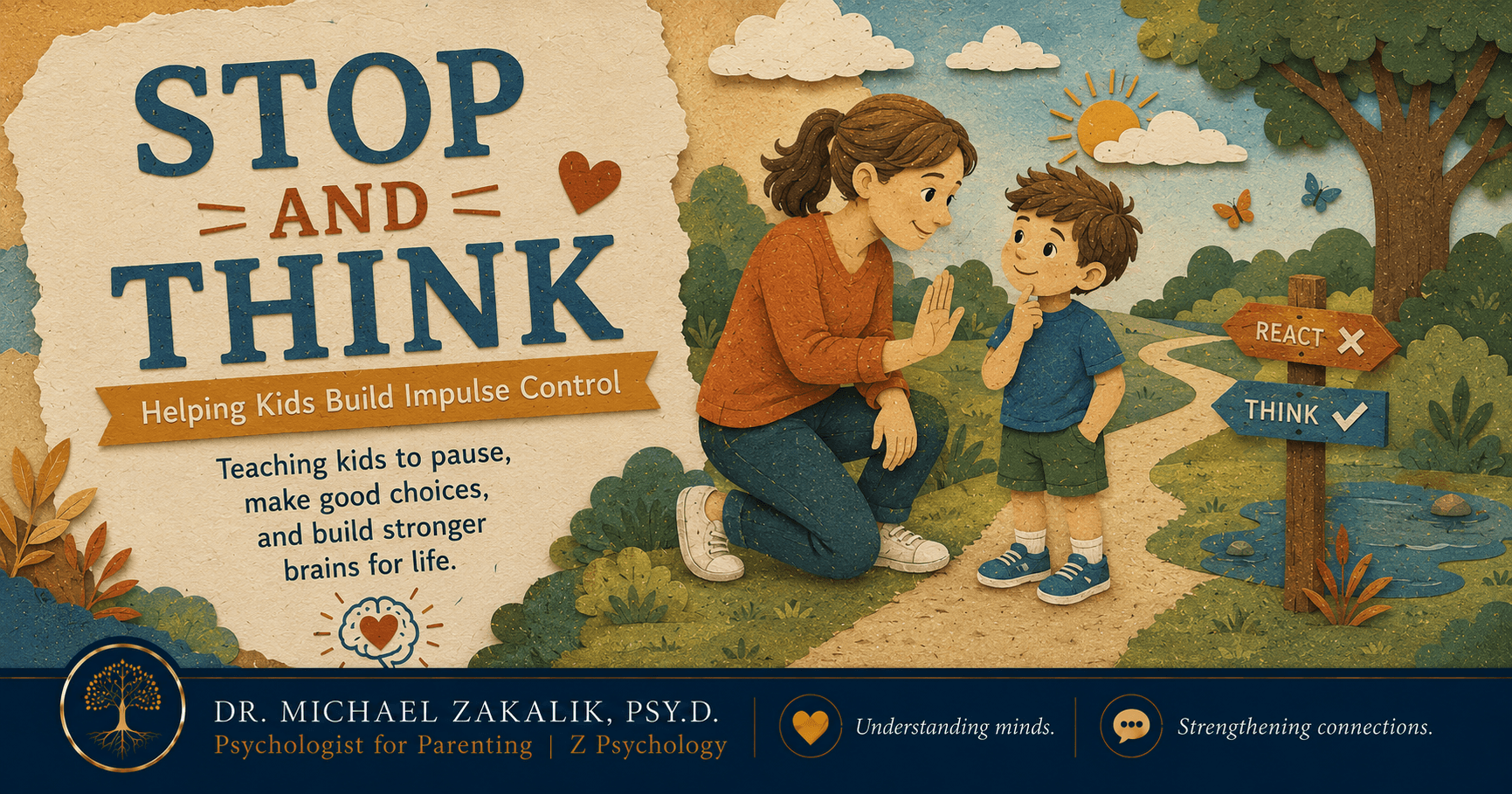
A child with weak brakes is not a bad child. They are a child whose accelerator works fine while the brakes are still under construction.
(Disclaimer: The articles provided on this website are for informational and enhancing mental health awareness purposes only. They are not intended to be clinical interventions or provide medical advice. If you have any concerns about your well-being and/or well-being of others, please seek guidance from a qualified professional, such as a physician, psychologist, or counselor. If you are experiencing a clinical emergency please call 911 or 988 or go to the nearest emergency room. Here are some national and international helplines.)
By Dr. Michael Zakalik, Licensed Clinical Psychologist
Part of Dr. Z's Toolbox.
Impulse Control in Kids: Help Them Stop & Think
Every parent of a young child has watched this movie: you say do not touch, and the hand drifts toward the thing as if pulled by a magnet. It is tempting to read that as defiance.
Far more often, it is a brain whose brakes are still being installed. Impulse control, the ability to stop and think before acting, is one of the last skills to come fully online, and one of the most teachable along the way.
What is impulse control?
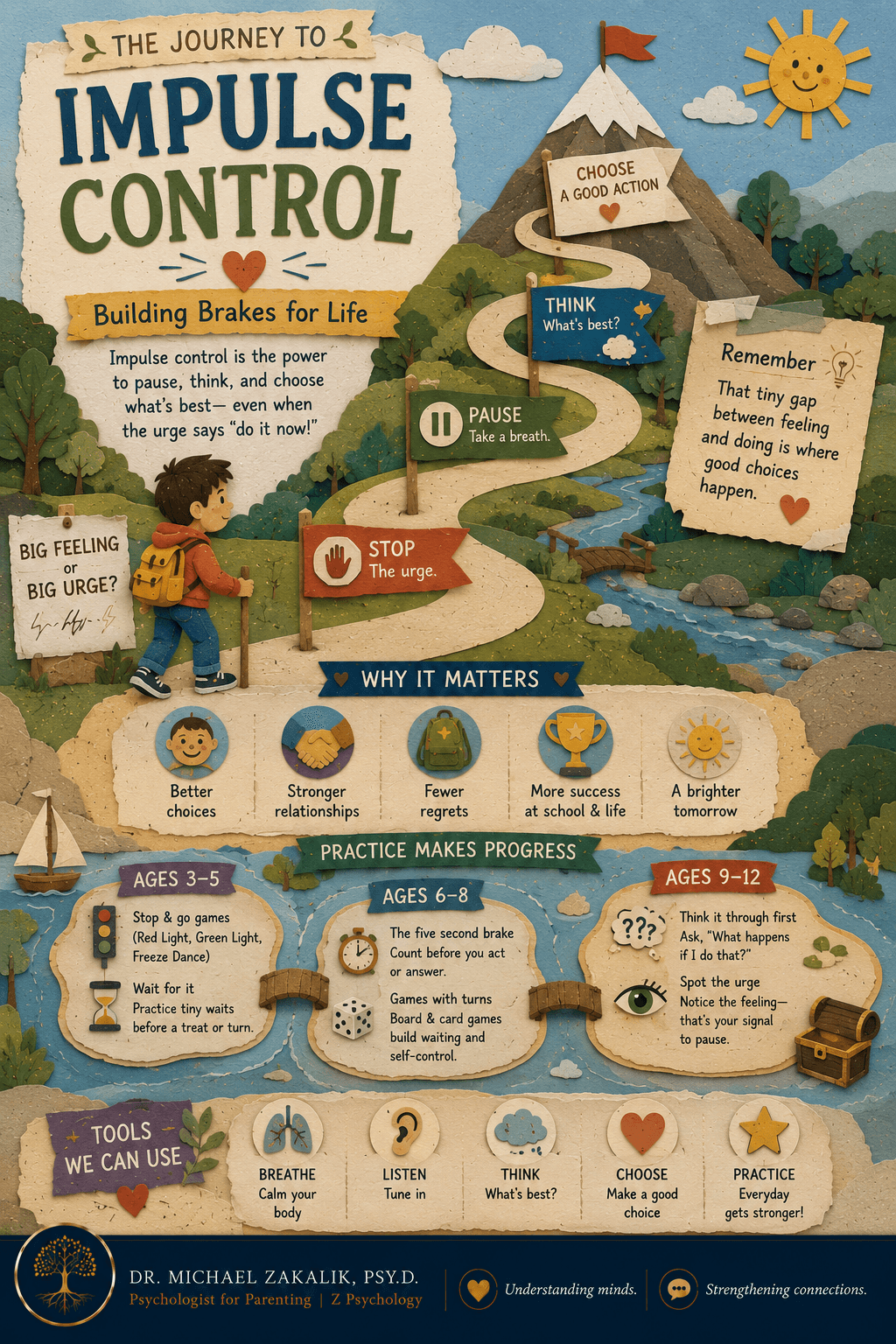
Impulse control, sometimes called inhibition, is the brain's ability to pause and resist acting on the first urge. In kids it looks like waiting their turn, not blurting, keeping hands to themselves, and stopping to think before doing something they will regret. It is one of the three core executive functions, the part that works the brakes.
Why it matters
A child with weak brakes is not a bad child. They are a child whose accelerator works fine while the brakes are still under construction. Stronger impulse control means fewer blurted answers, fewer grabbed toys, fewer regretted reactions, and a child who can put a tiny gap between feeling and doing. That gap is where good choices get made.
"That gap between feeling and doing is where good choices get made."
How to explain it to your child
Your brain has a gas pedal and a brake. The gas pedal makes you want to do things right away, like grab the cookie or shout the answer. The brake helps you stop and think first. Your brake is still getting stronger, so we are going to practice using it, because the brake is what keeps you out of trouble you did not even mean to get into.
What it looks like in real life
Your daughter blurts the answer before her brother gets a chance, again. The lecture, let others have a turn, aims at the wrong system, because she is not so much choosing to interrupt as failing to brake in time. Sometimes the urge underneath is a big feeling boiling over. Try naming the pause out loud and making it a game: let us see if your brake can hold the answer for five whole seconds. You are turning an invisible skill into something she can feel herself doing.
Try it together: activities by age
Build the skill in small, everyday moments. By age:
- Ages 3 to 5. Stop and go games: red light green light, freeze dance, Simon Says, because every one of these is pure brake practice dressed up as fun. Wait for it: build in tiny, playful waits before a treat or a turn, since even a few seconds of practiced waiting strengthens the pause.
- Ages 6 to 8. The five second brake: make a game of pausing before answering or acting, counting a few seconds first, because naming and timing the pause makes it real. Games with turns: board and card games that require waiting your turn and following rules are impulse control practice in disguise, with built in motivation.
- Ages 9 to 12. Think it through first: before reacting to something frustrating, coach a quick inner question, what happens if I do that, inserting a thought between impulse and action. Spot the urge: help them notice the urge itself, the wanting to blurt or grab, as the signal to pause, because noticing the urge is the moment the brake becomes available.
Try this: next time your child is about to blurt or grab, make the pause a game instead of a lecture: let us see if your brake can hold it for five whole seconds. Counting the seconds turns an invisible skill into something they can feel themselves doing, and win at.
Frequently asked questions
At what age do kids develop impulse control?
It develops gradually and slowly. Toddlers have very little, early elementary kids have some, and the system keeps maturing into the late teens and beyond. Expecting adult level self control from a young child sets everyone up for frustration.
Is poor impulse control a sign of ADHD?
Not on its own. All young children have developing impulse control. ADHD involves impulsivity that is more intense and persistent and that interferes across settings. If the difficulty is significant and lasting, an evaluation can help clarify what is going on.
How can I help my impulsive child without constant punishment?
Punishment does little to build brakes that are still developing. Practice through games, name the pause, set the child up for success by reducing temptations, and notice the moments they do stop. The skill grows through rehearsal far more than through consequences.
Free download: Impulse Control Family Discussion Guide
The gas pedal and brake explainer plus simple, age-by-age games to help your child stop and think before acting.
Download the guide (PDF)Enjoyed this? Explore more of Dr. Z's Toolbox