
This article is for educational purposes and is not a substitute for professional mental health care. Grand Theft Auto is rated M (Mature 17+); this piece explains the phenomenon and is not a recommendation for children to play.
By Dr. Michael Zakalik, Licensed Clinical Psychologist
The Psychology of Grand Theft Auto: Hype, Belonging, and Why the Whole World Is Playing
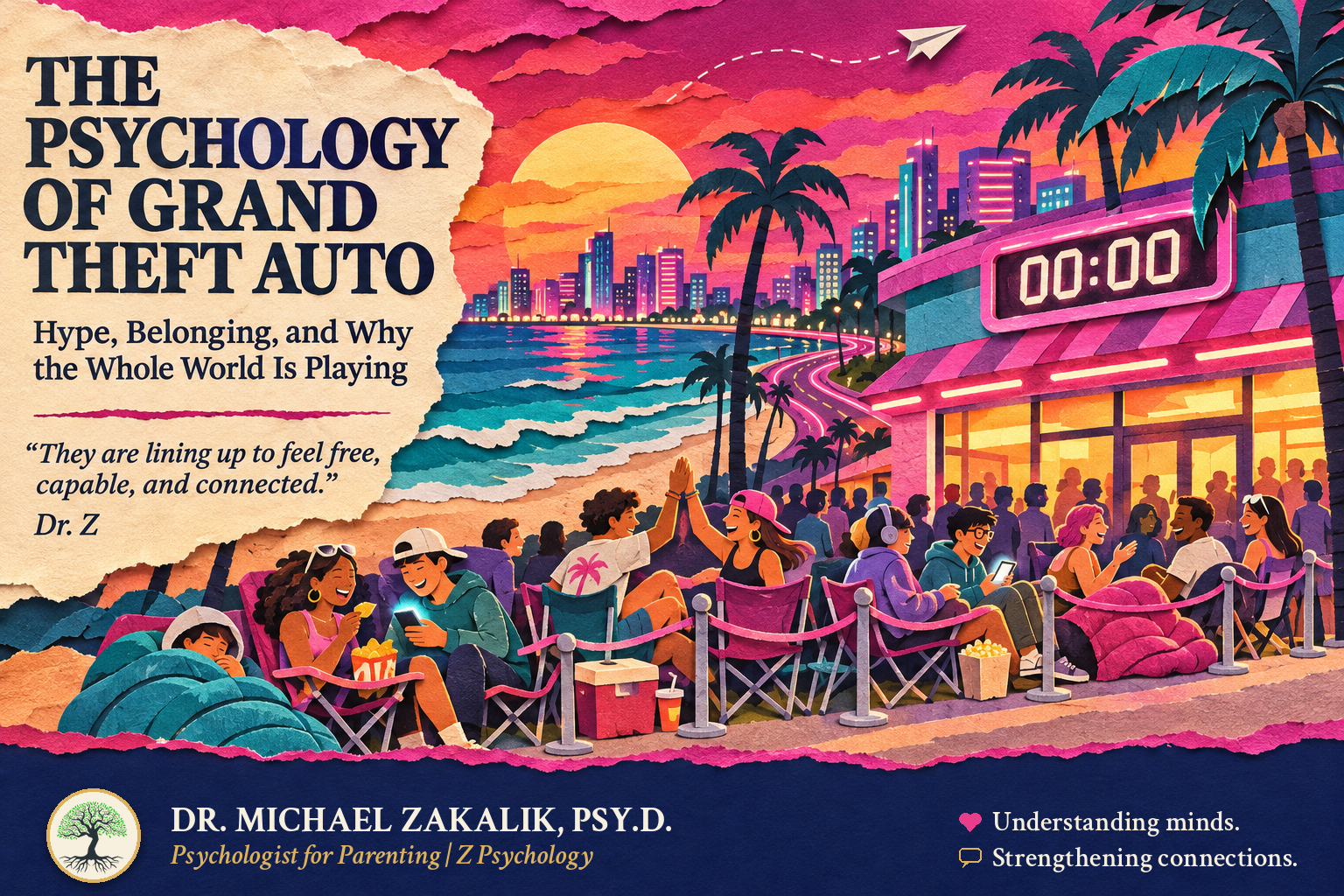
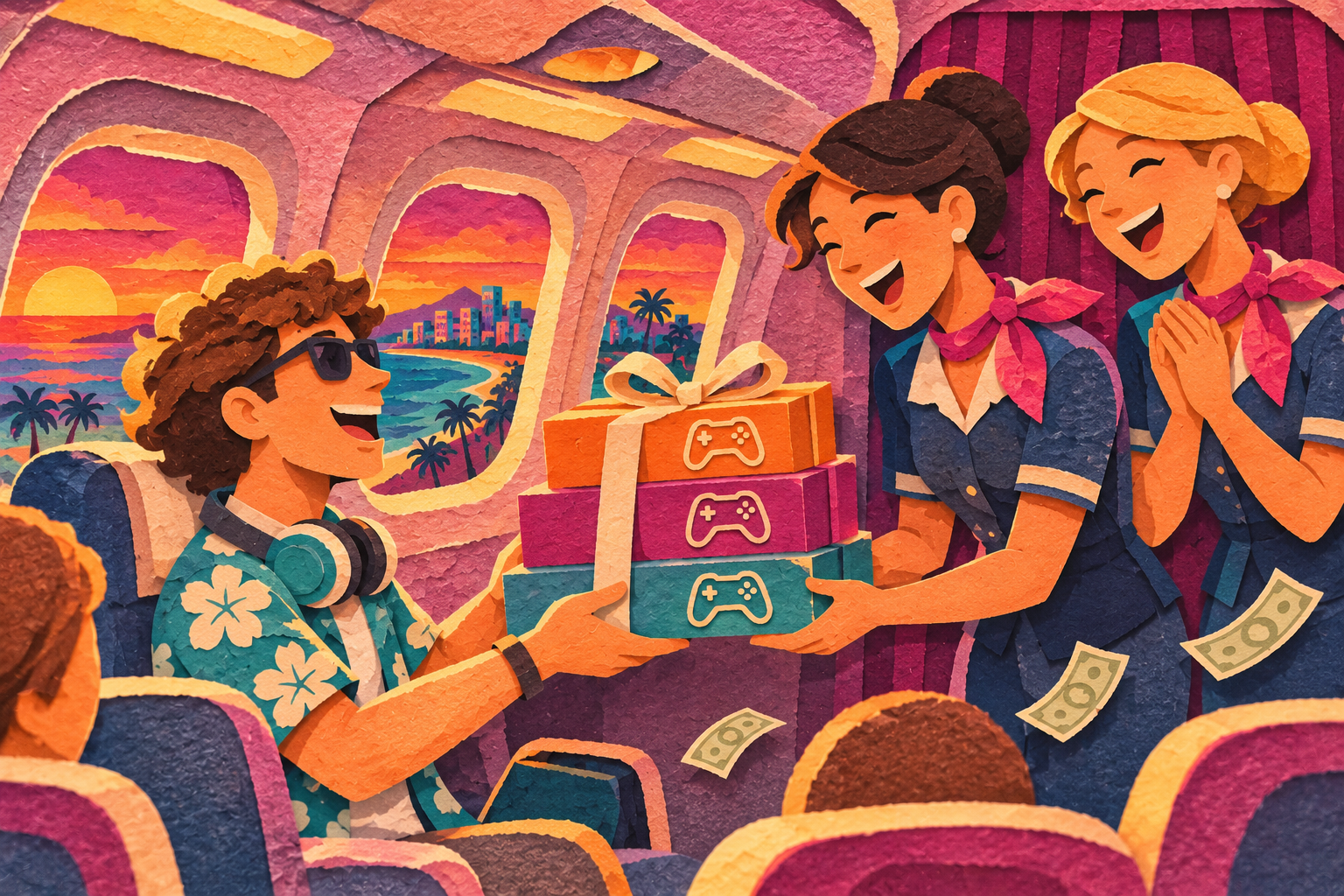
At midnight on November 19, 2026, people stood in line outside gaming cafes in New York. Workers called in with what the internet cheerfully named "the GTA flu." On a flight from Phoenix to Miami, a passenger handed the crew six copies of Grand Theft Auto VI, a game that had not even come out yet, along with a joking request for a first-class upgrade. He did not get one. The airline's rules won. But the crew loved the gift, and the video spread everywhere.
By release day, analysts estimated the game had already brought in about $1.84 billion, more than twice what its predecessor earned on its first day. Most of those copies were bought before a single person outside the studio had played it.
So what is going on? Why does one video game take over the headlines, the group chats, and the sick-day calendar? Why would someone treat early access to a game as more valuable than money? And why do millions of people happily spend hours watching someone else play it?
The answers have very little to do with cars or crime. They have everything to do with some of the deepest needs we have as human beings: to feel free, to feel capable, and above all, to belong. Once you see those needs underneath the hype, the whole phenomenon starts to make sense. So does the teenager in your house who cannot stop talking about it.
A Quick History: From a Cartoon Map to a Thirteen-Year Wait
Grand Theft Auto began in 1997 as a small game made by a studio in Scotland. You looked down on a cartoon city from above, almost like a map, and drove tiny cars around. It was crude, funny, and controversial almost immediately.
The turning point came in 2001 with Grand Theft Auto III. For the first time, players could roam a full three-dimensional city with almost no rules about where to go or what to do. That idea, now called the "open world," changed the entire video game industry. Vice City, a neon 1980s version of Miami, followed in 2002, then San Andreas in 2004, Grand Theft Auto IV in 2008, and Grand Theft Auto V in 2013.
GTA V became something closer to a cultural institution than a game. It sold more than 11 million copies in its first 24 hours, earned about $815 million on day one, and crossed $1 billion in three days, a record for any entertainment product at the time. Then it simply kept selling, across three generations of consoles, for more than a decade. Its online mode turned it into a place people visited, not just a story they finished.
Then came the wait. The first trailer for GTA VI arrived in December 2023 and drew more than 93 million YouTube views in its first 24 hours. Release dates slipped. Fans counted down. By launch, it had been thirteen years since the last new Grand Theft Auto. A whole generation of kids grew up hearing about the game their older siblings, cousins, and even parents were waiting for.
The Numbers Behind the Frenzy
- About 230 million: copies of GTA V sold since 2013. The series as a whole has sold roughly 475 million.
- About $1.84 billion: estimated GTA VI sales by release day, from roughly 19 million copies. This is a third-party estimate that includes months of pre-orders, not official figures from the publisher.
- 13 years: the gap between GTA V and GTA VI.
- 475 million: views the second trailer generated across platforms in a single day, according to the publisher.
- 125 million hours: time people spent watching others play GTA VI on livestreaming platforms in the first 24 hours, with a peak of nearly 8 million viewers at once.
- 1.5 million: a widely shared estimate of Americans skipping work on launch day. Economists doubt the number. That it went viral anyway tells its own story.
- 17+: the series is rated M for Mature. It was never designed for children.
The Framework: Self-Determination Theory
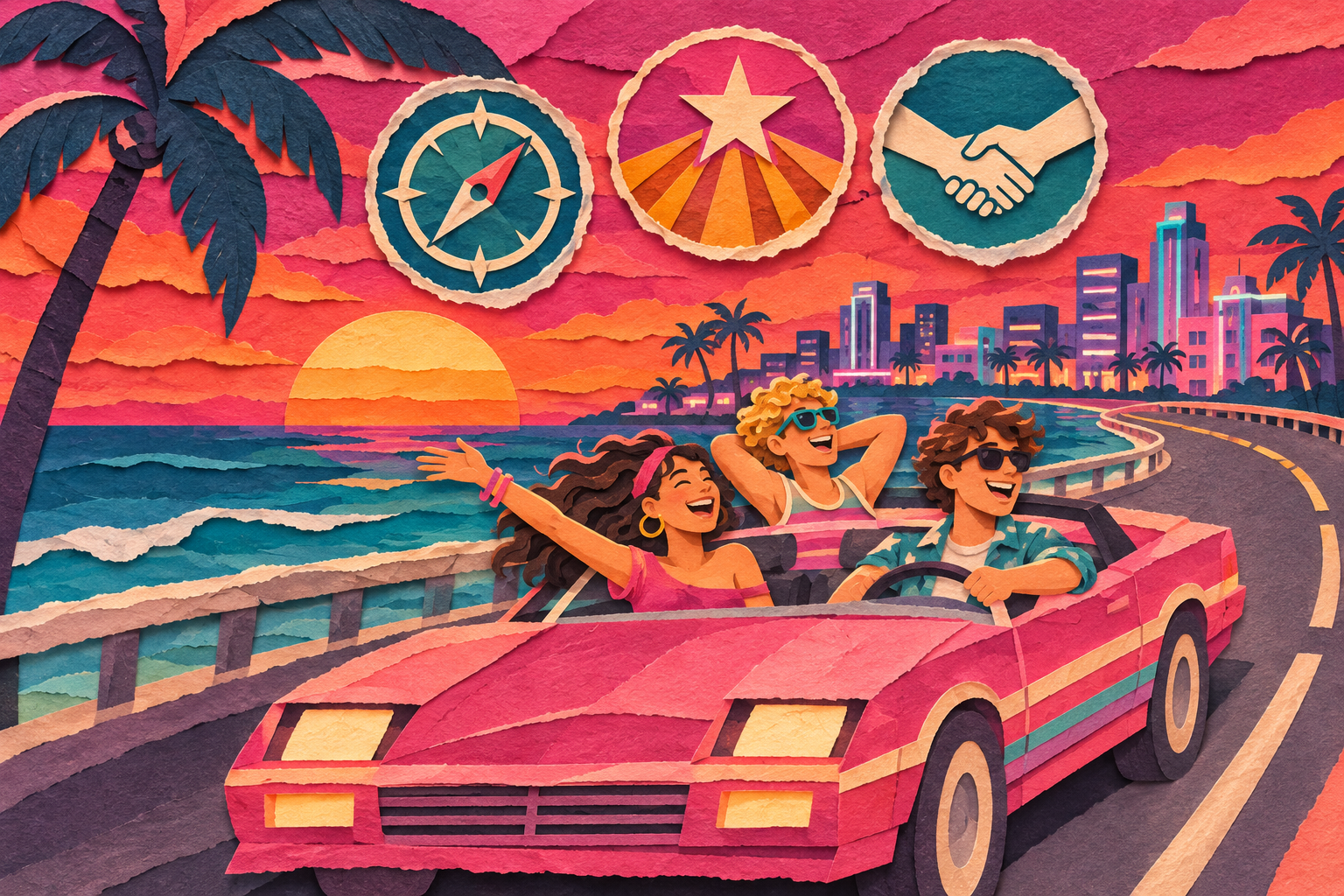
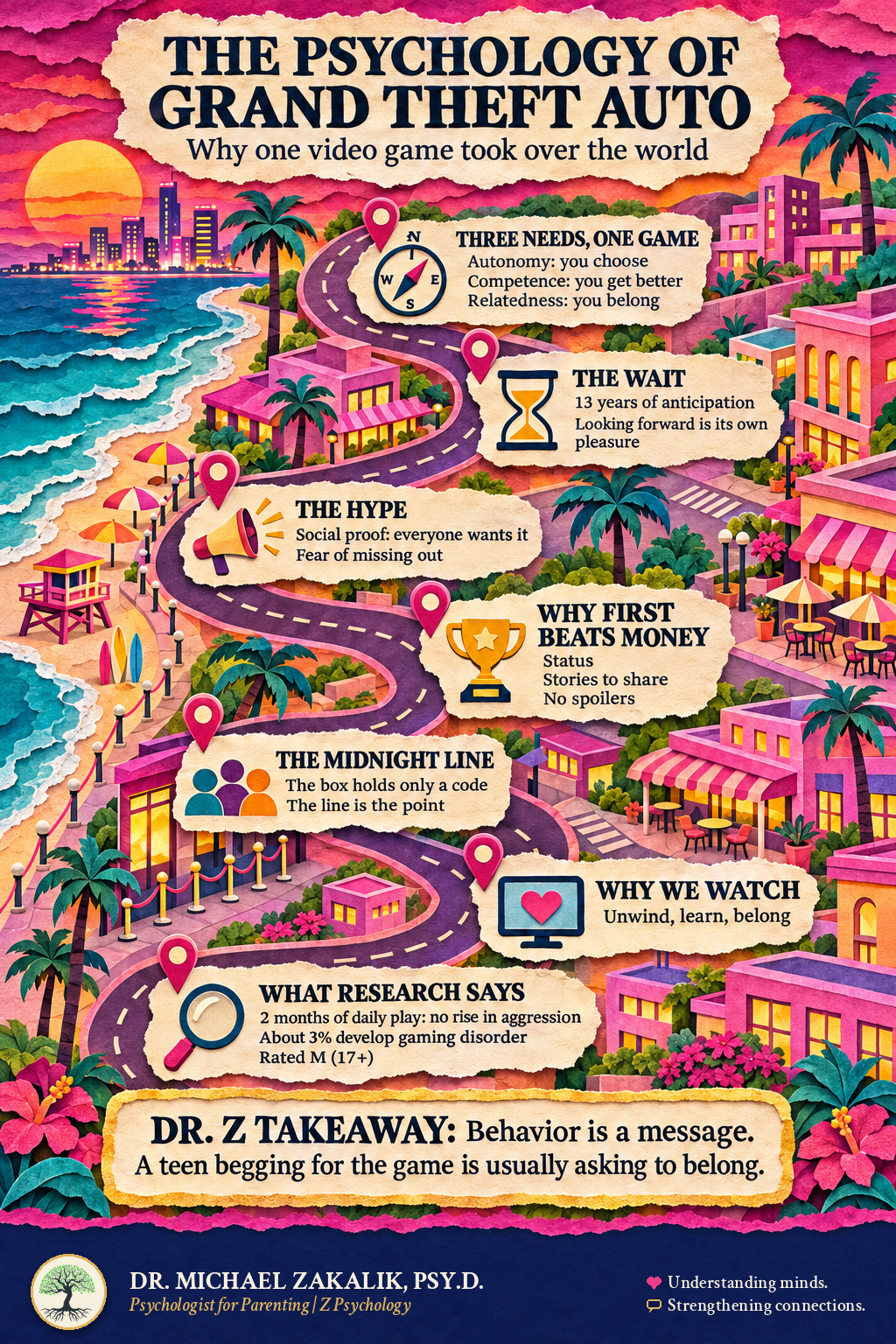
To understand why this game has such a grip, it helps to borrow one of the most respected ideas in motivational psychology. Self-Determination Theory, developed by psychologists Edward Deci and Richard Ryan, says that human beings have three basic psychological needs. We need autonomy, the feeling that our choices are our own. We need competence, the feeling that we are good at something and getting better. And we need relatedness, the feeling that we are connected to other people.
When an activity meets all three needs, we do not have to be pushed to do it. We are pulled.
In 2006, Ryan and his colleagues Scott Rigby and Andrew Przybylski tested this idea directly with video games across four studies. Players who felt free and capable inside a game enjoyed it more, wanted to keep playing, and even showed short-term boosts in well-being after playing. In multiplayer games, all three needs, including the need for connection, independently predicted enjoyment and future play.
Grand Theft Auto may be the purest example of this formula ever built.
Autonomy. The open world is a giant playground with very few walls. You can follow the story, or ignore it and drive to the beach at sunset. For a teenager whose days are scheduled by bells, coaches, and parents, that sense of "I get to decide" is intoxicating. For an adult buried in obligations, it is a vacation.
Competence. Missions get harder, skills get sharper, and progress is visible on the screen. The game constantly tells you, in small ways, that you are getting good at something.
Relatedness. This one is the secret ingredient, and it may be the most powerful. GTA is not just a game. It is a shared language. People play online together, trade stories, quote it, argue about it, and compare notes. If you are playing, you are part of the conversation.
People are not lining up for a game. They are lining up to feel free, capable, and connected, all at once.
Why the Wait Made It Better: The Pleasure of Anticipation
Here is something surprising. Part of the joy of GTA VI happened before anyone played it.
Psychologists have long noticed that looking forward to something can be as pleasurable as the thing itself. Economist George Loewenstein called this "savoring" the future. Later research by Amit Kumar, Matthew Killingsworth, and Thomas Gilovich found that waiting for an experience, like a trip or a concert, tends to feel more pleasant and exciting than waiting for a material purchase. The wait for an experience is part of the experience.
For thirteen years, fans took that waiting and turned it into a hobby. Every trailer was studied frame by frame. Theories were shared, debated, and shared again. The anticipation became its own community. By the time the game arrived, millions of people had already spent years emotionally invested in it. Launch day was not the beginning of the story. It was the payoff.
Hype Is Social: Social Proof and the Fear of Missing Out
Why do the headlines keep piling up? Because hype feeds on itself.
Psychologist Robert Cialdini described a principle called social proof: when we are unsure what something is worth, we look at what other people are doing. If everyone is excited, our brains quietly conclude that it must be worth being excited about. Each headline about record sales becomes evidence for the next headline. Even the urge to write about it, or read about it, is part of the same pull. When everyone is talking about something, our attention naturally follows.
Then there is the fear of missing out. In 2013, researchers led by Andrew Przybylski, the same psychologist from the video game studies, defined FOMO as a pervasive worry that others are having rewarding experiences without you. Their research found something telling: people who felt their basic needs for autonomy, competence, and connection were less satisfied in daily life were more prone to FOMO.
In other words, the hype hits hardest when we are already a little hungry for connection. With GTA VI, the experience everyone was having was not only the game. It was the conversation around the game. Not playing meant being on the outside of the group chat, the lunch table, and the jokes.
Why Being First Can Feel Better Than Money
The airplane story is funny, but it reveals something real. The passenger did not offer the crew cash. He offered them an early copy of the game, as if it were a better kind of currency. And in a psychological sense, for a lot of people, it is.
Money is interchangeable. A dollar is a dollar today or next month. But being first is a moment that cannot be bought later. There are only so many days when you can be among the first to explore a new world, to finish the story before anyone spoils it, or to be the one who shows your friends something they have not seen.
Several forces stack up here:
- Status. Being first, or finishing first, signals skill and dedication. Within a group, it earns a kind of respect.
- Social currency. The person who has played it has something to share. Stories, tips, and surprises become gifts you can give to others.
- Spoiler protection. A shared story loses some of its magic once someone tells you how it ends. Playing early protects the experience.
- Perceived scarcity. Before launch, some pre-order codes were resold online for more than the retail price, even though anyone could buy the game at full price from the official stores. Nothing was actually scarce. It just felt that way.
An early copy is not really a product. It is a ticket into the moment everyone is talking about. For a social species like ours, belonging is often worth more than money.
The Overnight Line: Waiting Together
Here is a detail that might surprise you. The boxed version of GTA VI does not even contain a disc. Inside is just a download code. Most people could simply buy the game from home and start playing at midnight on their couch.
And yet people still lined up, and gaming cafes still packed in fans for the countdown.
That tells you the line is the point. The sociologist Émile Durkheim described a feeling he called collective effervescence: the electric charge we feel when a group of people shares the same emotion at the same time. It is the feeling of a stadium when the home team scores, a crowd at a concert when the first note hits, or a city on New Year's Eve. A midnight launch is a modern version of an ancient human ritual. Strangers become, for one night, a tribe.
Why We Love Watching Someone Else Play
To some parents, this is the most baffling part. Why would anyone spend hours watching another person play a video game?
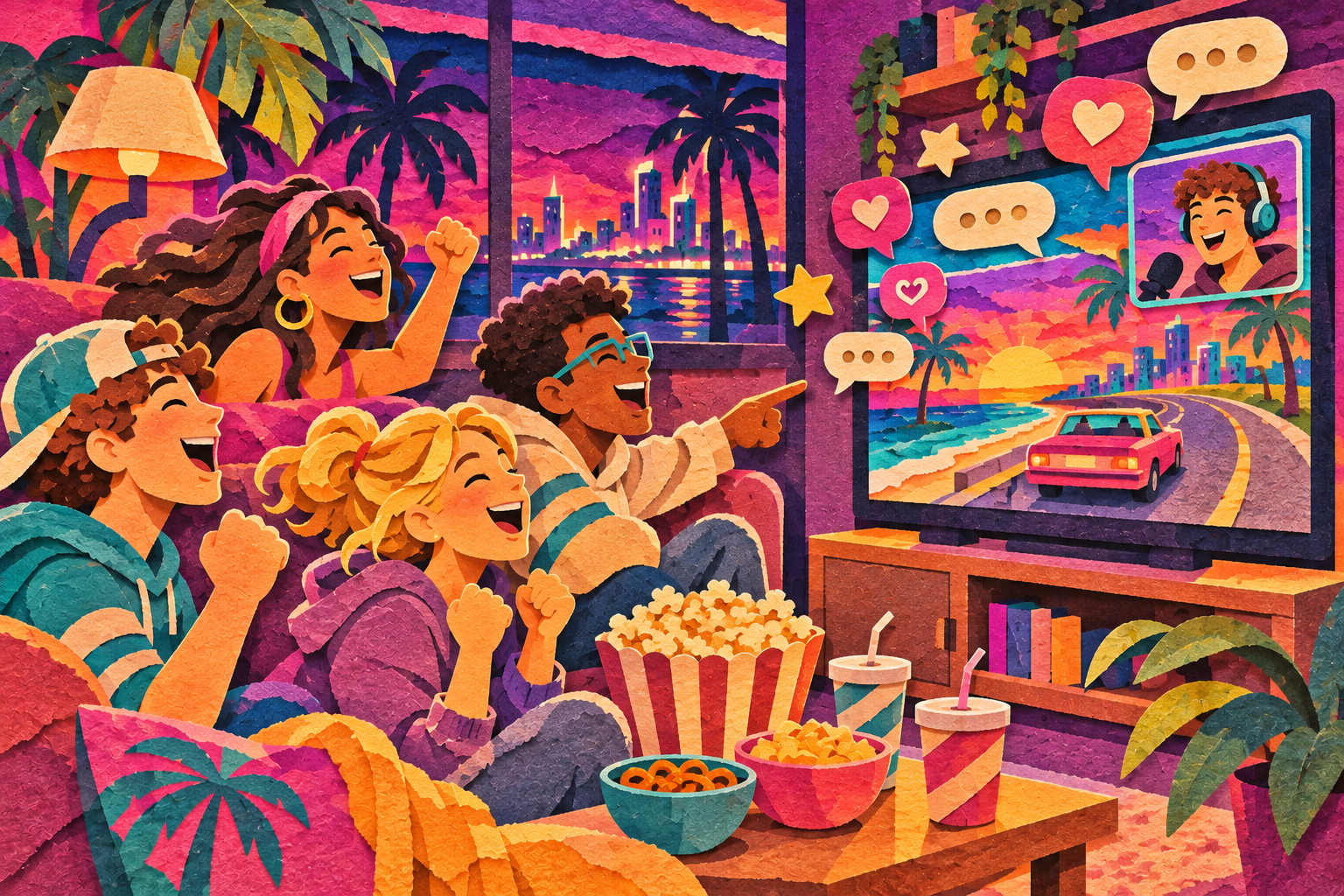
Researchers Max Sjöblom and Juho Hamari studied this question by surveying 1,097 viewers of Twitch, the largest game-streaming platform. They found that people watch for several reasons: to learn, to be entertained, to unwind, and to feel part of a community. The motivations most linked to how many hours people watched were releasing tension, feeling emotionally engaged, and social connection. Social connection was the strongest predictor of whether viewers paid to subscribe to a streamer.
When you think about it, this is not so strange. Millions of us watch other people play football, golf, or chess. We enjoy watching skill, reacting together, and sharing the ups and downs with a crowd. A streamer can also feel like a familiar friend who keeps you company. And watching lets people enjoy a game without needing the console, the money, or the free hours to play it themselves.
One note for parents: watching a stream is still watching the game. If a mature game is off-limits in your home, streams of it carry the same content.
Is It Addictive?
Games like GTA are designed to be absorbing, and our brains respond to that. In a landmark 1998 study published in the journal Nature, Matthias Koepp and colleagues used brain imaging to show that playing a video game releases dopamine in the striatum, a part of the brain involved in reward and learning. The better people performed, the more dopamine was released.
That sounds alarming, but it needs context. Dopamine is released by almost everything we find rewarding: good food, music, a hug, a great conversation. A reward response is not the same thing as an addiction.
The World Health Organization does recognize "gaming disorder" as a real condition. It is defined by losing control over gaming, giving it priority over other parts of life, and continuing despite clear harm, usually over a period of at least a year. A large meta-analysis by Matthew Stevens and colleagues, covering 53 studies and more than 226,000 people in 17 countries, estimated that about 3 percent of people meet the criteria. It is more common in boys and young men.
So the honest answer is that most people who love GTA are not addicted. A small number really do struggle, and they deserve real help.
From a psychodynamic point of view, the more useful question is not "How much is too much?" but "What is the game doing for this person?" When a game becomes the only place someone feels free, capable, or connected, the gaming is often a message about what is missing in the rest of life. Loneliness, stress at school, or feeling unsuccessful elsewhere can make a game's world feel like the only place that works.
What the Research Actually Says About GTA and Violence
For decades, Grand Theft Auto has been at the center of a debate: does playing violent games make people violent? Researchers have studied GTA specifically, and the findings are more reassuring than the headlines once suggested.
A two-month GTA experiment. In a study published in Molecular Psychiatry, Simone Kühn and colleagues randomly assigned adults ages 18 to 45 to play Grand Theft Auto V every day for two months, to play the gentle life simulation The Sims 3, or to play no game at all. They measured aggression, empathy, impulsivity, anxiety, mood, and more, before and after. Out of 208 statistical tests, only three showed changes, about what chance alone would produce. The researchers concluded that the results provide strong evidence against the feared negative effects of violent games in adults.
A study of teenagers. In 2019, Andrew Przybylski and Netta Weinstein studied 1,004 British teens ages 14 and 15. Instead of relying on the teens to describe themselves, they asked parents and caregivers to rate their child's aggressive behavior, and they used official ratings to judge how violent each game was. They committed to their analysis plan before seeing the data, a method designed to prevent researcher bias. They found no link between violent game play and aggressive behavior.
A study of middle schoolers. Researchers Cheryl Olson and Lawrence Kutner at Harvard's Center for Mental Health and Media surveyed 1,254 seventh and eighth graders in a study funded by the U.S. Department of Justice. Grand Theft Auto was the most popular game series among the boys and the second most popular among the girls. About two-thirds of boys regularly played at least one M-rated game. Boys who played mature games a lot were more likely to report fights and other problems, but this was a correlation, not proof that the games caused it. Kids who are already struggling may simply be drawn to certain games. A later analysis of the same students, led by psychologist Christopher Ferguson, found that once family environment and personality were taken into account, violent game exposure did not meaningfully predict bullying or delinquency. Kutner and Olson summed up their message to most parents in one word: relax.
The bigger picture. Some short-term lab studies do show small, temporary bumps in aggressive thoughts after playing violent games, and researchers still debate how much those effects matter. But the American Psychological Association stated in 2020 that there is insufficient evidence to link violent video games to real-world violence.
None of this means content does not matter. Grand Theft Auto is rated M for good reasons, including crime, sexual content, drug use, and cruelty presented as dark comedy. Much of the series is satire, a mocking mirror held up to American culture, and that satire flies right over the head of a younger child. A 16-year-old and a 10-year-old are not processing the same game in the same way. The research points away from "games create violent people" and toward something more practical: age, context, time, and conversation matter most.
Behavior Is a Message: What the GTA Frenzy Means for Parents
If your child or teen is begging for Grand Theft Auto, it helps to listen for the message underneath the request.
Most of the time, the message is not "I want to steal cars." It is "I want to be part of what my friends are part of." It is a request for belonging, for freedom, and for a chance to feel good at something. Those are healthy needs. They are the same three needs that make the game so powerful in the first place.
When you respond to the need, and not just the request, your answer lands differently. A "yes" can come with structure: limits on time, playing in shared spaces, and talking about what they see. A "not yet" can come with real alternatives for connection, like a different game their friends play, a gaming night with you, or a plan for when they are older. Either way, your child learns that you understand what they are really asking for. That understanding builds trust, and trust is what keeps them talking to you about the harder things later.
And this applies to adults too. If you took the day off, stood in line, or felt that tug of excitement, there is nothing silly about it. You were reaching for joy, freedom, and connection with other people. Those are some of the best things about being human.
Your "no" lands better when your child feels you understand the "why" behind their "please."
Frequently asked questions
Why is Grand Theft Auto so popular?
It meets three core psychological needs at once: freedom to choose (autonomy), the satisfaction of getting better (competence), and connection with other people (relatedness). Add more than two decades of history and thirteen years of anticipation, and it becomes a shared cultural event, not just a game.
How did GTA VI make so much money so fast?
Analysts estimated about $1.84 billion in sales by release day, largely from pre-orders placed over several months. Social proof, the fear of missing out, and years of built-up anticipation pushed millions of people to buy before they had seen much of the game.
Why do people wait in line or skip work for a video game?
Because the experience is social. Being first brings status, stories to share, and protection from spoilers. Waiting together creates what sociologists call collective effervescence, the electric feeling of sharing an emotion with a crowd.
Does playing Grand Theft Auto make people violent?
The best long-term research says no meaningful link has been found. A two-month study of adults playing GTA V found no increase in aggression, and a large study of teens found no link between violent games and aggressive behavior. Content still matters, though, and the game is rated for ages 17 and up.
Is it addictive?
Games trigger the brain's reward system, as many enjoyable activities do. About 3 percent of people meet the criteria for gaming disorder. For most players, the more useful question is what the game is providing and whether those needs are also being met in the rest of life.
Why do people watch others play video games?
Research on Twitch viewers found that people watch to unwind, feel emotionally engaged, learn, and, most of all, feel part of a community. It is a lot like watching sports with friends.
A Final Thought
Grand Theft Auto is a game about crime, but its success is a story about connection. Underneath the record sales and the midnight lines are ordinary human needs: to feel free, to feel capable, and to belong. When we understand those needs, in our kids and in ourselves, we can respond with curiosity instead of panic, and turn a cultural moment into a real conversation.
If questions about gaming, screens, or connection are coming up in your family, you do not have to sort them out alone. Explore more on the site, or reach out to learn about working with Dr. Z.
References
Studies and sources mentioned in this article.
- American Psychological Association. (2020). APA resolution on violent video games.
- Cialdini, R. B. (1984). Influence: The psychology of persuasion. William Morrow.
- Deci, E. L., & Ryan, R. M. (2000). The "what" and "why" of goal pursuits: Human needs and the self-determination of behavior. Psychological Inquiry, 11(4), 227-268.
- Durkheim, E. (1995). The elementary forms of religious life (K. E. Fields, Trans.). Free Press. (Original work published 1912)
- Ferguson, C. J., Olson, C. K., Kutner, L. A., & Warner, D. E. (2014). Violent video games, catharsis seeking, bullying, and delinquency: A multivariate analysis of effects. Crime & Delinquency, 60(5), 764-784.
- Koepp, M. J., Gunn, R. N., Lawrence, A. D., Cunningham, V. J., Dagher, A., Jones, T., Brooks, D. J., Bench, C. J., & Grasby, P. M. (1998). Evidence for striatal dopamine release during a video game. Nature, 393(6682), 266-268.
- Kühn, S., Kugler, D. T., Schmalen, K., Weichenberger, M., Witt, C., & Gallinat, J. (2019). Does playing violent video games cause aggression? A longitudinal intervention study. Molecular Psychiatry, 24(8), 1220-1234.
- Kumar, A., Killingsworth, M. A., & Gilovich, T. (2014). Waiting for merlot: Anticipatory consumption of experiential and material purchases. Psychological Science, 25(10), 1924-1931.
- Kutner, L., & Olson, C. K. (2008). Grand theft childhood: The surprising truth about violent video games and what parents can do. Simon & Schuster.
- Loewenstein, G. (1987). Anticipation and the valuation of delayed consumption. The Economic Journal, 97(387), 666-684.
- Przybylski, A. K., Murayama, K., DeHaan, C. R., & Gladwell, V. (2013). Motivational, emotional, and behavioral correlates of fear of missing out. Computers in Human Behavior, 29(4), 1841-1848.
- Przybylski, A. K., & Weinstein, N. (2019). Violent video game engagement is not associated with adolescents' aggressive behaviour: Evidence from a registered report. Royal Society Open Science, 6(2), 171474.
- Ryan, R. M., Rigby, C. S., & Przybylski, A. (2006). The motivational pull of video games: A self-determination theory approach. Motivation and Emotion, 30(4), 344-360.
- Sjöblom, M., & Hamari, J. (2017). Why do people watch others play video games? An empirical study on the motivations of Twitch users. Computers in Human Behavior, 75, 985-996.
- Stevens, M. W. R., Dorstyn, D., Delfabbro, P. H., & King, D. L. (2021). Global prevalence of gaming disorder: A systematic review and meta-analysis. Australian & New Zealand Journal of Psychiatry, 55(6), 553-568.
- World Health Organization. (2019). International classification of diseases (11th rev.), 6C51 Gaming disorder.
Sources for launch figures
Sources for launch figures: Sensor Tower estimates as reported by FOX 5 (November 19, 2026); Streams Charts data via esports.gg (November 2026); Take-Two Interactive quarterly results (August 2026); TheTravel (November 23, 2026); WLRN (November 19, 2026).
This article is for educational purposes only and is not a substitute for professional mental health care.