
(Disclaimer: The articles provided on this website are for informational and enhancing mental health awareness purposes only. They are not intended to be clinical interventions or provide medical advice. If you have any concerns about your well-being and/or well-being of others, please seek guidance from a qualified professional, such as a physician, psychologist, or counselor. If you are experiencing a clinical emergency please call 911 or 988 or go to the nearest emergency room. Here are some national and international helplines.)
By Dr. Michael Zakalik, Licensed Clinical Psychologist
The Psychology of Sleeping Beauty: Overprotection and the Limits of Control
Disney's Sleeping Beauty, released in 1959, was one of the most ambitious and most expensive animated films the studio had produced to that point, with a visual style modeled after medieval tapestries and a score adapted from Tchaikovsky's 1890 ballet of the same story. It performed disappointingly at its initial release and contributed to a period of financial difficulty for the studio. Its reputation has since improved considerably, with contemporary critics often citing its visual achievements as among the most distinctive in Disney animation. What deserves examination beyond its aesthetic significance is the substantive psychological content the underlying narrative actually contains.
The story, drawn from a tradition stretching back through Charles Perrault's 1697 version to much older oral sources, presents a psychological case study in what happens when adults try to protect a young person from a predicted danger by removing the young person from the world in which the danger might find them. Princess Aurora, cursed at her christening to die from a spinning wheel injury before her sixteenth birthday, is taken by three fairies into the forest to be raised in hiding under a different name, Briar Rose. The protective project does not, in fact, succeed. Aurora encounters the spinning wheel anyway, the curse operates as predicted, and the measures taken across sixteen years prove inadequate to the very outcome they were designed to prevent. The film depicts something important about the limits of overprotective parenting and about the developmental costs such parenting produces even when it appears to be working.
The Psychology of Overprotective Parenting
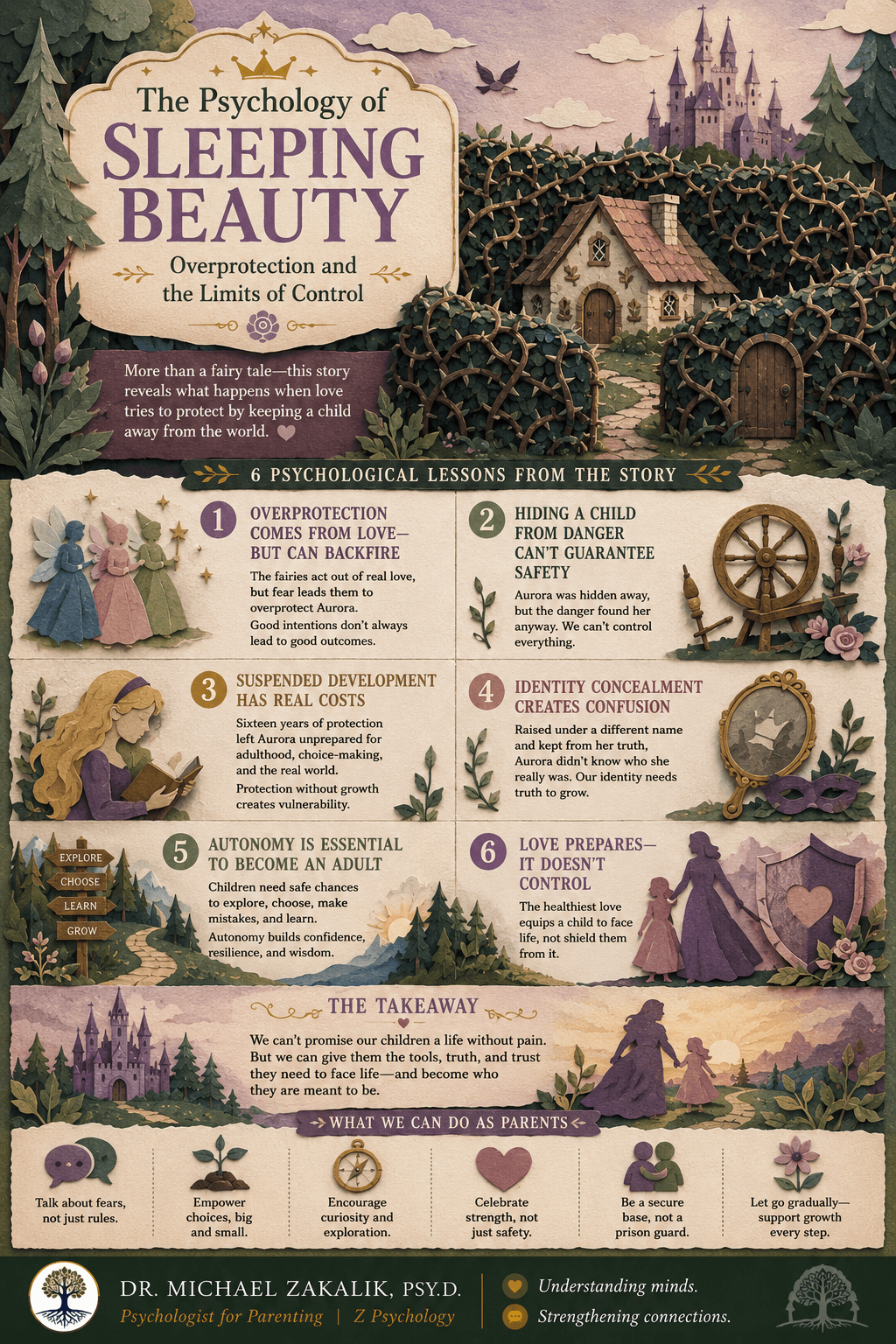
Research on what has been called overprotective or helicopter parenting has documented patterns and consequences that the fairies' approach to raising Aurora exemplifies. The overprotective parent typically operates from genuine love and genuine concern. They are not, in the simple sense, bad parents. They are, more accurately, parents whose anxiety about specific dangers leads them to take protective measures that exceed what the actual risks would justify, and that produce developmental costs their protective focus prevents them from recognizing. The child raised under such conditions often develops a reduced capacity for independent decision-making, because opportunities for such decision-making have been systematically prevented; elevated anxiety about situations the parents have framed as dangerous; and difficulty with the developmental tasks of late adolescence and early adulthood, including establishing an identity separate from parental expectations and managing independent life conditions.
Sixteen Years of Prevented Development
What the fairies do across the sixteen years they spend raising Aurora exhibits these patterns in concentrated form. They prevent her from making independent decisions about her life. They control what she knows about her own identity, including the fact of her royal heritage. They restrict her movements to a limited geography and prevent her from forming relationships with anyone outside their household. They organize her entire developmental experience around preventing the cursed event rather than around preparing her for the adult life she will eventually need to lead. By the time the film's events occur, Aurora is a sixteen-year-old who has been protected effectively from one danger but who has not been prepared in any meaningful way for the person she is supposed to become. The developmental costs are visible in her behavior: at sixteen she is still substantially child-like in her orientation to the world, exhibiting what could be called developmental delay produced not by any underlying condition but by environmental restriction. The capacities have not developed because the conditions for their development have not been provided.
Why Prediction-Based Protection Fails
The film also depicts, perhaps without fully recognizing it, the failure of protection strategies based on preventing specific predicted events. The fairies have been told Aurora will die from a spinning wheel injury before her sixteenth birthday, so they organize everything around that one event. They burn all the spinning wheels in the kingdom. They take her to a forest. They restrict her movements. The strategy is focused and substantial, and it fails anyway. What this illustrates is something important about the limits of risk prevention as a parenting strategy. The dangers any particular parent identifies are typically only a small subset of the dangers a child might actually encounter, and effort spent preventing identified dangers is necessarily not spent preparing the child for the broader range of unpredicted situations life will present. The child whose upbringing has been organized around prevention of specific dangers may be protected from those dangers while left unprepared for the much larger range of situations the parents did not predict.
"The hiding successfully prevented some dangers. It also prevented the developmental experiences her later life would require."
Resilience Over Prevention
Research on what is sometimes called resilience-building parenting, an alternative that emphasizes preparation for difficulty rather than prevention of specific difficulties, has documented clear advantages. Children whose parents have allowed them to encounter manageable difficulties typically develop the capacity to navigate later difficulties more effectively than children whose exposure to challenge has been systematically prevented. The capacity to recover from setbacks, to navigate uncertainty, to evaluate situations independently, and to make decisions without external direction develops through practice that overprotective parenting does not provide. The child who has never encountered manageable difficulty has not had the chance to build the capacities that managing larger difficulties later will require, and is in significant ways more vulnerable to the difficulties their parents could not predict than peers who were permitted appropriate exposure to challenge.
The Revelation of Aurora's Identity
One of the film's most psychologically substantive moments is the revelation to Aurora of her actual identity on her sixteenth birthday. The fairies tell her, just hours before returning her to her biological parents, that she is not Briar Rose but Princess Aurora, that the people she has believed to be her aunts are not, and that she is to be married to a prince she has not met. The information is delivered all at once, with no preparation, and her response is substantial distress. This is recognizable from clinical literature on identity concealment, including children of adoption who have not been told, children whose biological parentage has been concealed, or children whose family circumstances have been misrepresented. The distress is not primarily about the content of what they have learned. It is about recognizing that people they trusted have been deceiving them for years, and about the reorganization of their own identity the new information requires. Research on late discovery has documented that people who learn fundamental information about themselves later in life often experience an identity disruption that those who grew up with the information do not, and that the argument that concealment protects the child rarely survives examination of the consequences when the revelation finally comes.
Sleep as Suspended Adulthood
The curse-induced sleep, which the fairies modify from death to sleep, can be read as more than plot mechanism. It occurs precisely at the moment Aurora is supposed to be transitioning from the protected life of the cottage to the adult responsibilities of being princess and future queen. She has just learned her actual identity, just been told she will marry someone she did not choose, and just been informed that her entire upbringing was preparation for a life she had no input in selecting. The sleep that follows allows her to avoid, temporarily, the transition her circumstances are demanding. This has parallels in clinical observations of what is sometimes called the failure to launch phenomenon, in which young adults raised under protective conditions struggle with the transitions adulthood requires: leaving the parental home, establishing independent income, forming adult partnerships, and taking responsibility for their own decisions. The deferral can persist for years and typically resolves only when external circumstances or therapeutic engagement permit the developmental work that should have occurred earlier to finally take place. Aurora's sleep, in this reading, is a symbolic representation of that suspension. The work is not eliminated. It is postponed.
Maleficent and Grievance Escalation
The film's antagonist, the dark fairy Maleficent, occupies a position that deserves attention beyond her function as conventional villain. She cursed Aurora at her christening because she was not invited to the celebration, a reaction disproportionate to the original offense, and the disproportion is part of what makes her psychologically interesting. What she represents is what happens when exclusion produces resentment that takes on a life of its own. Aurora's death would not provide Maleficent with the recognition or inclusion she was denied; the destruction is purely punitive rather than restorative. Research on what has been called grievance escalation, in contexts including workplace conflicts and online harassment, has documented patterns Maleficent exemplifies: the aggrieved party reframes the original incident so continued retaliation seems proportionate, sustains the investment far longer than most people would, and develops elaborate justifications for actions that observers would recognize as far exceeding the original offense. The damage to Aurora is real, and so is the damage to Maleficent herself, in the form of a life organized around revenge rather than around any positive engagement.
What the Awakening Actually Requires
The kiss that ends Aurora's sleep has been read in many ways across the decades, some celebrating it as romantic resolution and others raising concerns about what nonconsensual contact with an unconscious person represents. Alongside both readings, it is worth considering what the awakening actually accomplishes within the film's psychological structure. If the sleep represents the developmental suspension her overprotective upbringing produced, the awakening represents the arrival of conditions that permit the deferred work to begin. The person who awakens is in some ways not the person who fell asleep; she has had the opportunity to integrate, at some level, the information she received before her sleep. In this reading the kiss may matter less than the time the sleep provided for psychological reorganization to occur. Many real people have experienced periods of withdrawal or reduced functioning that, in retrospect, allowed developmental work to take place that previous active engagement was preventing. The romantic framing can obscure what the sleep itself accomplished.
Reflections for the Viewer
Sleeping Beauty has resonated with viewers across many dimensions despite its initial commercial difficulties and the cultural critiques later decades have raised about its romantic resolution. For viewers whose own developmental experiences included overprotective parenting, the film offers recognition. The protection your parents provided was typically motivated by genuine love and genuine concern. The developmental costs it produced were also real, and you may have arrived at adulthood with gaps in capacities that less protected peers had developed. That work is genuinely available in adulthood, though it usually requires deliberate engagement rather than the natural unfolding earlier development would have provided. For viewers who are themselves parents reflecting on their protective practices, the film offers a different invitation. The dangers you have identified are typically real, and the protection you provide has real value, but it also has costs that are often invisible from inside the protective stance. The capacities your child needs will not develop without opportunities for their development, which may include exposure to manageable challenge. Distinguishing protection that supports development from protection that prevents it is genuine work, and the cost of erring too far toward prevention can be substantial even when the prevention itself succeeds.
Frequently asked questions
- What is Sleeping Beauty really about, psychologically?
- Beneath the fairy tale, it is a story about overprotective parenting and the limits of control: adults try to protect a child by hiding her from one predicted danger, and in doing so prevent the development she needs to become an adult, while the danger finds her anyway.
- Why does hiding Aurora away backfire?
- Because protection organized around preventing one specific danger leaves a child unprepared for the much larger range of situations life actually presents. The fairies prevent her from making decisions, forming relationships, and knowing her own identity, so she reaches sixteen protected but undeveloped, and the curse operates regardless.
- What does the story say about autonomy and control?
- That a child needs practice making decisions and navigating manageable difficulty in order to build the capacity for adult life. Control that removes those opportunities can carry developmental costs that are invisible from inside the protective stance, even when the protection appears to be working.
- Is Sleeping Beauty good to watch with kids?
- Yes, with conversation. It is an accessible way for families to talk about safety versus independence, why honesty about identity matters, and the difference between protecting a child and preparing one.
Enjoyed this? Explore more from Psychology at the Movies