
(Disclaimer: The articles provided on this website are for informational and enhancing mental health awareness purposes only. They are not intended to be clinical interventions or provide medical advice. If you have any concerns about your well-being and/or well-being of others, please seek guidance from a qualified professional, such as a physician, psychologist, or counselor. If you are experiencing a clinical emergency please call 911 or 988 or go to the nearest emergency room. Here are some national and international helplines.)
By Dr. Michael Zakalik, Licensed Clinical Psychologist
Content note: this article discusses a series that depicts violence and antisocial behavior, including harm within families. The treatment here is clinical and is not intended to glamorize. Written for adult readers.
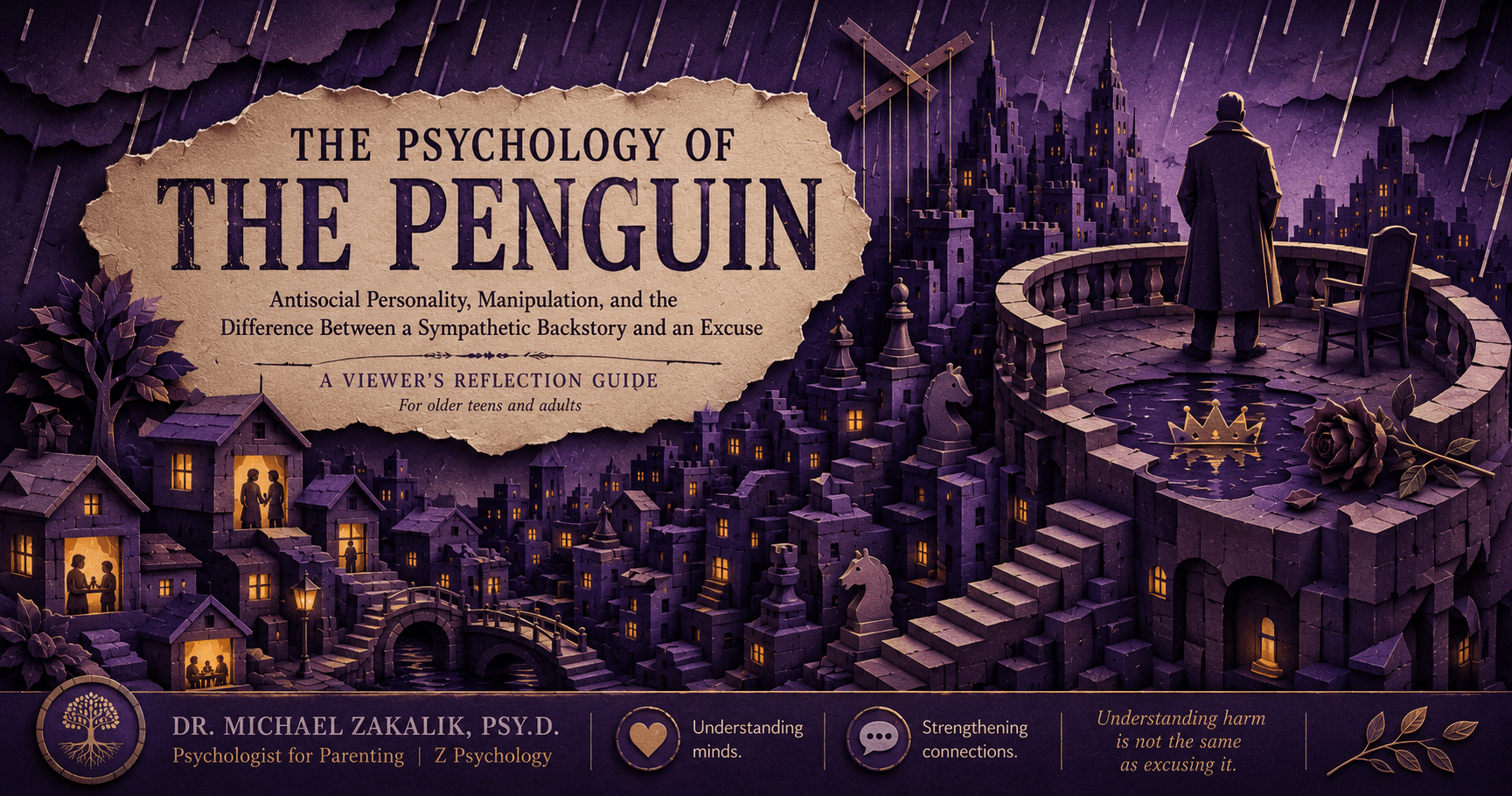
The Psychology of The Penguin: Antisocial Personality, Manipulation, and the Difference Between a Sympathetic Backstory and an Excuse
Lauren LeFranc's The Penguin, the eight-episode HBO limited series that premiered in 2024, has the polished surface of the operatic crime drama that prestige television has made familiar. A corrupt city, a power vacuum after the death of a mob patriarch, a rising criminal trying to take what he believes he is owed. The costumes are excellent, the performances are extraordinary, and Colin Farrell's work as Oswald Cobb is among the most technically accomplished leading performances in recent television. The pleasures are real. They also, the show gradually reveals, frame something considerably darker than the genre usually requires.
Beneath its surface, The Penguin is a sustained study of what produces a person whose capacity for empathy has been so thoroughly eroded that the ordinary categories of human moral response no longer fully apply to him. What makes it more than spectacle is its willingness to take seriously how Oswald Cobb became Oswald Cobb: his childhood, his mother, the specific events that shaped him, and the patterns visible across his whole life. The show is not making excuses for its protagonist. It shows, with clinical precision, how specific conditions produced a specific kind of person, and then lets us see what that person does when given power.
What Antisocial Personality Actually Is
Antisocial personality disorder, in contemporary psychiatric terms, involves a pervasive pattern of disregard for the rights of others. The features include repeated violations of laws or social norms, deceitfulness for personal gain, impulsivity, irritability and aggressiveness, reckless disregard for the safety of self or others, consistent irresponsibility, and lack of remorse after harming or exploiting others. The diagnosis requires evidence of conduct problems before age fifteen and that the person is at least eighteen. Most importantly, it is made only when the pattern is a consistent feature of how the person engages the world, rather than something attributable to a particular episode or circumstance. The extreme end of this spectrum is often described as psychopathy, which is not itself a formal diagnosis but is assessed with instruments like Robert Hare's Psychopathy Checklist, and which adds traits such as superficial charm, pathological lying, a grandiose sense of self-worth, and a shallow emotional range to the antisocial pattern.
How Oswald Fits the Pattern
Oswald Cobb displays a remarkable number of these features with precision. He lies constantly and without apparent discomfort. He manipulates everyone around him with sustained attention to their specific vulnerabilities. He is superficially charming when charm serves his purpose. He performs emotions he does not appear to feel. He kills without the hesitation or distress that ordinary people would experience. He is, importantly, not stupid; his intelligence is substantial and he is capable of complex planning and sophisticated social strategy. What he lacks, the show patiently demonstrates, is not cognitive capacity but something closer to the emotional substrate that produces ordinary moral judgment. The absence is so consistent that it cannot be attributed to circumstance. In the clinical sense, it is who he is.
Francis and the Mother Who Was Also Broken
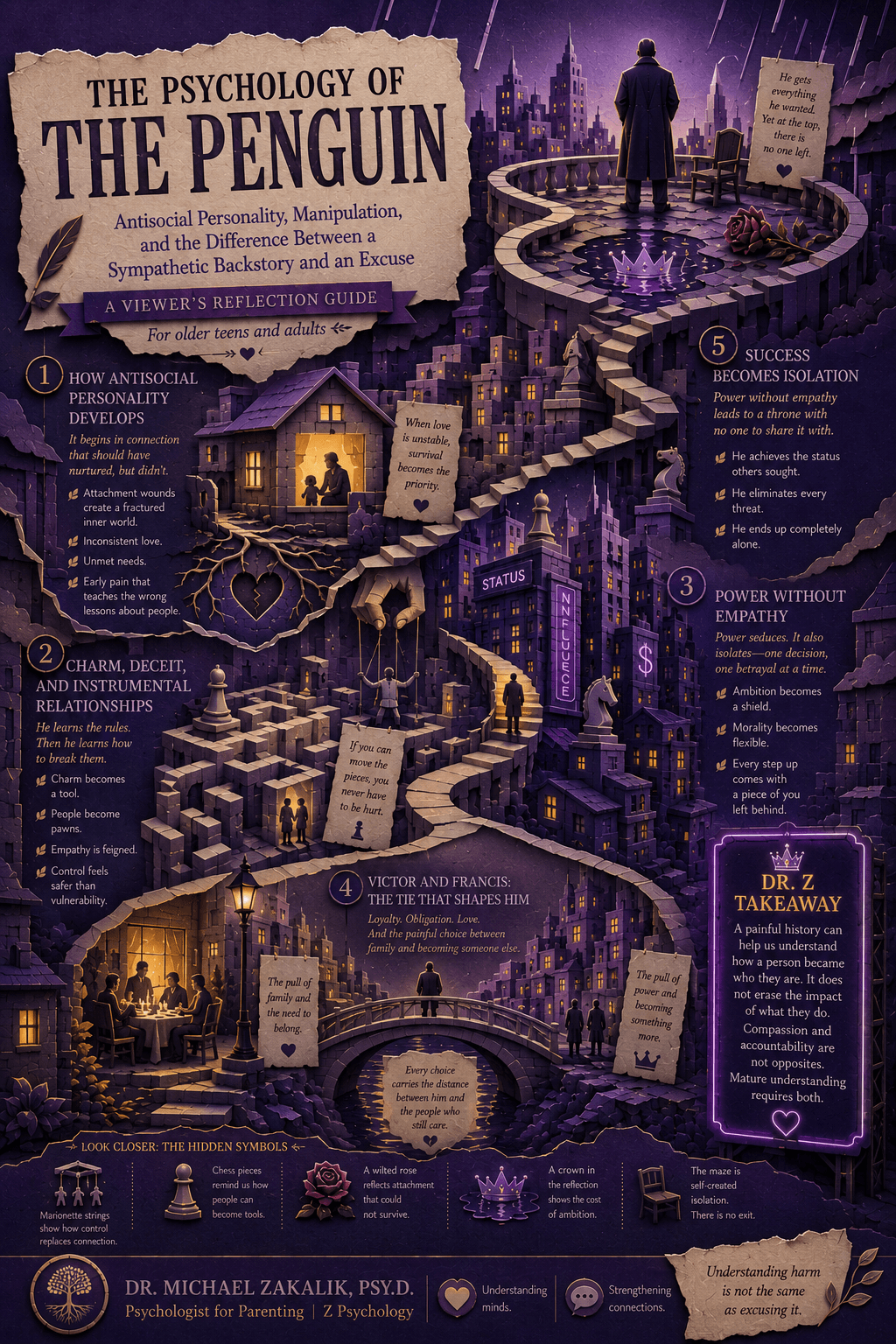
The show's greatest psychological achievement may be its depiction of Oswald's relationship with his mother Francis, played with extraordinary complexity by Deirdre O'Connell. Francis is not a simple abusive parent. She is a deeply damaged person in her own right, carrying serious trauma, mental illness, and the grief of having lost her two other sons in circumstances we come to understand only gradually. She is, in certain moments, capable of real love for Oswald. She is also profoundly aware that her remaining son is dangerous in ways the other two never were. Their bond has the shape of what clinicians sometimes describe as enmeshed but insecure attachment: two people fused in ways that prevent either from having a fully independent self, with tender moments of apparent understanding running alongside sustained manipulation in both directions. The devotion is real. It is also a specific kind of pathological attachment that has deformed both of them.
What the Research Says About Development
Research on the development of antisocial personality has consistently identified early attachment as a significant contributor. Children who experience unpredictable, disorganized, or inconsistently warm caregiving during the period when secure attachment usually forms often show elevated rates of behavioral and emotional difficulty later. When these early disruptions combine with other risk factors, including family criminality, trauma, genetic vulnerability, and exposure to violence, the cumulative impact can be substantial. The child does not simply learn specific behaviors from the environment. In the specific relational context of those early years, the child develops a particular kind of self whose capacity for ordinary moral engagement has been compromised before the child is old enough to know what has happened. The show presents Oswald this way: as the product of specific interactions between whatever he was born with and the conditions he grew up in.
“Oswald is responsible for what he does. He was also, in clinical terms, set up to become someone who would do these things.”
The Reveal About His Brothers
The show's most devastating reveal, which arrives in its fourth episode, concerns the deaths of Oswald's two younger brothers, Jack and Benny, when he was a child. They drowned in a flooded sewer tunnel, and Oswald has always told the story as an accident. The truth the show confirms is that Oswald locked his brothers in the tunnel deliberately, because he was jealous that Francis loved them more than she loved him. This reshapes everything before it. The audience has been allowed to develop sympathy for Oswald as an underdog who loves his mother and shows occasional warmth. The reveal forces a recognition that the capacity for warmth has coexisted, since early childhood, with a capacity for calculated violence against family. What makes this clinically accurate rather than sensationalistic is its specificity: serious violence toward siblings in middle childhood, particularly when it is instrumental rather than impulsive, is one of the most robust predictors of later severe antisocial outcomes.
Victor and the Question of Whether Oswald Can Love
One of the show's most interesting dynamics is Oswald's relationship with Victor, the young man he takes on as an apprentice after catching him stealing the rims off his car. Oswald teaches him the business, protects him in danger, and seems at times to express genuine concern. Victor, who has lost his family and is emotionally starved, comes to see Oswald as a father figure, and the relationship reads on its surface as one of the show's few redemptive threads. The final episode forces a reckoning. After consolidating his power, Oswald invites Victor to his mother's new home as an honored guest, and once inside he kills him. The killing is not rage or revenge. It is a calculated decision that Victor has become a liability who knows too much. This is a clinically accurate depiction of how severe antisocial personality operates in close relationships: the person may perform the behaviors of attachment, and even experience some internal state they call love, but they lack the emotional substrate that makes attachment durable under pressure. When the relationship becomes costly, they can discard the person without the disabling grief that would stop most people.
The Final Betrayal of Francis
The show's final moments contain its most devastating sequence. Francis, who has suffered a stroke and lost much of her capacity to communicate, is placed by Oswald in the beautiful penthouse he has promised her across the entire series. The view is magnificent, the furnishings are luxurious, and the life she was promised has arrived. She is also, in this penthouse, effectively a prisoner, unable to communicate or move freely, dependent on caregivers her son has chosen. The gift is also the containment. The series has been building toward a moment of triumph that is simultaneously the completion of Oswald's separation from everything human. He has achieved his ambitions, become Gotham's criminal ruler, and given his mother the life she wanted, and in doing so he has killed Victor, made his mother dependent, and finished his transformation into a man whose power rests on instrumentalizing everyone around him. The closing image, Oswald alone on the balcony looking out at the city he now controls, is a picture of what such a pursuit actually ends in. The success is indistinguishable from the isolation.
Sympathetic Backstory Is Not the Same as Excuse
One of the difficult questions the show leaves with its viewers is what moral response is appropriate to a person like Oswald. It provides enough of his origin to make clear that his pathology was shaped by conditions he did not choose: a damaging mother, an early environment of trauma and violence, and a development that compromised the ordinary moral responses most people take for granted. In one sense he was set up to become what he became. In another sense, his adult choices have been his choices, and they have caused enormous suffering. Contemporary thinking about responsibility in cases of severe personality pathology has not produced consensus. Some frameworks emphasize that the conditions producing such pathology do not excuse the resulting actions, because moral and legal systems must hold persons responsible in order to function. The show does not resolve this. It insists the question be asked rather than dissolved into either pure condemnation or pure explanation. The sympathy his origins might elicit coexists with the clear facts of what he has done; understanding the cause is not the same as excusing the harm.
Reflections for the Viewer
The Penguin has resonated for reasons beyond its genre pleasures. For some viewers it offers one of the most accurate depictions they have encountered of people they have actually known: the colleague whose charm obscured a sustained pattern of exploitation, the family member whose capacity for calculated harm did not match their public warmth, the partner whose professions of love did not prevent serious damage. For those who have been close to someone with features resembling Oswald's, the show can provide a particular validation, because many such people spend years doubting their own perception while being told they must be misreading things. For viewers without that experience, the show offers a more general education. Most people you encounter will not be Oswalds, but a few will be, and the features to watch for are consistent: claims of exceptional closeness early in relationships, charm calibrated to what you respond to, a sustained willingness to lie about matters large and small, the absence of genuine remorse after causing harm, and patterns of using and then discarding people. The show is not asking us to become paranoid. It is asking us to notice what we are sometimes encouraged to overlook, and to consider what we are actually pursuing in our own lives.
Frequently asked questions
- What is antisocial personality disorder?
- It is a pervasive, consistent pattern of disregard for the rights of others, including deceit, manipulation, impulsivity, aggression, and a lack of remorse, with evidence of conduct problems before age fifteen. The extreme end is often described as psychopathy. The Penguin depicts many of these features with unusual precision through Oswald Cobb.
- Does the show excuse what Oswald does?
- No. It provides a detailed origin story that explains how his pathology developed, including trauma, an enmeshed and damaging relationship with his mother, and early risk factors, but it is careful to hold him responsible for his adult choices. A sympathetic backstory explains harm; it does not excuse it.
- Can someone with severe antisocial features really love anyone?
- They can perform the behaviors of attachment and may even describe an internal state they call love, but research suggests they typically lack the emotional substrate that makes attachment hold up under pressure. When a relationship becomes costly, they can discard the person, as Oswald does with Victor.
- Is The Penguin appropriate for teens?
- It depicts serious violence and antisocial behavior, including harm within families, and is written for adult viewers. It is best approached by adults who want a clearer-eyed understanding of manipulation, personality pathology, and how charm can coexist with calculated harm.
For ways to help children name their feelings and trust their own judgment, see How to Teach Emotional Regulation and Building Confidence in Children.