
Twenty thousand people feeling the same thing at the same moment.
(Disclaimer: The articles provided on this website are for informational and enhancing mental health awareness purposes only. They are not intended to be clinical interventions or provide medical advice. If you have any concerns about your well-being and/or well-being of others, please seek guidance from a qualified professional, such as a physician, psychologist, or counselor. If you are experiencing a clinical emergency please call 911 or 988 or go to the nearest emergency room. Here are some national and international helplines.)
This article is about the psychology of fandom and crowds, for general interest. It is educational and is not therapy or clinical advice.
By Dr. Michael Zakalik, Licensed Clinical Psychologist
The Psychology of Live Sports: Being There When It Counts
A person can watch a sporting event at home in comfort, with a better view, replays, commentary, and a refrigerator nearby. Instead, large numbers of people pay considerable sums to sit in distant seats, in weather, among strangers, to watch the same event with a worse view and no replays. They do this repeatedly, describe it as among their most valued experiences, and grieve when they can no longer do it. This preference, which makes little sense as a way of seeing a game, makes a great deal of sense once one understands that seeing the game is not the point. This essay examines the psychology of attending a live sporting event: the tribal identification it engages, the collective states it produces, the emotional investment in outcomes one cannot influence, and why being physically present matters when the same contest could be watched more clearly elsewhere.
Live sport is worth examining because it engages some of the oldest features of human social psychology, group identity, collective emotion, ritual, in a form that is unusually intense and unusually visible. The behaviour of a crowd at a match reveals things about human beings that more restrained settings conceal.
My Team
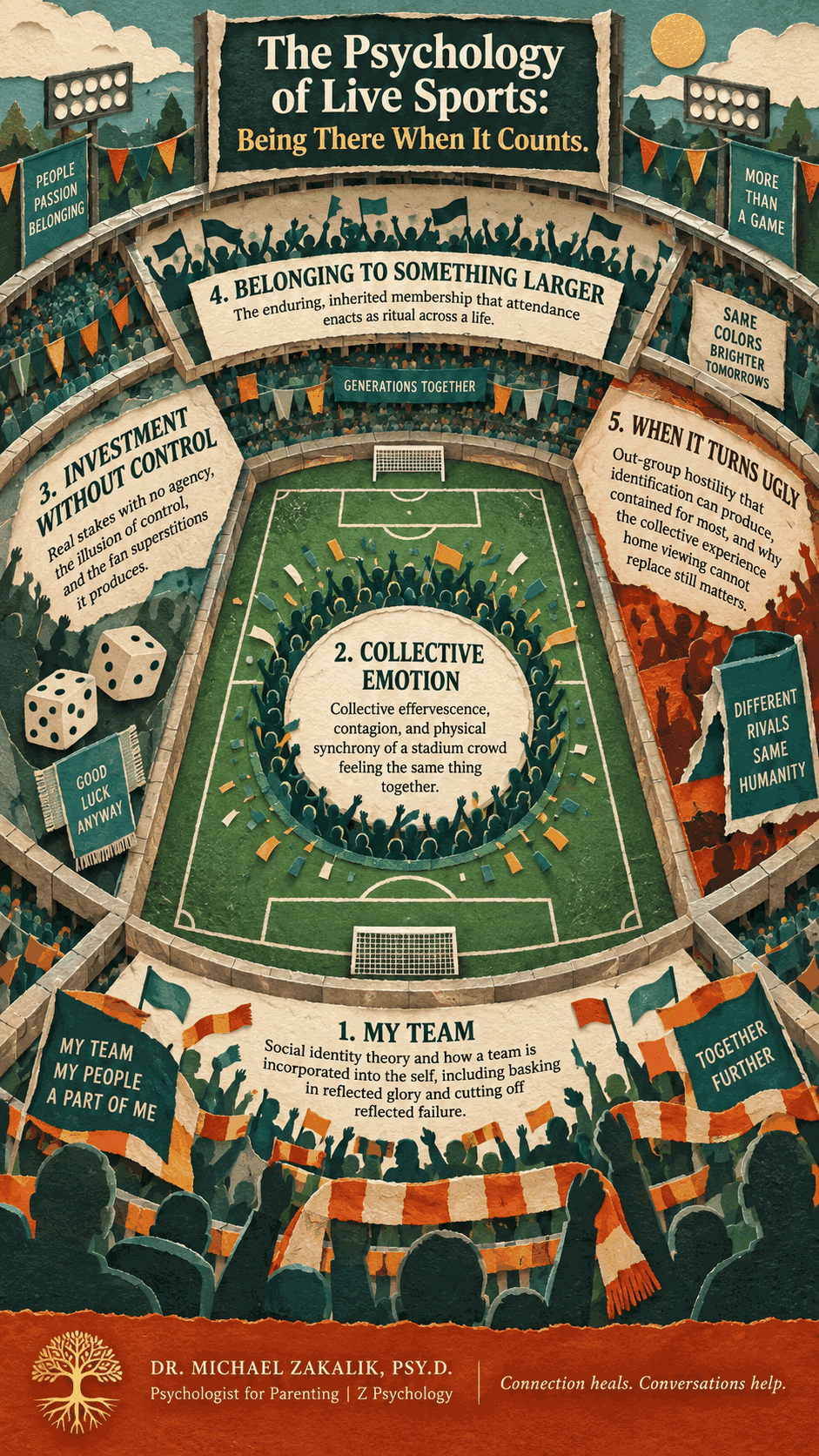
The foundation of sports fandom is identification, the incorporation of a team into one's own sense of self, so that the team's fortunes become, psychologically, one's own. This is not a metaphor but a describable psychological process with measurable effects.
Social identity theory, developed by Henri Tajfel and John Turner, holds that a substantial part of a person's identity derives from the groups they belong to, and that people are motivated to see their groups favourably because the group's standing reflects on the self. A sports team is an unusually pure vehicle for this. It provides a clear group membership, a clear rival, and a continuous stream of contests that deliver the group either victory or defeat, and the fan's self-esteem rises and falls with results in which they had no part.
This identification is measurable. Researchers have documented what is called basking in reflected glory, the tendency to associate oneself more closely with a successful group, observable in the increased wearing of team colours after a win and in the linguistic shift by which fans describe victories as we won and defeats as they lost. The distancing after defeat has its own name, cutting off reflected failure, and the two together demonstrate that the team's outcomes are being processed as information about the self.
Attending in person intensifies this identification considerably. Wearing the colours, sitting among thousands of others wearing them, and being physically surrounded by one's group makes the membership vivid and embodied in a way that solitary viewing cannot. The stadium is a place where an ordinarily abstract identity becomes a concrete, visible, collective fact, and the fan is not merely someone who supports the team but is, for the afternoon, physically part of the group that is the team's support.
Twenty Thousand People Feeling the Same Thing
The stadium produces collective emotional states that solitary viewing cannot approach, and these states are among the primary things attendance provides.
The sociologist Émile Durkheim described collective effervescence, the heightened emotional intensity and sense of unity that arises when people gather for shared activity, generating a feeling that exceeds anything the individuals would experience alone. Sport is one of the purest modern producers of this state. A crowd united in hope, tension, and release, all attending to the same event and responding to it together, enters conditions of shared intensity that participants describe as among the most powerful experiences available to them.
The mechanism is partly contagion. Emotion spreads through crowds via automatic mimicry and the direct perception of others' arousal, so that each person's excitement amplifies their neighbour's in a loop that can carry a whole stand into a state no individual could generate. The roar that follows a goal is not many individual reactions occurring simultaneously but a single collective event in which the crowd's response feeds on itself.
Physical synchrony contributes. Crowds chant, sing, clap, and move together, and coordinated collective action of this kind has been shown to increase feelings of bonding and unity among participants. The synchronised behaviours of a crowd, dismissed by outsiders as tribal noise, are doing real psychological work, converting a collection of individuals into a single feeling body. The moments of unified sound and motion are frequently what attendees remember most vividly, above the details of the game itself.
These collective states are increasingly rare elsewhere. Occasions on which large numbers of people gather to feel something together have diminished in many societies, and sport is among the few remaining reliable sources. Part of what fills a stadium is a hunger for exactly this collective experience, which ordinary life supplies less and less often.
Investment Without Control
Fans experience genuine and intense emotion over outcomes they cannot influence in the slightest, and this peculiar arrangement, real stakes with zero agency, is central to what makes sport compelling and distressing in equal measure.
The fan's situation is unusual: they care enormously about a result, their mood, sometimes their week, depends on it, and they can do absolutely nothing to affect it. This is close to the definition of a psychologically difficult situation, high investment combined with no control, and it produces the visible agony of the watching supporter, who wants desperately to influence what they are powerless to touch.
This powerlessness produces the elaborate superstitions and rituals characteristic of fans, the lucky shirts, the fixed routines, the refusal to change position during a good run. These behaviours reflect what has been described as the illusion of control, the tendency to believe one can influence random or uncontrollable outcomes, particularly under conditions of high investment. The fan knows, rationally, that their shirt does not affect the game, and wears it anyway, because the intolerable helplessness of caring without control demands some gesture of agency, however magical.
The genuine uncertainty of the outcome is essential to the whole experience, and it is what distinguishes live sport from scripted entertainment. Nobody knows what will happen, the result is not predetermined, and this authentic uncertainty produces a suspense that fiction cannot replicate because fiction is authored and sport is not. The knowledge that the outcome is real and unknown is precisely what makes it worth the emotional investment, and it is why a recorded game whose result one already knows is a pale thing compared to a live one whose result hangs genuinely in the balance.
The stakes also make the emotional payoffs extreme. Because the investment is real and the outcome uncontrollable and uncertain, victory produces genuine elation and defeat genuine grief, emotions of an intensity that little else in ordinary life reliably delivers. Fans frequently acknowledge that this volatility is irrational and would not trade it, because the intensity is the point.
Belonging to Something Larger
Beyond any single match, sports fandom provides an enduring sense of belonging and continuity, and attendance is the ritual through which this belonging is enacted and renewed.
A team provides membership in a community that persists across time, connecting the fan to other supporters, to the team's history, and to a tradition extending before their own involvement and continuing after it. This membership is stable in a way that much of modern life is not, providing a fixed point of identity and belonging that a person can rely on across the changes of their life. People who have moved, changed careers, and lost other affiliations frequently retain their team, and the continuity it provides is genuinely valuable.
This belonging is frequently inherited and transmitted, passed from parent to child as a family tradition, and attendance becomes a means of connecting generations. The parent who takes a child to a match is transmitting not merely an interest but a membership and a bond, and the shared support becomes part of the relationship. Much of the emotional weight fans attach to their team derives from these associations, the team standing for a father, a childhood, a place one came from.
Attendance is the ritual that enacts this belonging. Going to the match is a recurring, structured occasion, marked off from ordinary time, undertaken with others, following customary sequences, and it functions as ritual in the anthropological sense, affirming membership and renewing the bonds of the supporting community. The specific journey, the pre-match customs, the usual seat and usual companions, are not incidental but constitute the ritual through which belonging is repeatedly reconstituted.
The community of a stadium also provides a rare experience of connection with strangers. Fans embrace people they have never met after a goal, fall into conversation with those around them, and experience a temporary dissolution of the ordinary reserve between strangers. This shared-identity licence for connection is itself valuable, offering a brief experience of the easy fellowship that shared membership permits and that ordinary urban life rarely allows.
When It Turns Ugly
The same identification that produces belonging and collective joy also produces hostility, and an honest account of live sport must address the aggression, tribalism, and occasional violence that attend it.
The group identification at the heart of fandom has an in-group and an out-group structure, and the favouring of one's own group is frequently accompanied by hostility toward the rival. Social identity processes produce not only attachment to the in-group but derogation of the out-group, and in sport this appears as genuine antipathy toward rival teams and their supporters, an antipathy that can shade into aggression. The rival is necessary to the identity, and the hostility toward them is not incidental but structural.
Crowd conditions can amplify this. The anonymity of a large crowd, the diffusion of responsibility among many, and the intense collective arousal can produce what has been described as deindividuation, a state in which ordinary individual restraints weaken and people behave in ways they would not alone. Under these conditions, hostility that would remain private can find collective expression, and a minority of fans engage in aggression that the crowd context enables. Alcohol, frequently present, compounds this considerably.
It is worth being clear that serious violence involves a minority, that most fans of most teams behave well, and that the tribal hostility of sport is, for the great majority, contained within understood limits and discharged harmlessly. But the potential is real, the structural basis of it, in-group identification and out-group derogation amplified by crowd conditions, is well understood, and the history of the game includes genuine tragedy. The energies that make a stadium exhilarating are the same energies that, in the wrong conditions, make it dangerous.
The tribalism also has a benign reading worth noting. The rivalry provides a contained arena for the expression of group loyalty and competitive antipathy that might otherwise find worse outlets, and the hostility is, for most, a kind of licensed play, felt intensely within the match and set down afterward. The supporter who despises the rival for ninety minutes and shares a drink with them afterward is engaged in something more like ritual combat than genuine enmity.
Why Being There Matters
The persistence of attendance despite the superiority of home viewing as a way of seeing the game confirms that attendance provides something other than a view of the game, and that something is worth naming directly.
Home viewing is better in every respect that concerns seeing the contest: the view is closer, replays are available, commentary explains, and comfort is assured. Attendance is worse on all these dimensions and more expensive besides. That people choose it anyway demonstrates that what they are purchasing is not a view of the game but presence at it, participation in the collective experience, and membership enacted in physical company.
The unrepeatability matters. A live match happens once, its outcome genuinely unknown, and those present witness something singular that will not recur in that form. Being present at a significant match, a decisive victory, a historic moment, confers a value that watching the same event on a screen does not, and fans speak of having been there with a pride that reflects the genuine difference between presence and observation. They were part of it, not merely witnesses to it.
The collective dimension is ultimately what cannot be reproduced. The roar, the shared tension, the unified release, the embrace of strangers, the sense of being one body among thousands feeling the same thing, none of this survives transmission to a solitary living room. What the stadium provides is the collective experience itself, and this is precisely what home viewing, however superior as a way of seeing, cannot supply. The fan at home sees the game better and experiences almost none of what the fan in the stadium has come for.
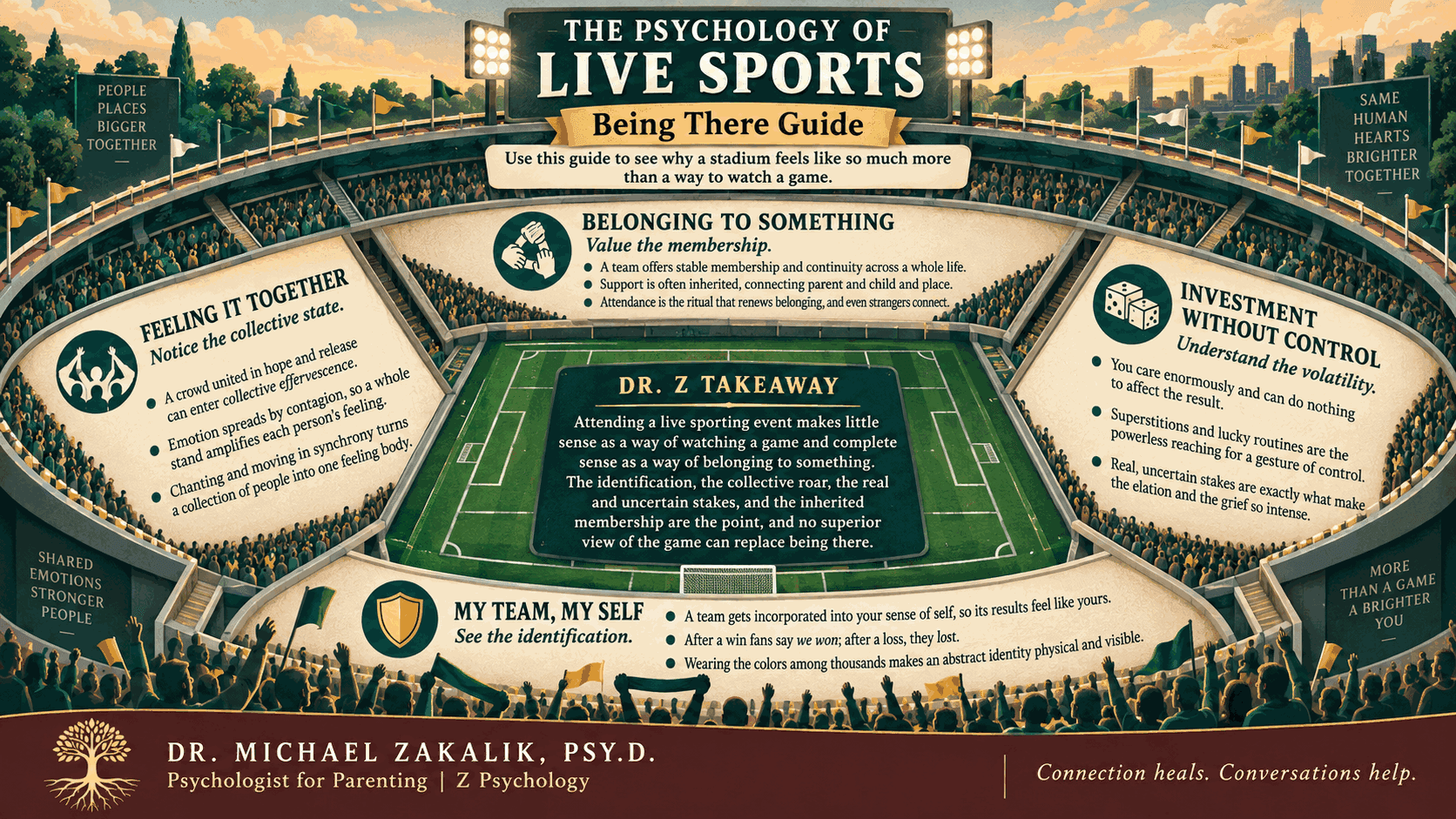
"Attending a live sporting event makes little sense as a way of watching a game and complete sense as a way of belonging to something."
Reflections for the Fan
Attending a live sporting event engages identification that incorporates the team into the self, produces collective emotional states of an intensity ordinary life rarely offers, generates real emotion over uncontrollable and genuinely uncertain outcomes, provides enduring belonging enacted through ritual, and carries a tribal hostility that is mostly contained but genuinely present.
For fans, understanding this psychology may deepen the appreciation of what attendance provides. The recognition that one attends for the collective experience rather than the view reframes the expense and discomfort as the price of presence and participation, which is what is actually being purchased. The recognition that the emotional volatility derives from real investment in a genuinely uncertain and uncontrollable outcome may make the agony of a tight match easier to hold, since the distress is the direct cost of the elation, and the two are inseparable.
The belonging that fandom provides is genuine and valuable, a stable membership and continuity that much of modern life lacks, and the transmission of it across generations is among the more meaningful things it offers. It is worth valuing this deliberately, and worth being aware that the same identification that provides it also generates the hostility toward rivals that, kept in proportion, is harmless play and, allowed to escape it, becomes something worse.
In the end, attending a live sporting event makes little sense as a way of watching a game and complete sense as a way of belonging to something. The identification at its heart incorporates the team into the self, so that its uncontrollable fortunes are processed as information about one's own worth, and attendance makes this ordinarily abstract membership physical, visible, and collective. The stadium produces the collective effervescence that Durkheim described, the shared intensity and unity that contagion and synchrony generate and that ordinary life increasingly lacks. The genuine uncertainty of the outcome, combined with the fan's complete powerlessness over it, produces emotion of an intensity little else delivers, along with the magical rituals by which the powerless assert a gesture of control. And beneath the single match lies an enduring belonging, inherited and transmitted, enacted through the ritual of attendance, connecting the fan to a community and a continuity that persist across a life. The tribal hostility is real and mostly contained. And the whole of it depends on being present, in the crowd, for something that happens once, because presence and participation are what the stadium offers and what no superior view of the game can replace.
Frequently Asked Questions
- Why do fans care so intensely about a team they cannot influence?
- Through identification, the team becomes part of the fan's sense of self, so its wins and losses are processed as information about their own worth even though they have no control over the result.
- What is BIRGing, or basking in reflected glory?
- It is the tendency to associate more closely with a winning group, seen in wearing team colors after a win and in the linguistic shift by which fans call victories we won and defeats they lost.
- Why is being at the stadium different from watching at home?
- Home viewing is better for seeing the game, but the stadium provides collective effervescence, emotional contagion, physical synchrony, and membership enacted in company, which is what fans actually come for.
- Why does live sport sometimes turn hostile or violent?
- The same in-group identification that creates belonging also produces out-group hostility, which crowd anonymity, arousal, and alcohol can amplify. Serious violence involves a minority, but the structural potential is real.