
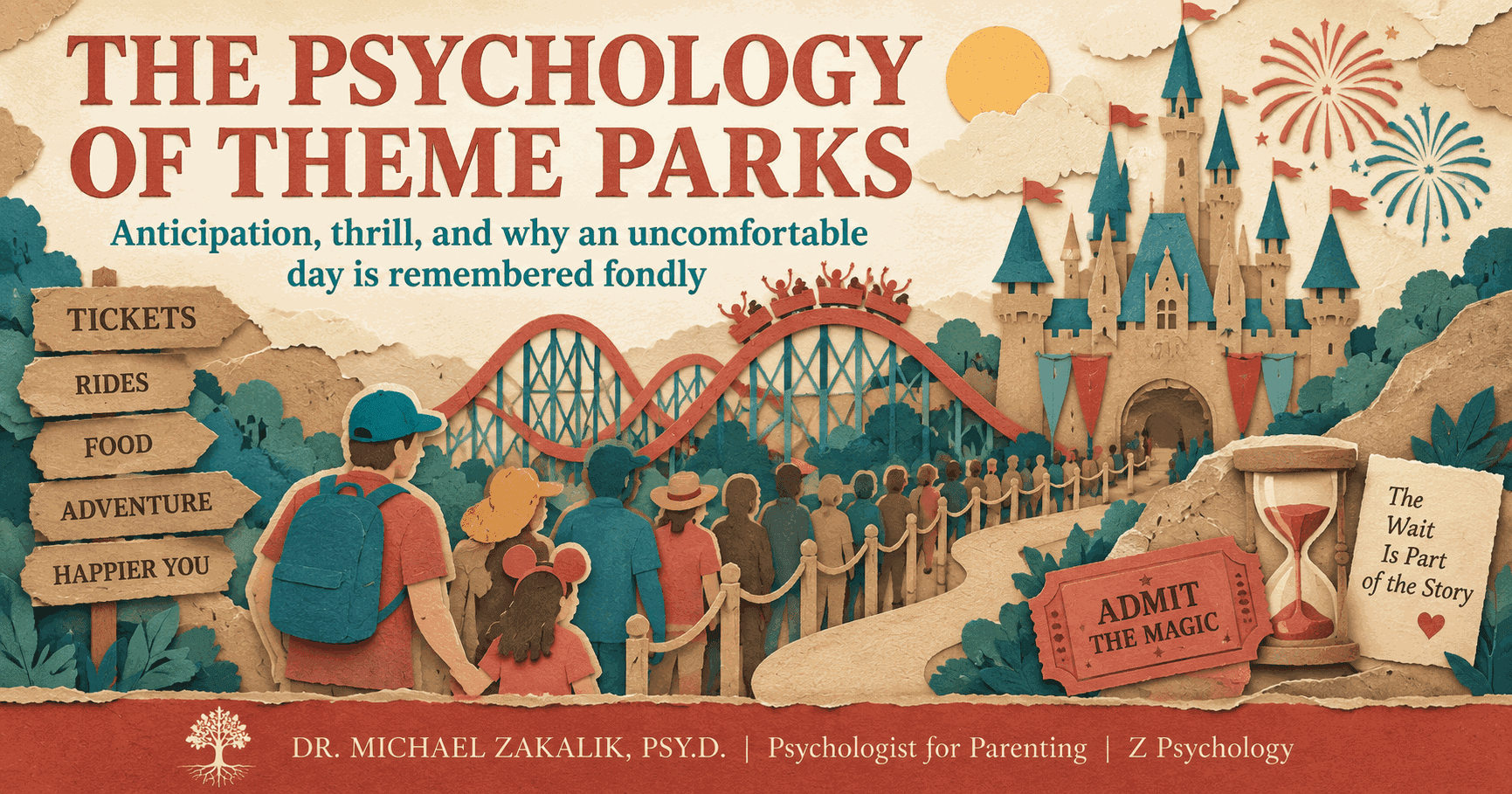
One of the most carefully engineered environments people voluntarily pay to enter.
(Disclaimer: The articles provided on this website are for informational and enhancing mental health awareness purposes only. They are not intended to be clinical interventions or provide medical advice. If you have any concerns about your well-being and/or well-being of others, please seek guidance from a qualified professional, such as a physician, psychologist, or counselor. If you are experiencing a clinical emergency please call 911 or 988 or go to the nearest emergency room. Here are some national and international helplines.)
This article is about the psychology of everyday experiences, for education and general interest. It is not therapy or advice.
By Dr. Michael Zakalik, Licensed Clinical Psychologist
The Psychology of Theme Parks
The Happiest Queue on Earth: Anticipation, Thrill, and the Psychology of Theme Parks
The theme park is a peculiar human invention: an enclosed environment, expensive to enter, in which people voluntarily endure long waits, large crowds, and considerable physical discomfort in order to experience carefully engineered thrills and to occupy, briefly, a world that does not exist. Millions of people do this every year, many of them repeatedly, and many describe the experience in terms of genuine joy and lasting memory. That an environment involving so much objective unpleasantness produces such powerful positive experience is a genuine psychological puzzle, and its resolution reveals a great deal about anticipation, controlled fear, immersion, and the way memory reconstructs experience. This essay examines the psychology of the theme park, the pleasures it engineers, and why the discomfort it involves so rarely dominates the memory of it.
Theme parks are worth taking seriously because they are, among other things, industrial-scale applications of experience design, refined across decades of observation into environments that reliably produce specific emotional states. Understanding how they work illuminates the mechanics of anticipation, thrill, and immersion more generally.
The Pleasure Before the Pleasure
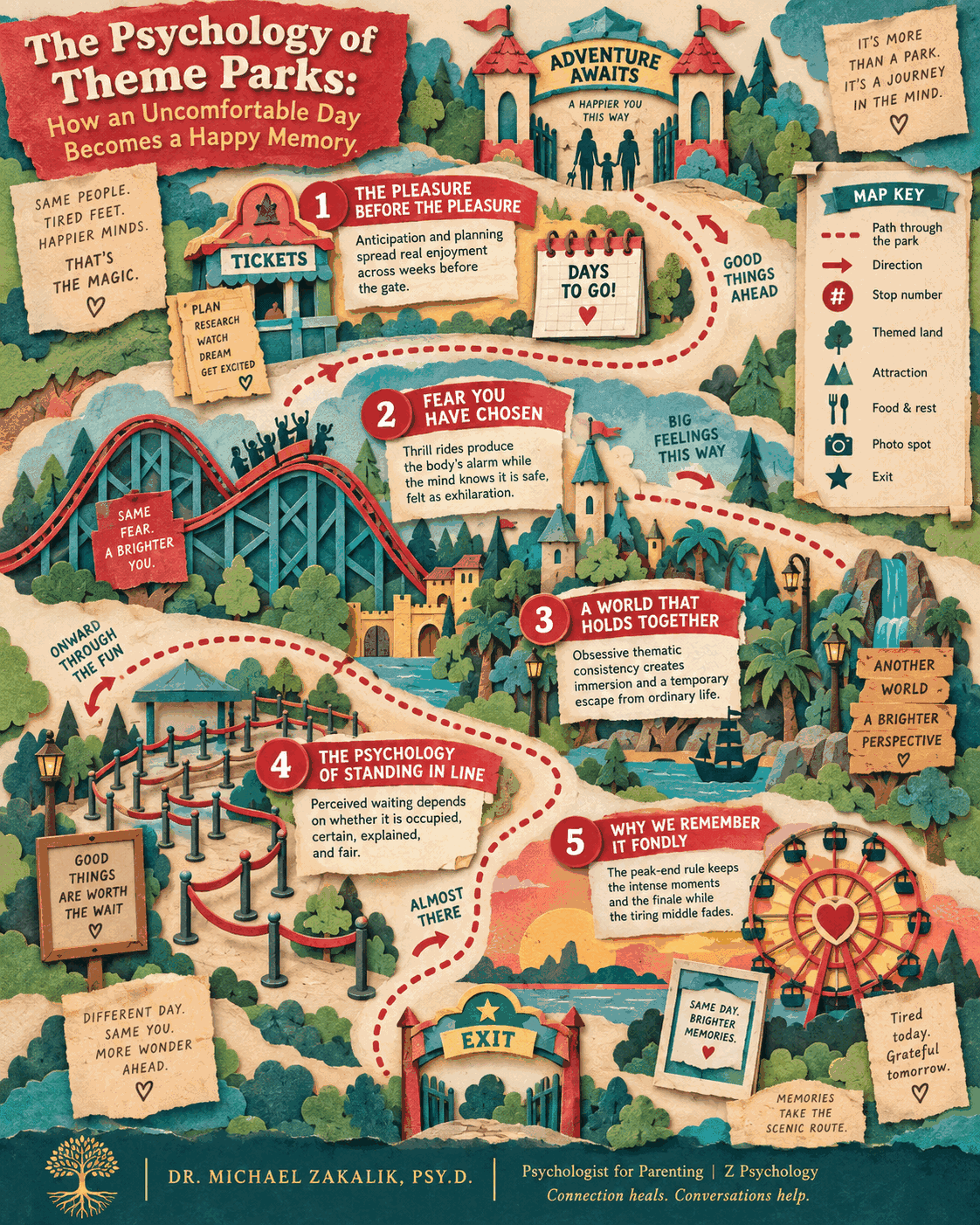
A substantial portion of the enjoyment a theme park provides occurs before the visit begins, in the anticipation that planning and waiting generate, and this anticipatory pleasure is psychologically distinct from and sometimes greater than the experience anticipated.
Research on anticipation has consistently found that looking forward to a positive event produces genuine pleasure, and that this anticipatory pleasure constitutes a real component of the total enjoyment an experience provides. Studies of vacation happiness have found that anticipation accounts for a substantial share of the wellbeing associated with travel, with the period before departure producing measurable elevation in mood. The pleasure of a planned event is not merely deferred until the event occurs; it is distributed across the waiting.
Theme parks exploit this deliberately. The planning process is extended and elaborate, involving reservations, itineraries, and considerable research, and this extended planning generates weeks or months of anticipatory pleasure before anyone enters a gate. Marketing sustains and intensifies this anticipation, and for families with children the countdown becomes a shared ritual with its own emotional life.
This has an implication worth noticing: a theme park visit produces value well beyond the hours spent inside it. The weeks of looking forward and the years of looking back may together contain more total pleasure than the visit itself, which helps explain why an expensive and physically taxing day can be judged so favorably. The day is only part of what is being purchased.
Fear You Have Chosen
The thrill ride occupies a curious psychological position, deliberately producing the physiological signature of terror in people who have queued at length for the privilege, and understanding this requires attention to the relationship between arousal and safety.
A roller coaster produces a genuine fear response: elevated heart rate, released stress hormones, heightened alertness, the physiological state of an organism in danger. What distinguishes it from actual danger is the rider's knowledge that they are safe, that the apparatus is engineered and inspected and that thousands have preceded them without harm. The body responds as though threatened while the mind knows better, and this divergence is precisely the source of the pleasure.
The psychologist Paul Rozin described a category of experience he termed benign masochism, in which people enjoy activities that produce negative sensations in contexts rendering them harmless. The burn of chili, the plunge of a drop tower, the terror of a haunted attraction: in each case an aversive sensation is enjoyed because the person knows it cannot hurt them. Rozin proposed that part of the pleasure lies in a kind of mastery, the satisfaction of experiencing one's body signal alarm while one's judgment recognizes safety, a demonstration of mind over reflexive response.
The arousal itself also contributes. High physiological activation is not intrinsically unpleasant; it is a state of intense aliveness that, absent genuine threat, can be experienced as exhilarating. And the relief that follows a ride's conclusion is intensified by the arousal that preceded it, a phenomenon consistent with what the psychologist Dolf Zillmann described as excitation transfer, in which residual arousal from one experience amplifies the emotion of the next. The moment of stepping off a coaster, laughing with the people one rode with, may be the peak of the entire sequence.
Individual differences matter considerably here. People vary substantially in what has been described as sensation seeking, the disposition to pursue intense and novel experience, and this variation explains why the same ride produces exhilaration in one person and genuine misery in another. Neither response is a failure; they reflect different thresholds for the arousal that thrill rides supply.
A World That Holds Together
Theme parks invest enormously in the coherence of their environments, and this immersive design serves a specific psychological function: the production of a temporary absorption in which ordinary reality recedes.
The distinguishing feature of a theme park, as opposed to an amusement park, is thematic coherence. Environments are designed so that every visible element, architecture, landscaping, signage, music, staff costume, even the vocabulary employees use, belongs to a consistent fictional world. Sightlines are engineered to exclude anything that would break the illusion. This is expensive and deliberate, and its purpose is to sustain the absorption that inconsistency would puncture.
The psychological state being cultivated resembles what researchers studying narrative and virtual environments call presence or transportation, the sense of being located within a represented world rather than observing it from outside. This state requires consistency; a single incongruous element can collapse it, which is why theme park design attends so obsessively to detail. When it succeeds, visitors experience a genuine, if temporary, relocation, a sense of having stepped out of ordinary life into somewhere else.
This relocation is a substantial part of what visitors are seeking. Ordinary life carries continuous low-level demands, obligations, concerns, and identities that a person cannot easily set down. An environment engineered to be wholly other provides a genuine escape from these, a period during which the ordinary self and its concerns are suspended. The psychological benefit of such suspension is real, related to the restoration that research on restorative environments has documented, and it accounts for the intensity with which people value these experiences.
The Psychology of Standing in Line
Waiting constitutes a large fraction of the time spent in a theme park, and the management of waiting has become a sophisticated discipline because the experience of a wait depends far more on its psychological features than on its duration.
Research on waiting has established that perceived wait time diverges substantially from actual wait time, and that this divergence is governed by identifiable factors. Unoccupied time feels considerably longer than occupied time. Uncertain waits feel longer than waits of known duration. Unexplained waits feel longer than explained ones. Anxious waiting feels longer than relaxed waiting. And unfair waits, in which others appear to be advancing faster, generate disproportionate frustration.
Theme parks address each of these. Queues are themed and filled with things to look at, converting unoccupied time into occupied time and, in the best cases, into part of the attraction itself. Posted wait times convert uncertainty into known duration, and are frequently overstated slightly so that the actual wait produces a small positive surprise. Queues are designed to conceal their full length, since the visible extent of a line affects the decision to join it more than the actual duration does.
The fairness dimension has become more complicated with the proliferation of paid queue-skipping systems. Research on procedural fairness indicates that people care intensely about whether a process is fair, sometimes more than about outcomes, and watching others advance past one's position produces a distinctive irritation that duration alone does not explain. Parks navigate a genuine tension here between revenue and the perceived fairness that affects the whole experience.
"Judged as an experience, a theme park day is a mixed proposition. Judged as a memory-generating device, it is remarkably effective."
Ritual, Family, and Return
Theme parks function for many families as ritual occasions, and this ritual dimension accounts for much of the emotional weight such visits carry and for the intensity of adult attachment to parks visited in childhood.
Rituals, in the anthropological sense, are structured occasions marked off from ordinary time, characterized by prescribed sequences and shared participation, and serving to affirm group membership and shared identity. Family theme park visits carry these features: they are planned and anticipated, set apart from ordinary routine, follow customary sequences, and are undertaken together. They function as occasions on which a family constitutes itself as a family, and the memories they produce serve as reference points in a family's shared narrative.
This ritual quality is intensified by the intergenerational transmission that parks encourage. Adults return with their own children to places they visited as children, and the visit becomes a means of connecting generations, of giving one's child an experience one remembers receiving. The emotional weight this carries far exceeds anything the attractions themselves would produce, and it explains the loyalty that particular parks command across decades.
Nostalgia contributes substantially. Parks visited in childhood become objects of powerful nostalgic attachment, and returning as an adult produces the characteristic bittersweetness of encountering a preserved piece of one's own past. Parks understand this and preserve legacy attractions well beyond what their popularity alone would justify, recognizing that they are maintaining not merely rides but the objects of a great many people's autobiographical memory.
Why We Remember It Fondly
The gap between the objective experience of a theme park day, which involves considerable discomfort, and the memory of it, which is characteristically fond, is explained by well-documented features of how experience is encoded into memory.
The psychologist Daniel Kahneman and colleagues demonstrated that retrospective evaluations of experiences are determined disproportionately by two moments: the most intense point and the ending, a pattern termed the peak-end rule. The duration of an experience, and the aggregate quality of its ordinary moments, contribute surprisingly little to how it is remembered. An experience containing substantial discomfort but an intense positive peak and a good ending will be remembered favorably, while an experience of uniformly mild pleasantness may leave little trace.
Theme parks are structured, whether by design or by evolution, to exploit this. They contain intense peaks, the thrill ride, the moment of wonder, the fireworks, and they engineer strong endings, characteristically a spectacular finale. The hours of queuing, heat, expense, and fatigue occupy the undifferentiated middle that retrospective evaluation largely discards. What remains in memory is the peak and the ending, which is to say the best of it.
Photography intensifies this selection. Photographs are taken at good moments and rarely at bad ones, and subsequent review of them reinforces the pleasant memories while the unrecorded difficulties fade. The remembered day is assembled substantially from its documented highlights, producing a reconstruction considerably better than the day as lived.
This is not a deception but a genuine feature of how experience becomes memory, and it has a practical implication: the value of such a day lies substantially in what it will become in memory rather than in its moment-to-moment quality. Judged as an experience, a theme park day is a mixed proposition. Judged as a memory-generating device, it is remarkably effective.
Reflections for the Visitor
The theme park engineers a specific set of psychological effects: anticipation distributed across weeks of planning, thrill produced by arousal in conditions of known safety, immersion sustained by obsessive environmental consistency, waiting managed through the psychology of perceived duration, ritual significance that binds families across generations, and a structure of peaks and endings that memory will recall favorably.
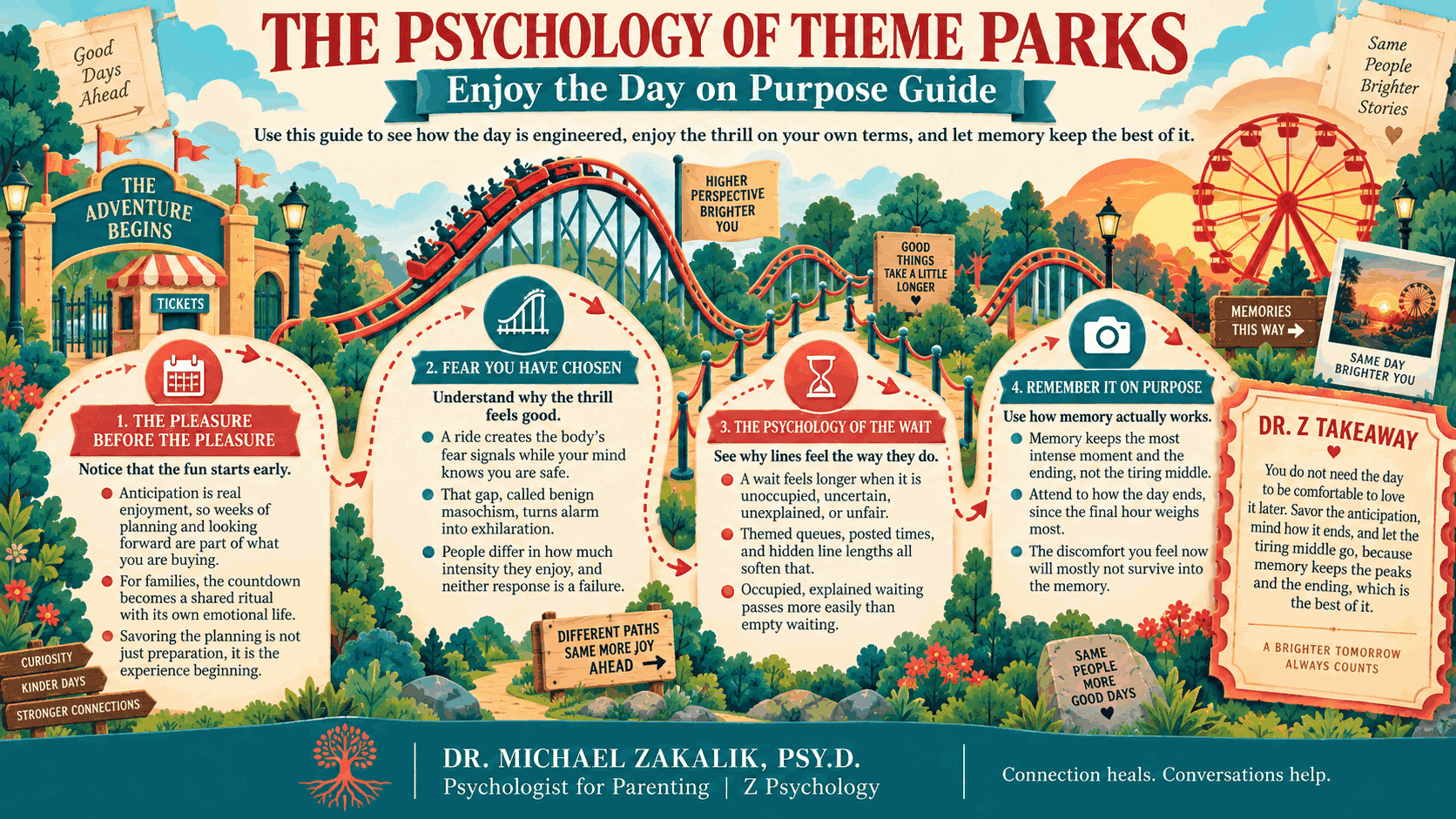
For visitors, understanding this offers some practical purchase. Recognizing that anticipation is a real component of the pleasure suggests that extending and savoring the planning is not merely preparation but part of the experience. Recognizing the peak-end structure suggests attending to how a day ends, since the final hour will weigh disproportionately in what remains. And recognizing that discomfort occupies the forgettable middle may make the discomfort easier to bear in the moment, since one knows it will not survive into the memory.
It is also worth acknowledging what these environments cost and who they exclude. Theme parks are expensive, and the experiences described here are unavailable to a substantial population for whom the price is prohibitive. The nostalgic attachment and family ritual that parks cultivate are, in this respect, distributed by income, which is worth holding alongside any celebration of what they provide.
In the end, the theme park is not simply a collection of rides. It is an environment engineered to produce specific psychological states: the anticipatory pleasure that begins weeks before arrival, the exhilaration of fear experienced in conditions of known safety, the temporary relocation that obsessive environmental consistency makes possible, and the ritual significance that binds families and generations to particular places. Its considerable discomforts, the queues and crowds and expense and fatigue, occupy exactly the undifferentiated middle that retrospective evaluation discards, while its engineered peaks and spectacular endings occupy the positions that memory weights most heavily. The result is an experience that is frequently unpleasant to undergo and reliably wonderful to remember, which is a strange achievement, and a more sophisticated one than the form is usually credited with.
Frequently Asked Questions
- Why do people remember a tiring theme park day so fondly?
- Because retrospective memory is shaped disproportionately by the most intense moment and the ending, the peak-end rule. The engineered peaks and spectacular finales occupy the positions memory weights most, while the queues, heat, and expense sit in the forgettable middle.
- Is looking forward to the trip really part of the fun?
- Yes. Anticipation is a genuine component of the total enjoyment, and studies of vacation happiness find the period before departure produces measurable elevation in mood. The weeks of looking forward can hold as much pleasure as the visit.
- Why do thrill rides feel good when they produce fear?
- A ride creates the physiology of fear while the mind knows it is safe, a pattern Paul Rozin called benign masochism. The arousal is experienced as exhilaration, and the relief afterward is amplified by it.
- Why does standing in line feel so long?
- Perceived wait time depends on more than duration. Unoccupied, uncertain, unexplained, anxious, and seemingly unfair waits all feel longer, which is why parks theme their queues, post wait times, and hide a line's full length.