
Why we pay to be uncomfortable, and call it the best money we spend.
(Disclaimer: The articles provided on this website are for informational and enhancing mental health awareness purposes only. They are not intended to be clinical interventions or provide medical advice. If you have any concerns about your well-being and/or well-being of others, please seek guidance from a qualified professional, such as a physician, psychologist, or counselor. If you are experiencing a clinical emergency please call 911 or 988 or go to the nearest emergency room. Here are some national and international helplines.)
This article is about the psychology of travel and everyday experience, for general interest. It is educational and not a substitute for therapy.
By Dr. Michael Zakalik, Licensed Clinical Psychologist
The Psychology of Travel: Novelty, Restoration, and the Trip You Remember
People spend substantial portions of their income to leave places where they are comfortable for places where they are not, to sleep in unfamiliar beds, navigate incomprehensible signage, eat at unpredictable hours, and endure the considerable indignities of transit. They do this voluntarily, describe it as among the best uses of their money, and begin planning the next one before the current one has ended. Travel is expensive, frequently uncomfortable, and reliably reported as one of the most valuable things people do. This essay examines the psychology of travel, the appetite for novelty that drives it, the restoration it can provide, the expansion of self it appears to produce, the search for authenticity that shapes it, and the peculiar relationship between the experience of a trip and the memory of it.
The gap between travel as experienced and travel as remembered is particularly interesting and turns out to explain a good deal, including why people persist in an activity whose moment-to-moment reality frequently includes considerable frustration.
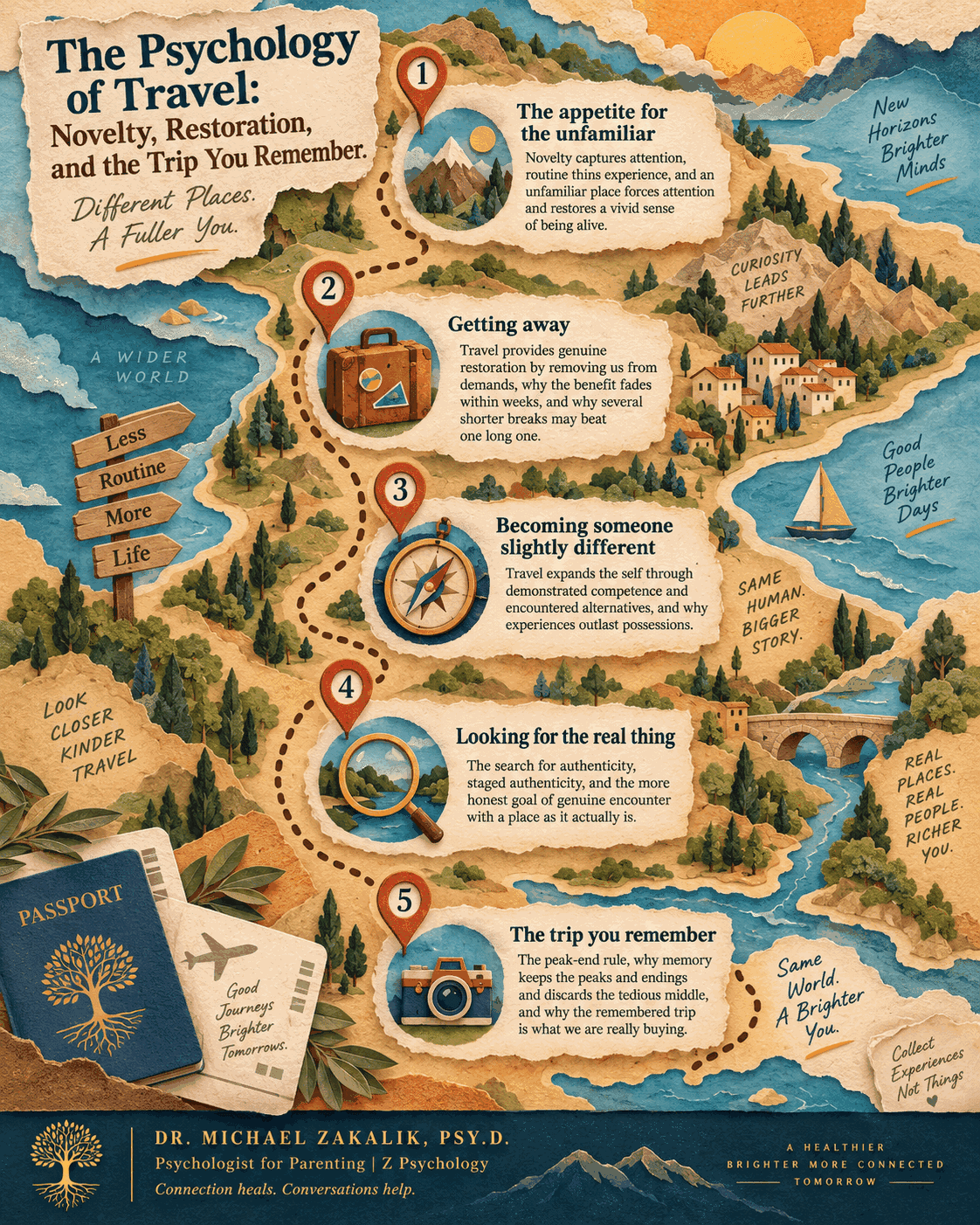
The Appetite for the Unfamiliar
The foundation of travel's appeal is the human appetite for novelty, a disposition with deep roots and identifiable neural correlates that ordinary settled life systematically underfeeds.
Human beings are drawn to the new. Novel stimuli capture attention automatically, novel environments produce heightened alertness, and the encounter with the unfamiliar engages reward-related neural systems. This disposition presumably conferred advantage, since exploration yields information and resources that remaining in place does not, and it persists whether or not contemporary circumstances require it.
Ordinary life provides limited novelty. Routines are repetitive by design, environments become thoroughly familiar, and the automaticity that makes daily functioning efficient also renders it largely unnoticed. A person may traverse the same route for years while perceiving very little of it, since familiar environments are processed with minimal attention. This efficiency is useful and it is also a kind of impoverishment, an experiential thinning that accumulates unnoticed.
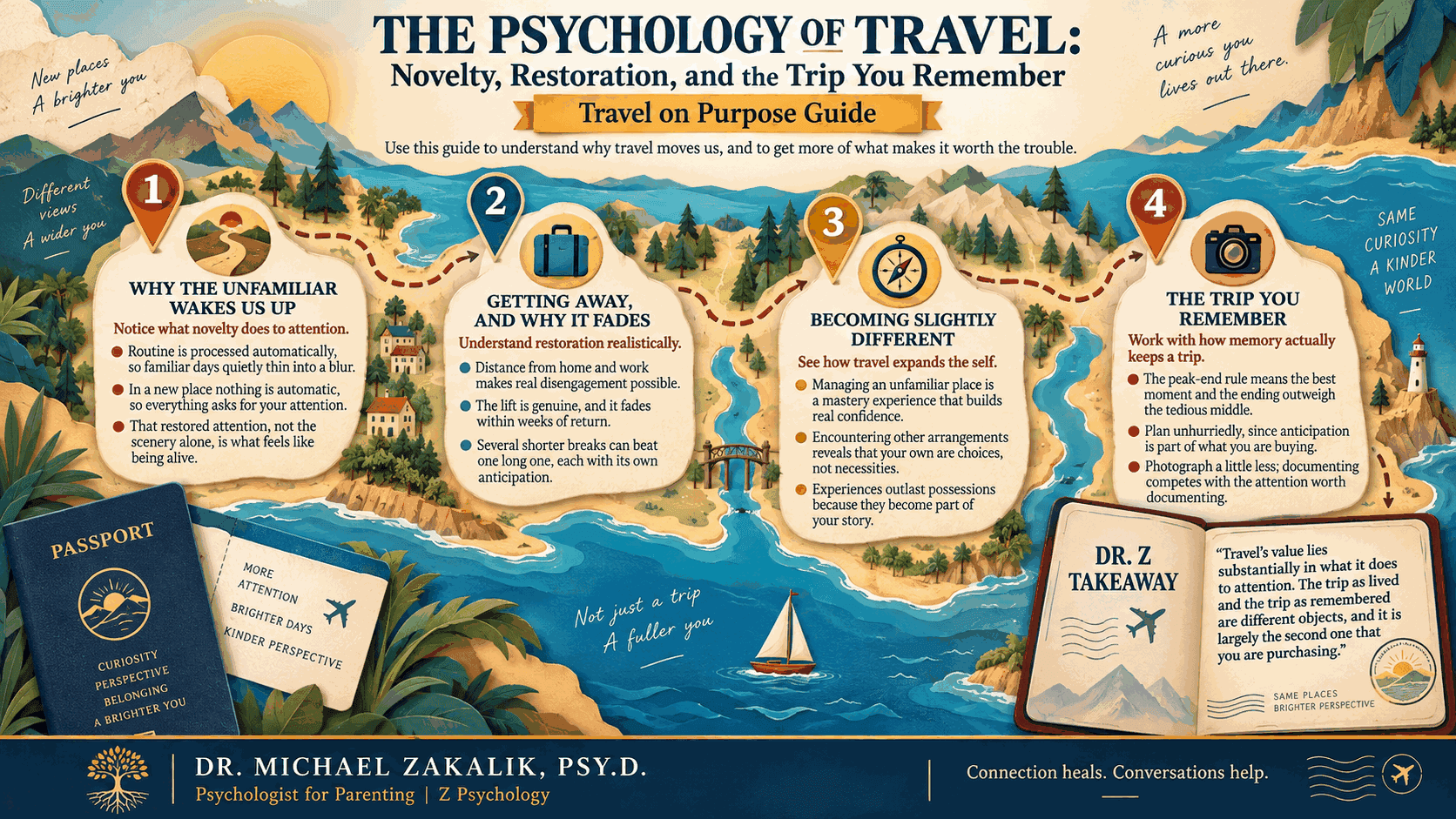
Travel reverses this abruptly. In an unfamiliar place, nothing can be processed automatically, and everything requires attention: how to cross the street, what the signs mean, how transactions work, what the food is. This forced attention produces a heightened perceptual vividness that travelers consistently report, the sense that one is seeing and noticing far more than usual. What has changed is not the density of the environment but the attention brought to it, and travel's characteristic aliveness derives substantially from this restoration of attention to a world that familiarity had rendered invisible.
People differ substantially in how much novelty they find pleasurable rather than stressful, and this variation explains much of the difference between travelers who seek unfamiliarity and those who prefer the predictable. Neither disposition is superior; they reflect different optimal levels of the arousal that unfamiliarity produces.
Getting Away
Travel provides restoration, and research on vacations has examined what this restoration consists of, how long it lasts, and what conditions produce it.
Attention restoration theory holds that the directed attention required by demanding work depletes and requires recovery, and that environments permitting effortless fascination allow this recovery to occur. The theory identifies being away as a key feature of restorative environments, and travel provides this in its most literal form: physical removal from the setting where demands are located.
This removal appears to matter beyond the psychological. Being physically distant from one's work, home, and obligations makes disengagement possible in a way that remaining in their vicinity does not. The person on holiday at home is surrounded by undone tasks and available demands; the person abroad is genuinely unable to address them, and this unavailability permits a disengagement that willpower alone rarely achieves.
Research on vacation effects has produced consistent findings that are worth stating plainly: vacations do improve wellbeing, and the improvement fades quickly, typically within weeks of return. This fadeout has been documented repeatedly and has practical implications, suggesting that several shorter breaks may produce more total benefit than one long one, since each generates its own anticipation and its own recovery. The finding also suggests that the restorative value of travel should be understood realistically: it interrupts depletion rather than resolving its causes, and a life that requires escape will require it again.
Research has also found that anticipation contributes substantially to vacation-related wellbeing, with the period before departure showing measurable elevation. This means that a portion of travel's benefit is available before any traveling occurs, and that the planning process is not merely preparatory but is itself part of what is being purchased.
Becoming Someone Slightly Different
Travel appears to expand the self in ways that persist beyond the trip, and this expansion may account for the disproportionate value people assign to travel experiences.
Psychologists Arthur and Elaine Aron developed a model proposing that people are motivated to expand the self, to increase their capacities, perspectives, and resources, and that experiences providing such expansion are intrinsically motivating and satisfying. Travel provides expansion straightforwardly: new capabilities acquired through necessity, new perspectives from encountering different arrangements of life, and new material incorporated into one's sense of who one is.
The expansion is partly a matter of demonstrated competence. Navigating an unfamiliar city, managing a difficulty in a language one does not speak, or simply arriving somewhere complicated produces evidence of capability that ordinary competent routine does not. This is a mastery experience in Bandura's sense, and its effect on self-efficacy appears to be genuine, with travelers frequently reporting increased confidence that transfers beyond the trip.
Perspective is the other component. Encountering societies organized differently reveals that one's own arrangements are choices rather than necessities, a recognition difficult to obtain without contrast. Research on the relationship between international experience and cognitive flexibility has found associations, though the causal direction is complicated by the likelihood that people disposed toward openness travel more. What is clearer is that the experience of alternative arrangements makes visible what familiarity conceals, and this making-visible is a genuine cognitive gain.
This expansion contributes to identity. Travel experiences become part of the story a person tells about themselves, and this narrative incorporation may explain why experiences produce more durable satisfaction than possessions. Research comparing experiential and material purchases has consistently found greater and longer-lasting satisfaction from experiences, attributed partly to their resistance to comparison, partly to their social nature, and substantially to their becoming part of one's identity rather than remaining external to it.
Looking for the Real Thing
Travelers frequently express a desire for authentic experience and an aversion to the touristic, and this preoccupation has been examined at length with interesting results.
The sociologist Dean MacCannell argued that modern tourists are engaged in a search for authenticity, seeking genuine experience of other ways of life in response to a sense that their own lives are somehow inauthentic. He observed that this search is systematically frustrated, since the tourist's presence transforms what they encounter, and since destinations respond to the demand for authenticity by producing what he termed staged authenticity, performances of genuineness arranged for visitors who are seeking the unarranged.
This produces a familiar paradox. The traveler seeking an unspoiled place contributes to its spoiling by arriving; the search for undiscovered destinations is precisely what causes their discovery. The desire not to be a tourist is itself a thoroughly touristic desire, and the distinction travelers draw between themselves and mere tourists is difficult to sustain under examination, generally amounting to the claim that one's own presence is different in kind from that of the people arriving on the same flights.
There is something worth examining in the desire itself. The wish for authentic experience frequently involves a desire for a place to be static and traditional, to have escaped the modernity the visitor is escaping, which is a demand made of other people's lives that the visitor does not make of their own. The expectation that a destination remain picturesquely unchanged for the benefit of visitors carries an implication worth noticing.
A more sustainable orientation may involve abandoning the pursuit of authenticity for something more modest: genuine encounter with a place as it actually is, including its ordinariness, its modernity, and its indifference to one's presence. This is less romantic than the search for the unspoiled and considerably more achievable.
The Trip You Remember
The relationship between travel as experienced and travel as remembered is substantially non-linear, and this gap explains a great deal about why people travel.
Travel involves considerable frustration: delays, exhaustion, disorientation, expense, and the various ways plans fail. Yet these dominate the memory of a trip far less than they occupied its duration. This reflects the peak-end rule identified by Kahneman and colleagues, which holds that retrospective evaluations are determined disproportionately by the most intense moment and the ending, with duration contributing surprisingly little. A trip containing extended tedium and one extraordinary afternoon will be remembered as the afternoon.
Novelty compounds this effect. Novel experiences are encoded more richly than routine ones, so that a week of travel produces more distinct memories than a month of routine. This asymmetry produces the sensation, common among travelers, that time abroad expanded, since the density of retrievable memory is what retrospective duration is estimated from. The trip feels longer in memory than the equivalent period at home, and it feels fuller.
Photography intensifies the selection substantially. Images are captured at good moments and rarely at bad ones, and their subsequent review reinforces those moments while the unrecorded difficulties fade. The remembered trip is assembled largely from documented highlights, producing a reconstruction considerably better than the trip as lived. There is some evidence that heavy photography can impair memory for the experiences being photographed, which suggests a genuine tradeoff between documenting and attending.
Even difficulties transform. The disaster that ruined an afternoon becomes, in the telling, the best story of the trip, since narrative value and experiential quality are largely independent. This transformation is real rather than merely rhetorical: the difficulty genuinely becomes a valued possession once it has become a story.
"Travel's value lies substantially in what it does to attention. The trip as lived and the trip as remembered are different objects, and it is largely the second one that you are purchasing."
Reflections for the Traveler
Travel restores attention to a world that familiarity has rendered invisible, provides genuine if temporary restoration from depletion, expands the self through demonstrated competence and encountered alternatives, and produces memories whose favorable reconstruction accounts for much of its perceived value.
Several findings have practical application. The rapid fadeout of vacation benefit suggests that several shorter breaks may serve better than one long one. The substantial contribution of anticipation suggests that planning deliberately and unhurriedly extends the benefit rather than merely arranging it. The peak-end structure suggests attending to how a trip ends, since the final days weigh disproportionately in what remains. And the evidence on photography suggests some restraint, since the impulse to document competes with the attention that produces the experience worth documenting.
The authenticity question deserves a measure of honesty. The desire not to be a tourist is a common and largely unachievable aspiration, and the expectation that destinations remain unchanged for visitors' benefit makes a demand of other people's lives that few would accept for their own. A more modest orientation, seeking genuine encounter with places as they actually are rather than as one wishes them to be, is both more achievable and more respectful of the people who live there.
In the end, travel's value lies substantially in what it does to attention. Familiar environments are processed automatically and therefore barely perceived, and the accumulated result is an experiential thinning that goes unnoticed until something interrupts it. Unfamiliarity interrupts it completely, since nothing can be automatic, and the resulting vividness is what travelers describe as feeling alive. Beyond this, travel provides genuine restoration whose fading is well documented, expansion of the self through competence demonstrated under difficulty and alternatives made visible by contrast, and a set of experiences that become part of the story one tells about oneself. Its frustrations occupy the undifferentiated middle that retrospective evaluation discards, its peaks and endings occupy the positions memory weights, and its disasters convert reliably into the stories that get told for decades. The trip as lived and the trip as remembered are different objects, and it is largely the second one that people are purchasing.
Frequently Asked Questions
- Why does travel feel so vivid and alive?
- In an unfamiliar place nothing can be processed automatically, so everything requires attention. Travel restores attention to a world that familiarity had rendered invisible, and that restored attention is what feels like aliveness.
- Why does the good feeling from a vacation fade so fast?
- Research finds that vacations improve wellbeing but that the improvement fades quickly, typically within weeks of return. A trip interrupts depletion rather than resolving its causes, which is why several shorter breaks may produce more total benefit than one long one.
- Why do I remember a trip as better than it actually was?
- Because of the peak-end rule: retrospective evaluation is weighted toward the most intense moment and the ending, while the frustrating middle is largely discarded. Photography and storytelling reinforce the highlights further.
- Is it worth planning a trip far in advance?
- Yes. Anticipation contributes substantially to vacation wellbeing, so a portion of the benefit is available before you travel, and unhurried planning extends the benefit rather than merely arranging it.