
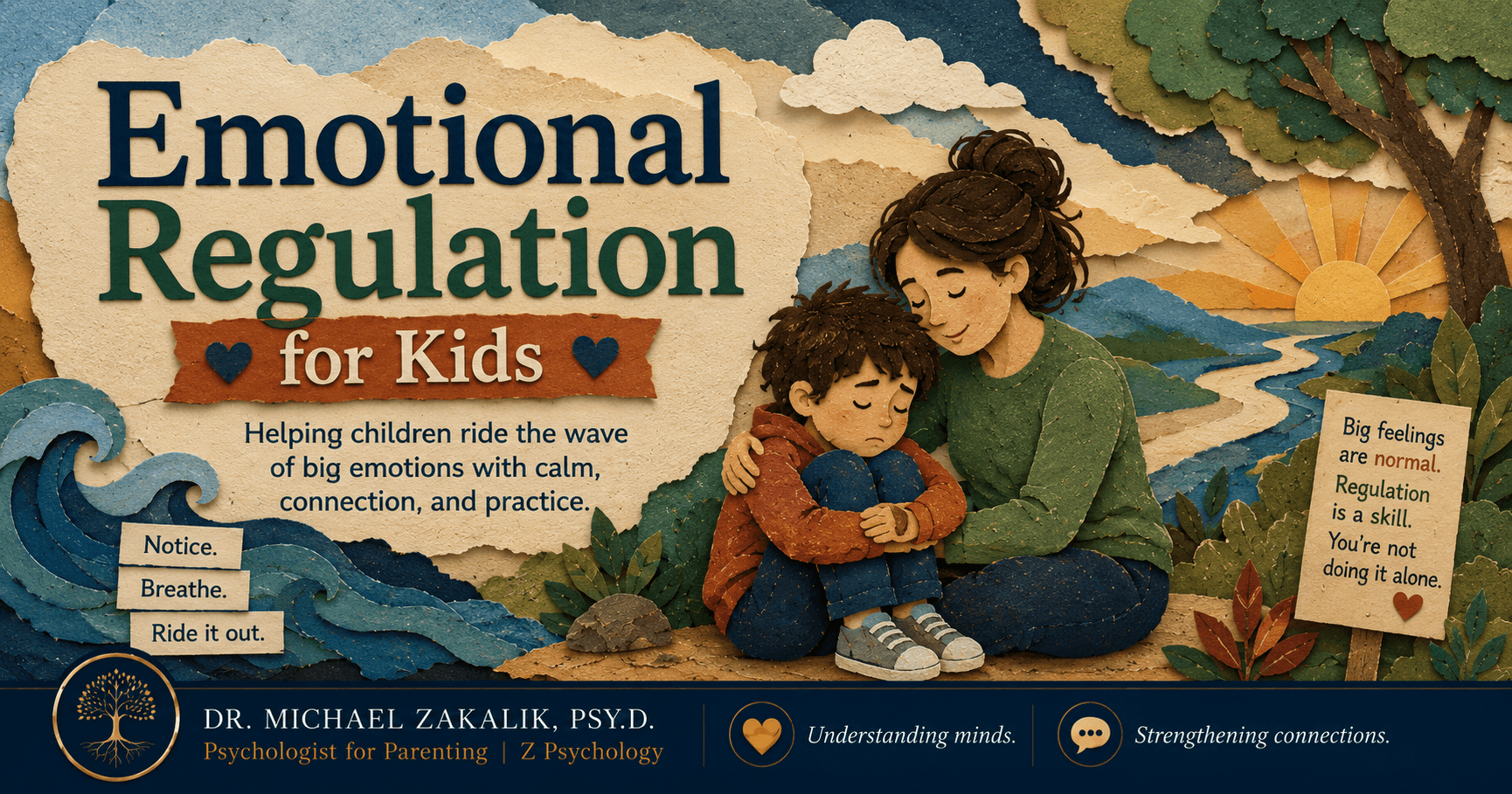
Regulation is not about making big feelings disappear, it is riding the wave without capsizing.
(Disclaimer: The articles provided on this website are for informational and enhancing mental health awareness purposes only. They are not intended to be clinical interventions or provide medical advice. If you have any concerns about your well-being and/or well-being of others, please seek guidance from a qualified professional, such as a physician, psychologist, or counselor. If you are experiencing a clinical emergency please call 911 or 988 or go to the nearest emergency room. Here are some national and international helplines.)
By Dr. Michael Zakalik, Licensed Clinical Psychologist
Part of Dr. Z's Toolbox.
Emotional Regulation for Kids: A Parent Guide
Naming a feeling is step one. Step two is the question every parent eventually asks: okay, but what do we actually do with it? A child can know they are furious and still hurl the controller across the room. Emotional regulation is the set of skills that lives in that gap, between feeling something big and choosing what to do about it.
Here is the part that takes the pressure off. Regulation is not about making big feelings disappear. Anger, fear, and disappointment are supposed to be there. Regulation is about riding the wave without capsizing, and like any skill, it is built through practice and a calm adult nearby.
What is emotional regulation?
Emotional regulation is the ability to manage the intensity of a feeling so it does not take over. For kids, it looks like calming down after getting upset, soothing themselves, and staying in control of their actions even when the feeling is strong. It does not mean bottling emotions up. It means handling them, and it is a core part of emotional intelligence.
Why it matters
A child who can regulate can think, learn, and stay connected to others even when upset. A child who cannot is at the mercy of every wave. The reassuring news from brain science is that the regulation system is one of the slowest parts to mature, which means almost every young child struggles with it, and almost every child gets better with support.
"Big feelings are like waves in the ocean. You can learn to ride the wave instead of getting knocked over, and every wave always gets smaller in the end."
How to explain it to your child
Big feelings are like waves in the ocean. You cannot stop a wave from coming, and you would not want to. But you can learn to ride it instead of getting knocked over. Taking a slow breath, stomping it out, or asking for a hug are all ways of riding the wave until it gets smaller. And every wave, even the biggest one, always gets smaller in the end.
What it looks like in real life
Your daughter is mid-meltdown over the wrong-colored cup. The temptation is to reason with her, but a flooded brain cannot hear logic. The first move is co-regulation: your calm becomes the thing she borrows. Lower your voice, get down to her level, and ride it out with her. The teaching happens later, once the wave has passed, when you can talk about what helped. Trying to teach during the storm is like trying to read a map in a hurricane.
Try it together: activities by age
Build the skill in small, everyday moments. By age:
- Ages 3 to 5. Belly breathing: practice slow breaths when everyone is calm, like blowing out a pretend candle or smelling a flower, because a skill rehearsed in calm is available in chaos. A calm spot: make a cozy corner with soft things they can choose to visit when feelings get big, framed as a tool they get to use, never a punishment.
- Ages 6 to 8. Name the size: help them rate the feeling from 1 to 5, then match the response to the size, since not every feeling needs the same-sized reaction. Move it out: offer physical outlets for big energy, jumping, dancing, squeezing a pillow, running in the yard, because feelings often need to move through the body before they settle.
- Ages 9 to 12. The pause plan: make a simple plan together for what to do when they feel themselves heating up, step away, breathe, come back, since having a plan ready beats inventing one mid-storm. Spot the early signs: talk about the body's early warning signs, like a hot face or clenched fists, so they can catch a feeling before it peaks, because caught early, a feeling is far easier to manage.
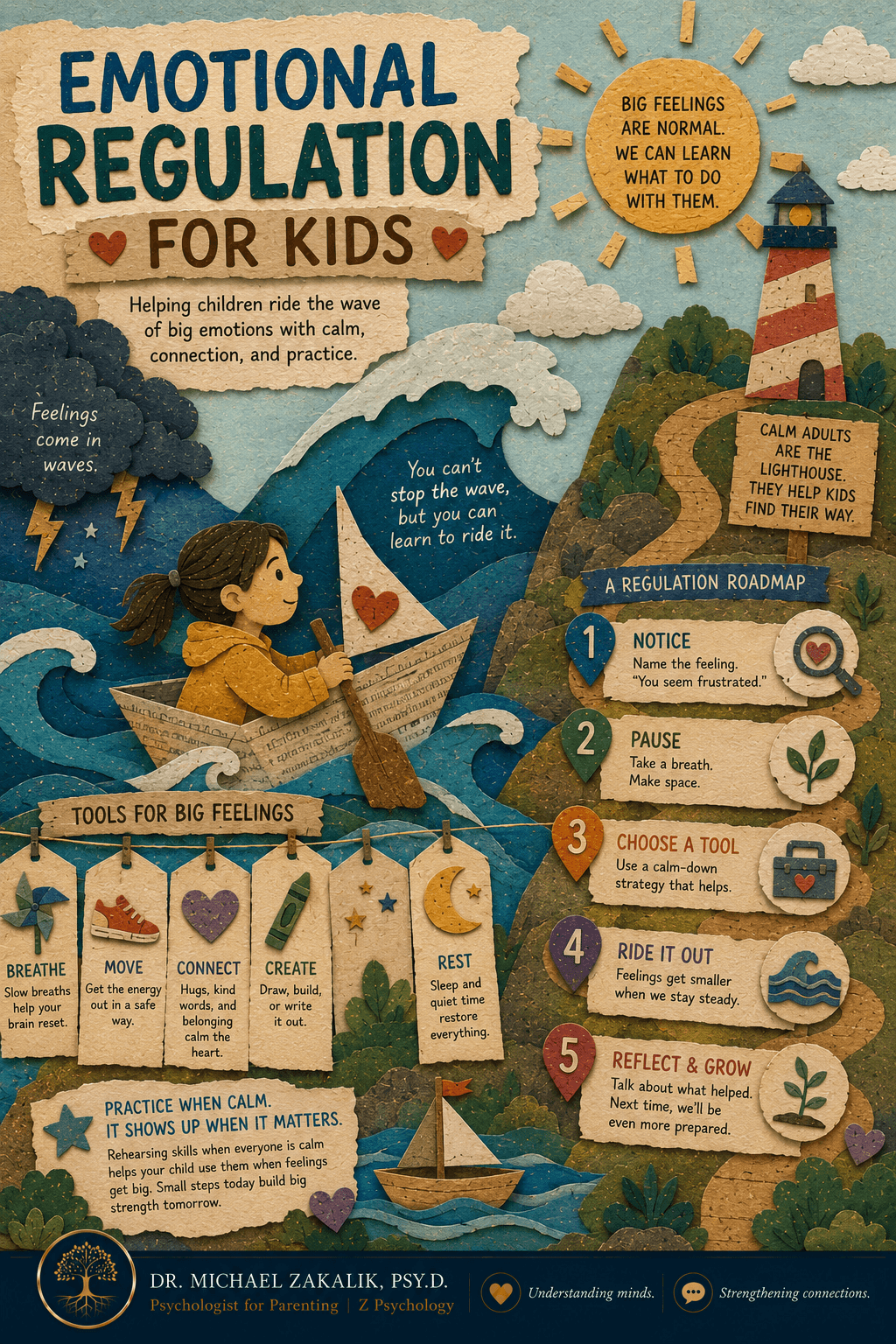
Try this: pick one calming tool, belly breathing, a hug, or a cozy calm spot, and rehearse it together tonight while everyone is calm. A skill practiced in calm is the one that shows up in chaos.
Frequently asked questions
At what age can kids regulate their emotions?
It develops slowly. Toddlers and preschoolers lean heavily on adults to co-regulate, meaning they borrow your calm. True independent self-regulation keeps maturing through childhood and well into the teens, so patience and support matter more than high expectations.
What is co-regulation?
Co-regulation is when a calm adult helps a child settle by lending their own steadiness through a soothing voice, presence, and tone. It is how children gradually learn to regulate themselves. You are the external version of the skill they are still building inside.
Is it bad to let my child feel big emotions?
Not at all. Feeling emotions fully is healthy, and the goal is never to switch them off. Regulation is about managing how a feeling is expressed and how long it runs the show, not about treating the feeling as wrong.
Free download: Emotional Regulation for Kids Family Discussion Guide
Calm-down tools and age-by-age ways to help your child ride out big feelings at home.
Download the guide (PDF)Enjoyed this? Explore more of Dr. Z's Toolbox