
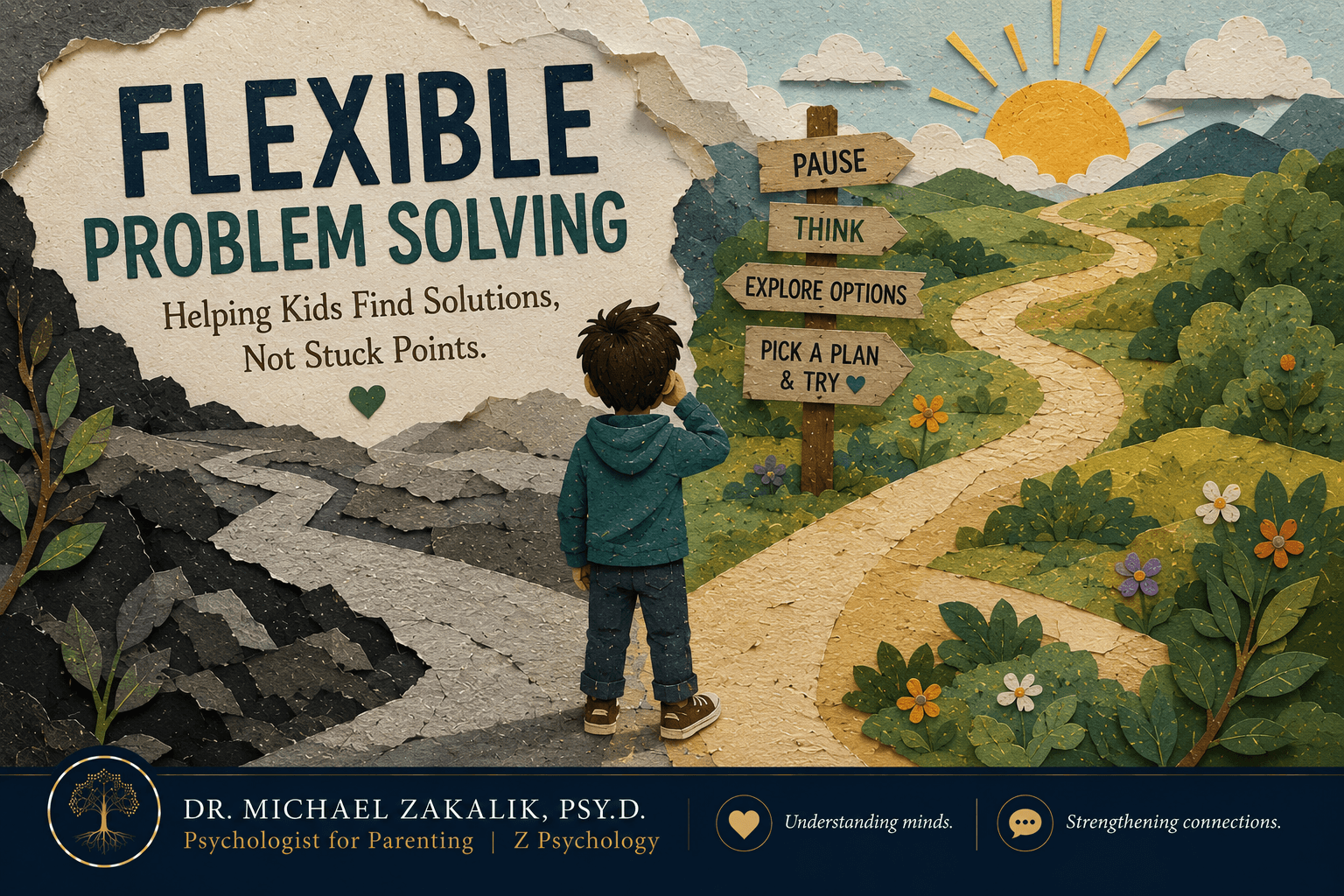
A child who believes there is always another way to try keeps going. That belief can be taught.
(Disclaimer: The articles provided on this website are for informational and enhancing mental health awareness purposes only. They are not intended to be clinical interventions or provide medical advice. If you have any concerns about your well-being and/or well-being of others, please seek guidance from a qualified professional, such as a physician, psychologist, or counselor. If you are experiencing a clinical emergency please call 911 or 988 or go to the nearest emergency room. Here are some national and international helplines.)
By Dr. Michael Zakalik, Licensed Clinical Psychologist
Part of Dr. Z's Toolbox.
Flexible Problem Solving for Kids: Another Way
Picture two kids whose block towers just fell. One bursts into tears, certain the tower is impossible. The other tilts their head, mutters "hmm," and tries a wider base. Same fallen tower, two completely different futures, and the difference is a skill: flexible problem solving, the ability to try another way when the first way fails.
This is cognitive flexibility put to work. A child who believes there is only one right way hits a wall and stops. A child who believes there is always another way to try keeps going. That belief, and the habit that grows from it, can be taught right at the kitchen table.
What is flexible problem solving?
Flexible problem solving is the ability to come up with more than one approach to a problem and to switch strategies when the first one does not work. In kids it looks like trying a different way to build, to solve, to ask, or to fix, instead of giving up or melting down when attempt number one fails. It is curiosity and persistence working together.
Why it matters
Life is a long series of first attempts that do not work. A child armed with "let me try another way" meets frustration as a puzzle rather than a wall. This skill sits underneath everything from homework to friendships to handling the small daily disappointments that otherwise become meltdowns. It leans on the same executive function muscles that help a child hold a goal in mind and shift gears. It is also a quiet confidence builder, because each solved problem proves they can find a way.
"Smart problem solvers are not the ones who get it right the first time. They are the ones who keep trying different keys until one works."
How to explain it to your child
When something does not work, it does not mean you are stuck. It means the first key did not fit the lock, so it is time to try a different key. Smart problem solvers are not the ones who get it right the first time. They are the ones who keep trying different keys until one works. There is almost always another key.
What it looks like in real life
Your son is stuck on a puzzle and the frustration is rising toward a tantrum. Every cell in you wants to lean over and place the piece. Resist, just for a moment, and ask one question instead: "What is a different way we could try?" Maybe turn the piece, maybe start with the edges. Offering a choice of strategies also sidesteps a lot of power struggles, because the child stays in the driver's seat. The goal is not to solve the puzzle for him. It is to teach the move of reaching for a second strategy, which is worth far more than a finished puzzle.
Try it together: activities by age
Grow the "try another way" habit in small, everyday moments. By age:
- Ages 3 to 5. More than one way: when you do everyday things, point out different ways to do them, two paths to the park, two ways to stack the cups, since the world is full of options once you look. What else could we try: when something small does not work, ask the question out loud and brainstorm together, modeling the search for option two.
- Ages 6 to 8. Brainstorm three: when a problem comes up, challenge them to think of three possible solutions before picking one, since quantity first and judgment later is how good problem solving works. Let them struggle a little: resist solving things instantly, because a little productive frustration with you nearby is where problem solving muscles actually grow.
- Ages 9 to 12. What is the real problem: coach them to name the problem clearly before solving it, since a well defined problem is half solved and older kids can learn to slow down at the start. Try, check, adjust: frame problem solving as a loop, try something, see if it worked, change it if it did not, the way scientists and engineers actually think.
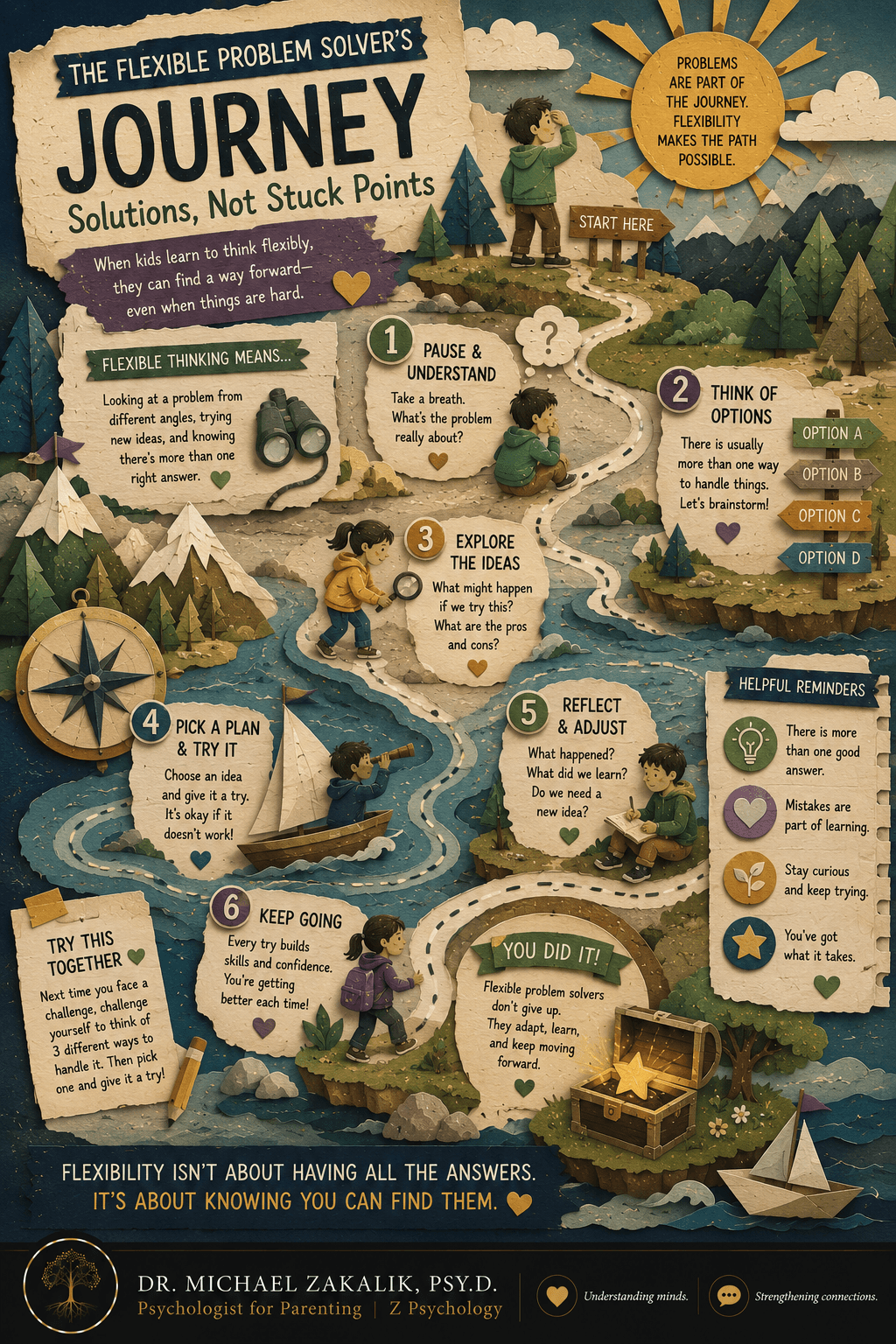
Try this: the next time your child hits a small snag, hold back the fix and ask one question, "What is a different way we could try?" Then brainstorm two or three options together before anyone picks. You are teaching the move, not the answer.
Frequently asked questions
How do I teach my child problem solving skills?
Resist solving things for them, and instead ask questions that prompt their own thinking, like "What is another way we could try?" Brainstorm options together, and let them experience small, manageable struggles. The skill grows from guided practice, not from being handed answers.
My child gives up the instant something is hard. What helps?
Treat the giving up as a missing skill rather than a flaw. Keep first steps small, stay nearby for support, and celebrate attempts and strategies rather than only success. Confidence in problem solving is built by surviving small struggles, not by avoiding them.
Should I let my child fail?
Small, safe failures are some of the best learning there is. Rescuing a child from every difficulty removes the very practice that builds resilience and problem solving. The goal is not to engineer failure, but to allow manageable struggle with you alongside them.
Free download: Try Another Key Family Discussion Guide
Simple, age-by-age ways to help your child reach for a second strategy instead of giving up.
Download the guide (PDF)Enjoyed this? Explore more of Dr. Z's Toolbox