
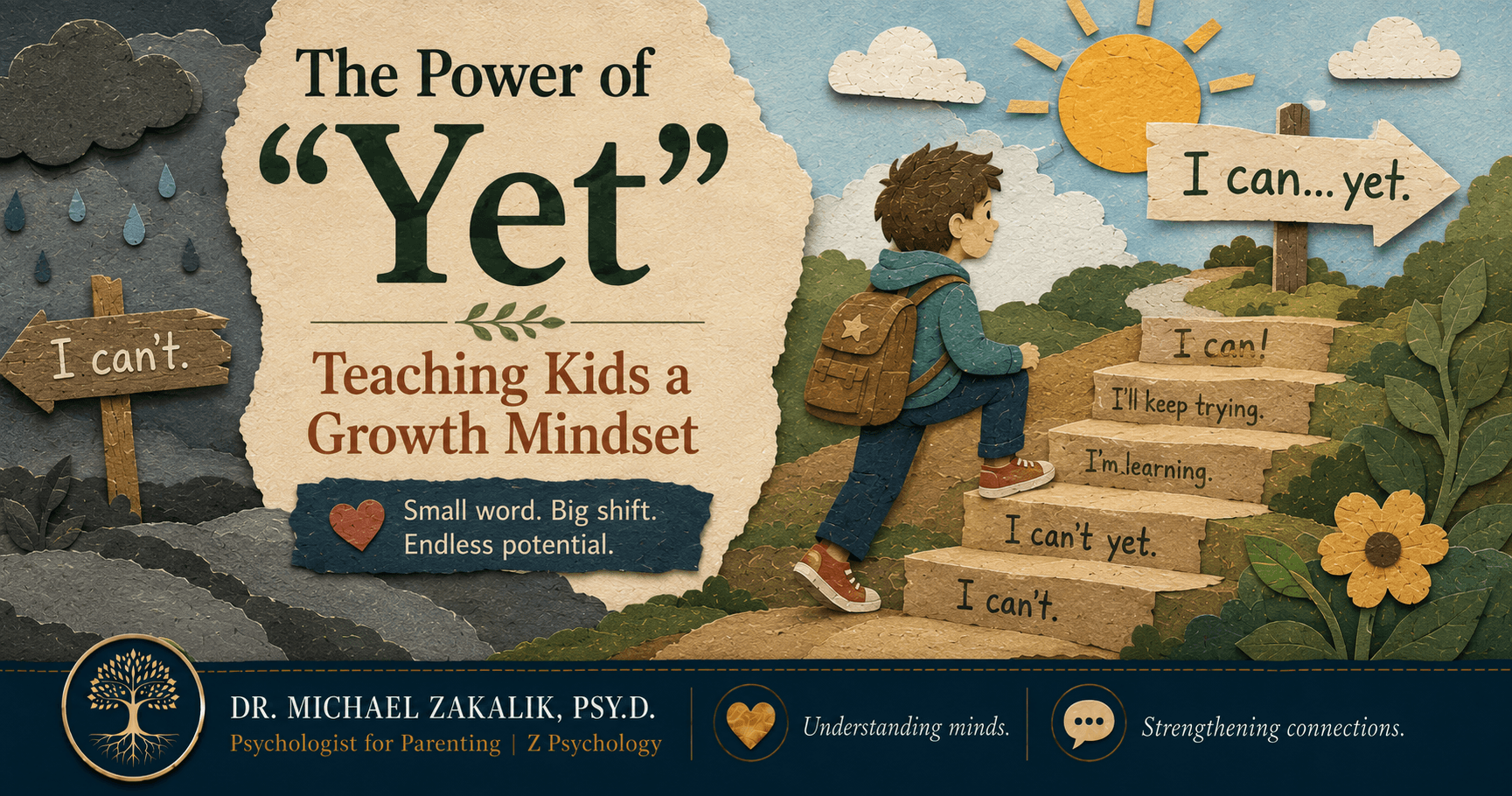
I can't ride a bike is a wall. I can't ride a bike yet is a road.
(Disclaimer: The articles provided on this website are for informational and enhancing mental health awareness purposes only. They are not intended to be clinical interventions or provide medical advice. If you have any concerns about your well-being and/or well-being of others, please seek guidance from a qualified professional, such as a physician, psychologist, or counselor. If you are experiencing a clinical emergency please call 911 or 988 or go to the nearest emergency room. Here are some national and international helplines.)
By Dr. Michael Zakalik, Licensed Clinical Psychologist
Part of Dr. Z's Toolbox.
Growth Mindset for Kids: A Parent's Guide
Few three-letter words do as much work as "yet." "I can't ride a bike" is a wall. "I can't ride a bike yet" is a road. Same child, same bike, completely different relationship to the struggle in front of them. Teaching a child to add that one word to the end of their frustrations is one of the highest-leverage things a parent can do.
It works because it changes what a hard moment means. And what a hard moment means turns out to decide almost everything about whether a child keeps trying or quits, which is also why it sits so close to a child's confidence.
What is a growth mindset?
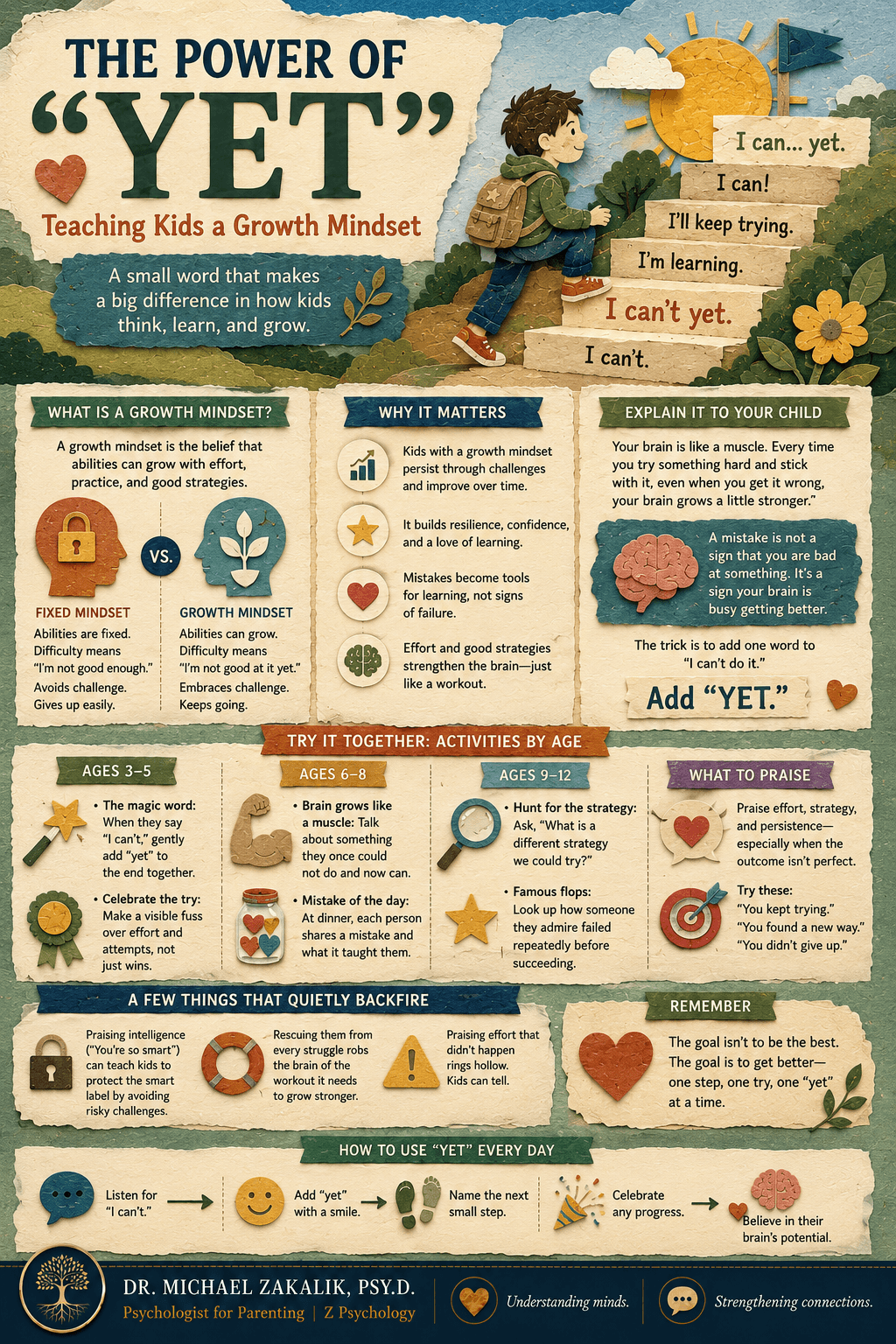
A growth mindset is the belief that abilities can grow with effort, practice, and good strategies, rather than being fixed traits you are simply born with or without. A child with a growth mindset sees a hard task as something to get better at. A child with a fixed mindset sees that same task as a test of whether they are smart or not, and that fear makes them want to avoid it. The idea comes from decades of research by psychologist Carol Dweck and others, and the practical takeaway is sturdy: how a child explains their struggles shapes whether they persist through them.
Why it matters
The mindset a child holds quietly decides what they do when things get hard, and things always get hard eventually. A fixed mindset turns difficulty into a threat: if I have to work this hard, maybe I am just not smart. So the child protects their self-image by giving up, dodging challenge, or hiding mistakes. A growth mindset turns the same difficulty into information: this is hard because I am still learning it, so I keep going. Over years, that difference compounds. The child who treats effort as the path tends to improve. The child who treats effort as proof of being dumb tends to stall. Mistakes in particular stop being catastrophes and become the actual mechanism of learning, a shift that also leans on the planning and follow-through skills a child uses to try a second time.
How to explain it to your child
Your brain is like a muscle. Every time you try something hard and stick with it, even when you get it wrong, your brain actually grows a little stronger. So a mistake is not a sign that you are bad at something. It is a sign your brain is busy getting better. The trick is to add one word to "I can't do it." Add "yet." That single word turns a closed door into a door that is simply still shut for now.
What it looks like in real life
Your daughter slams her pencil down: "I'm terrible at math." The instinct is to reassure: "No you're not, you're great!" But that aims at the wrong thing, because she just told you she believes math ability is fixed, and you only argued about which fixed box she belongs in. The growth-mindset response goes after the belief itself: "You're not terrible at math. You haven't learned this part yet. Let's find the spot that's tripping you up." You moved her from a verdict to a process. And notice which praise helps along the way. "You found three different ways to try that" builds a growth mindset. "You're so smart" quietly builds a fixed one, because it teaches that being smart is the prize, and hard things put the prize at risk. How she narrates the moment to herself matters too, which is why a growth mindset and kind self-talk grow up together.
"You found three different ways to try that builds a growth mindset. You're so smart quietly builds a fixed one."
Try it together: activities by age
Build the skill in small, everyday moments. By age:
- Ages 3 to 5. The magic word: when they say "I can't," gently add "yet" to the end together, a small, almost silly ritual that plants a very large idea. Celebrate the try: make a visible fuss over effort and attempts, not just wins, so "you kept going even when the tower fell" teaches that trying is the thing worth doing.
- Ages 6 to 8. Brain grows like a muscle: talk about something they once could not do and now can, like tying shoes or reading a word, because concrete proof that their own brain has grown is wildly motivating. Mistake of the day: at dinner, each person shares a mistake and what it taught them, making mistakes ordinary and removing their sting.
- Ages 9 to 12. Hunt for the strategy: when they are stuck, resist jumping to the answer and ask, "What is a different strategy we could try?", teaching that ability is about approach, not a fixed ceiling. Famous flops: look up how someone they admire failed repeatedly before succeeding, because athletes, inventors, and authors all have a pile of failures behind them, and seeing it reframes their own.
A few things that quietly backfire
Praising intelligence ("You're so smart") is the classic trap, because it teaches kids to guard the smart label by avoiding anything risky. Rescuing them from every struggle robs the brain of the workout, the same instinct that fuels everyday power struggles. And praising effort that did not actually happen rings hollow, because kids can tell. The aim is honest, specific recognition of real effort and real strategies, especially when the outcome was not perfect.
Try this: at dinner tonight, make it "Mistake of the Day." Each person, grown-ups first, shares one mistake they made and what it taught them. You're quietly teaching your child that mistakes are how brains grow, not proof that something is wrong with them.
Frequently asked questions
What is the difference between a growth mindset and a fixed mindset?
A growth mindset is the belief that abilities grow with effort and practice. A fixed mindset is the belief that abilities are set traits you either have or do not. The same hard task feels like an opportunity to the first child and a threat to the second.
Can I accidentally give my child a fixed mindset?
It is easy to do without meaning to, usually through praise. Telling a child they are smart or gifted, over and over, can quietly teach them that ability is fixed and must be protected. Praising effort, strategy, and persistence instead points them the other way.
My child gives up the moment something is hard. What do I do?
Treat the giving up as a mindset rather than a character flaw. Add "yet" to their "I can't," praise the attempt rather than the result, and break the hard thing into a piece small enough to succeed at. Confidence grows from surviving difficulty, not from avoiding it.
Is a growth mindset just telling kids to try harder?
No, and that is a common misunderstanding. Effort matters, but so do strategies and help. Telling a stuck child to simply try harder, with no new approach, can backfire. A real growth mindset includes finding a different way, not only pushing harder on the same one.
Free download: Growth Mindset Family Discussion Guide
A kid-friendly explainer on the power of yet, plus three activities you can start at dinner tonight.
Download the guide (PDF)Enjoyed this? Explore more of Dr. Z's Toolbox