

Starting is like jumping into a cold pool. The hardest part is the very first second. Once you are in, your body does the rest.
(Disclaimer: The articles provided on this website are for informational and enhancing mental health awareness purposes only. They are not intended to be clinical interventions or provide medical advice. If you have any concerns about your well-being and/or well-being of others, please seek guidance from a qualified professional, such as a physician, psychologist, or counselor. If you are experiencing a clinical emergency please call 911 or 988 or go to the nearest emergency room. Here are some national and international helplines.)
By Dr. Michael Zakalik, Licensed Clinical Psychologist
Part of Dr. Z's Toolbox.
How to Help Your Child Start Homework
There is a particular kind of stuck that drives parents up the wall: the child who has the ability to do the thing, knows they have to do the thing, even wants the thing done, and yet cannot seem to begin. They circle the homework like it is electric.
This is not laziness. It is a real executive function hurdle called task initiation, and it has real fixes.
What is task initiation?
Task initiation is the ability to get started on something without endless delay, especially when the task is boring, hard, or not your idea. For kids it is the gap between "I should start my homework" and actually picking up the pencil. For some children that gap is small. For others it is a canyon.
Why it matters
Getting started is often the single hardest moment of any task. Once a child is moving, momentum usually carries them. The freeze at the beginning, though, can wreck homework, chores, and mornings, and it is easily misread as defiance or laziness when it is really a stuck starter. It is closely tied to impulse control, because the same brain systems that help a child resist a distraction help them lean into a hard start. Helping a child begin is often more useful than any amount of pushing.
How to explain it to your child
Starting is like jumping into a cold pool. The hardest part is the very first second, when you are standing at the edge. Once you are in, it is fine, sometimes even great. So the trick is not to talk yourself into loving the pool. The trick is just to get the first toe in, because after that, your body does the rest.
What it looks like in real life
Your son has twenty minutes of reading to do and has spent forty minutes not doing it. Pushing harder ("Just start!") rarely works, because the problem is the starting itself. Shrink the first step until it is almost silly: "Just read one page," or "Let's set a timer for two minutes and stop when it rings." Lowering the cost of beginning is the whole game. Once the toe is in, the rest usually follows.
Try it together: activities by age
Build the skill in small, everyday moments. By age:
- Ages 3 to 5. Start it together: do the first tiny bit alongside them, then step back, because your presence lowers the cost of beginning for a young child. Make starting a game: "Can you beat me to putting on one sock?" Turning the start into play sidesteps the freeze entirely.
- Ages 6 to 8. The two minute start: agree to do just two minutes of the dreaded task, with permission to stop after, because starting is the hard part and two minutes almost always turns into more. Tiny first step: shrink the first step until it feels too small to refuse, like open the book, write your name, get out one pencil, and momentum builds from there.
- Ages 9 to 12. The launch ritual: build a consistent starting routine, like clear the desk, fill the water bottle, set a timer, go, because a ritual removes the daily negotiation about beginning. Pair it with something good: let them pair a boring task with something pleasant, like music while cleaning, because making the start less unpleasant makes it easier to take.
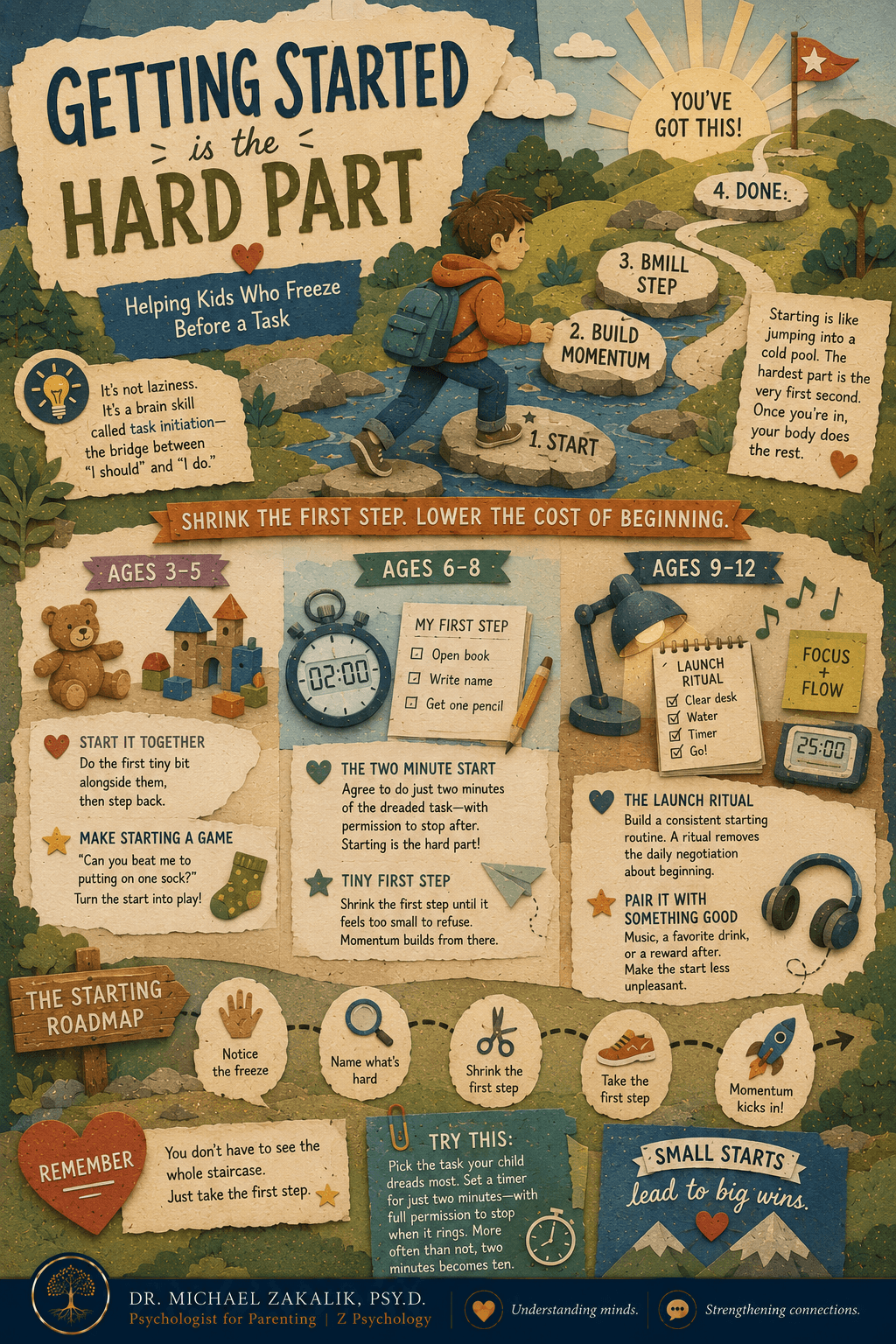
"Shrink the first step until it is almost silly. Lowering the cost of beginning is the whole game."
Try this: tonight, pick the task your child dreads most and set a timer for just two minutes, with full permission to stop when it rings. Do not aim for finished. Aim only for started. More often than not, two minutes becomes ten.
Frequently asked questions
Why does my child struggle to start tasks even when they can do them?
Because the skill of starting is separate from the skill of doing. Task initiation is an executive function that can lag behind ability, which is why a capable child can still freeze at the beginning. It is a real hurdle, not an attitude problem.
Is this just procrastination or laziness?
It looks like both but is usually neither. A genuine difficulty getting started is an executive function challenge, common in many children and especially in those with attention differences. Treating it as laziness tends to add shame without fixing the problem.
What actually helps a child get started?
Shrink the first step until it is tiny, set a short timer with permission to stop, build a consistent starting ritual, and reduce distractions at the launch point. The aim is to lower the cost of that first second, since that is where the difficulty lives.
Free download: Getting Started Family Discussion Guide
Simple, age-by-age ways to shrink the first step and help a stuck starter get one toe in.
Download the guide (PDF)Enjoyed this? Explore more of Dr. Z's Toolbox