
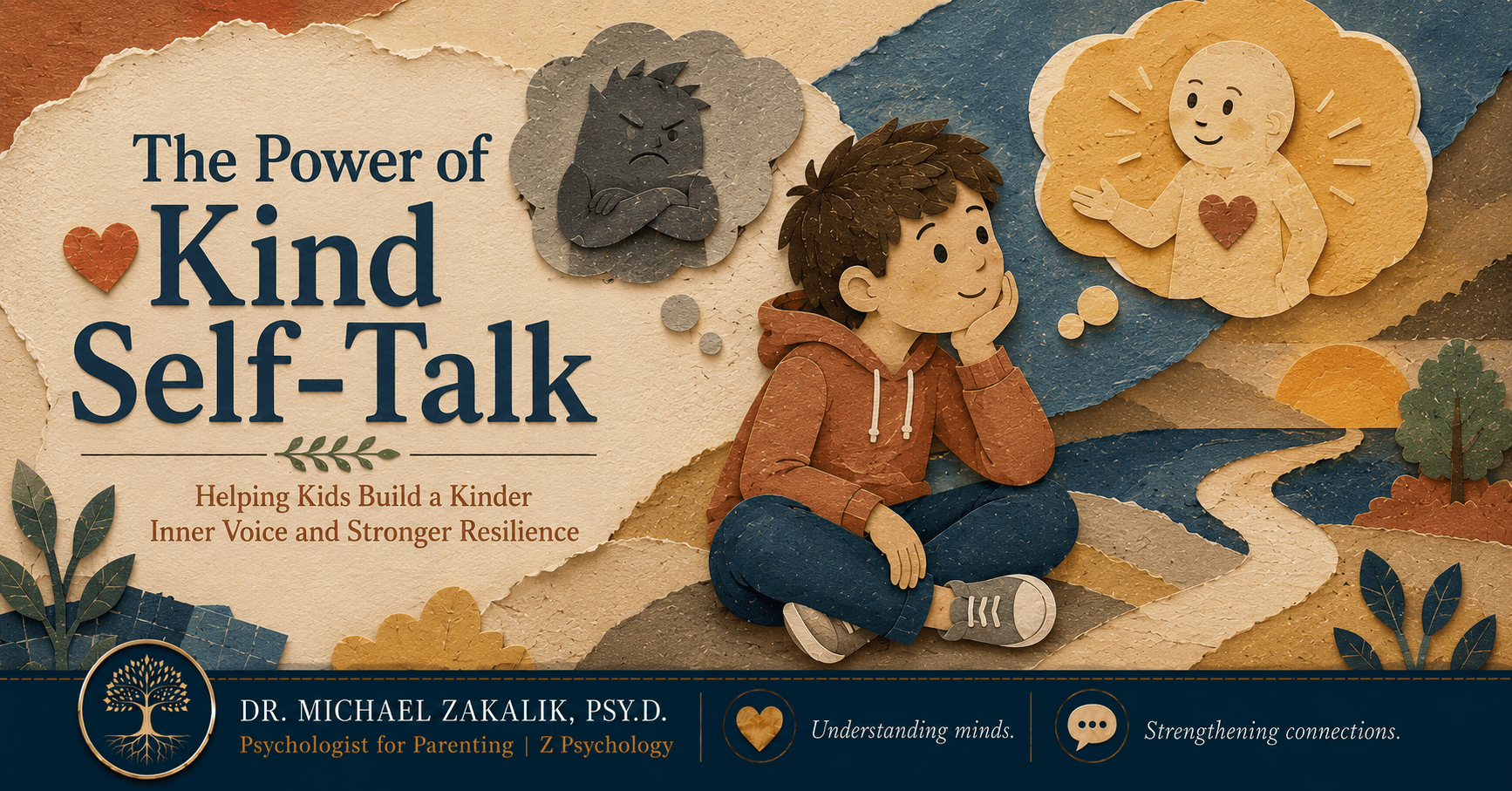
Kind self-talk isn't pretending everything is wonderful. It's talking to yourself the way a good friend would: honest, but on your side.
(Disclaimer: The articles provided on this website are for informational and enhancing mental health awareness purposes only. They are not intended to be clinical interventions or provide medical advice. If you have any concerns about your well-being and/or well-being of others, please seek guidance from a qualified professional, such as a physician, psychologist, or counselor. If you are experiencing a clinical emergency please call 911 or 988 or go to the nearest emergency room. Here are some national and international helplines.)
By Dr. Michael Zakalik, Licensed Clinical Psychologist
Part of Dr. Z's Toolbox.
Positive Self-Talk for Kids: A Parent's Guide
Somewhere around age five or six, a narrator moves into your child's head and starts commenting on everything they do. For some kids that voice is a coach. For others it is a critic that says "you're so stupid" the moment they spill the milk.
The remarkable part is that children do not always know the voice is theirs, or that it can be changed. Helping them hear it, and soften it, is a gift that keeps paying out for the rest of their lives.
What is self-talk?
Self-talk is the running inner voice we all use to narrate, judge, and coach ourselves through the day. In kids it often gets said out loud first ("I can't do this!") before it goes underground and becomes the private voice in their head. Kind self-talk is not pretending everything is wonderful. It is talking to yourself the way a good friend would: honest, but on your side.
Why it matters
The way a child talks to themselves shapes how they feel and what they do next. A child whose inner voice says "I always mess up" quits sooner, feels worse, and braces for failure. A child whose voice says "that was hard, let me try again" persists and recovers faster. Self-talk is one of the most direct levers on a child's mood and resilience there is, and it sits right inside their own head, which makes it a cornerstone of emotional intelligence. Harsh self-talk is also closely tied to anxiety and low mood. Learning to notice and answer an unkind inner voice early hands children a tool that some of the most effective therapies for adults are built around. You are essentially teaching a lifelong mental health skill, in kid-sized pieces.
How to explain it to your child
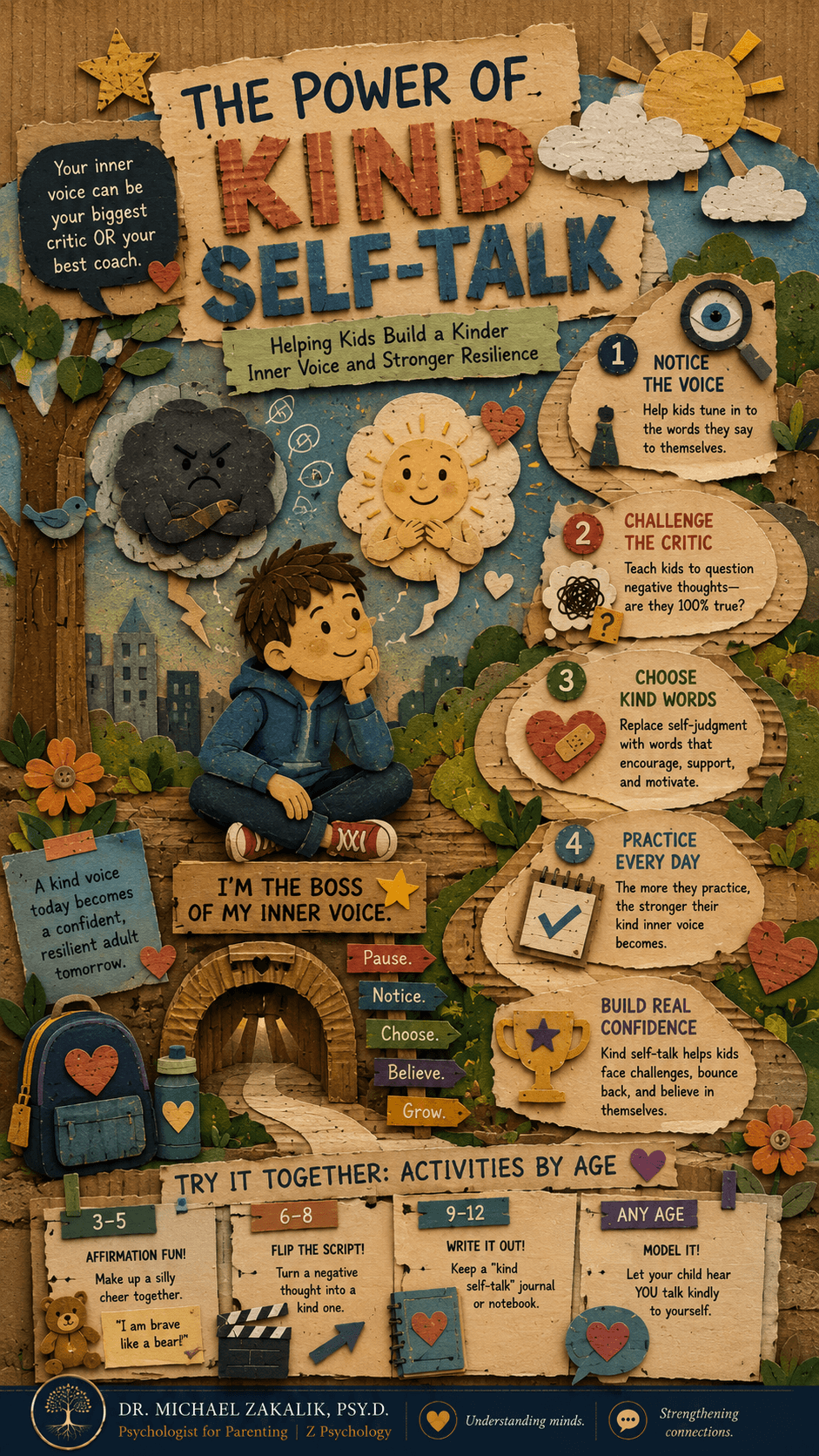
Everybody has a little voice inside their head that talks to them all day. Sometimes it is kind, like a good coach, and sometimes it is mean, like a bully. Here is the secret: you are the boss of that voice. When it says something mean like "you're dumb," you get to talk back and say, "that's not true, I'm still learning." You can teach your voice to be kind. The idea that they are the boss of the voice, rather than the other way around, is the part that sticks.
What it looks like in real life
Your son misses the goal and mutters, "I'm the worst, I always lose." It is easy to let that slide as harmless venting. But that sentence is a belief practicing itself. The move is to make the voice visible and gently question it: "I heard your inner voice being pretty mean just now. Is it true that you always lose? What would you say to a friend who missed that shot?" Kids are almost always kinder to a friend than to themselves, and that gap is the doorway. You are not arguing him into feeling great. You are teaching him that the voice is not the same thing as the truth, and that he is allowed to answer it back, a close cousin of adding the word "yet" to a hard moment.
"You are teaching him that the voice is not the same thing as the truth, and that he is allowed to answer it back."
Try it together: activities by age
Build the skill in small, everyday moments. By age:
- Ages 3 to 5. Name the voice: give the inner voice a simple name or character, so it becomes a thing they can notice rather than just who they are, because even young kids grasp that a "grumpy voice" is talking. Kind coach words: practice a few friendly phrases out loud for hard moments, like "I can try again," which, said often in calm times, tend to show up on their own in hard ones.
- Ages 6 to 8. Talk back: when the mean voice shows up, practice a comeback together, "that is not true, I am still learning," because giving kids a ready script to answer the critic makes the critic far less powerful. Friend test: ask, "Would you say that to your best friend?", since the contrast between how they treat a friend and how they treat themselves is usually striking, and instantly teachable.
- Ages 9 to 12. Catch and check: coach them to catch a harsh thought and check it against the evidence, is it actually true, or just loud, which is the core skill behind the most effective therapies, in plain clothes. Reframe the setback: after a disappointment, practice rewriting the story from "I failed" to "that did not work, here is what I will try next," so the facts stay the same while the meaning changes.
A few things that quietly backfire
Telling a child their harsh thought is silly or wrong only shames the voice further underground. Forcing relentless positivity ("Just think happy thoughts!") teaches them to bury feelings instead of working with them, and kids see right through it. And modeling brutal self-talk yourself, narrating your own mistakes with "I'm such an idiot," teaches more than any lesson you deliver on purpose. The goal is honest and kind, not fake and cheerful, the same honest warmth that builds real confidence.
Try this: next time your child says something harsh about themselves, try the friend test out loud: "Would you say that to your best friend?" Then help them offer themselves the kinder sentence they'd give a friend. You're showing them, in one move, that the inner voice can be answered.
Frequently asked questions
What is positive self-talk for kids?
It is teaching children to talk to themselves in a way that is honest but supportive, the way a good coach or friend would. It does not mean pretending problems away. It means answering a harsh inner voice with something truer and kinder, like trading "I'm dumb" for "I'm still learning this."
My child says "I'm stupid" or "I hate myself." Should I be worried?
Occasional harsh self-talk is common and very teachable. Take it seriously but not fearfully: name the voice, question it gently, and model kinder self-talk yourself. If the comments are frequent or intense, or come with lasting sadness or hopelessness, check in with your pediatrician or a mental health professional, who can help you understand what is going on.
At what age does self-talk develop?
Out-loud self-talk appears in the preschool years, when you hear kids narrate their own play. It gradually goes internal and private during early elementary school. That early window, while the voice is still spoken aloud, is a wonderful time to start shaping it.
How is this different from just being positive?
Being positive can slide into ignoring real feelings. Kind self-talk does the opposite: it acknowledges the hard thing and then responds to it supportively. It is the difference between "everything is fine" and "this is hard, and I can handle hard things."
Free download: Positive Self-Talk Family Discussion Guide
A kid-friendly explainer on the voice in your head, plus three activities you can try this week.
Download the guide (PDF)Enjoyed this? Explore more of Dr. Z's Toolbox