
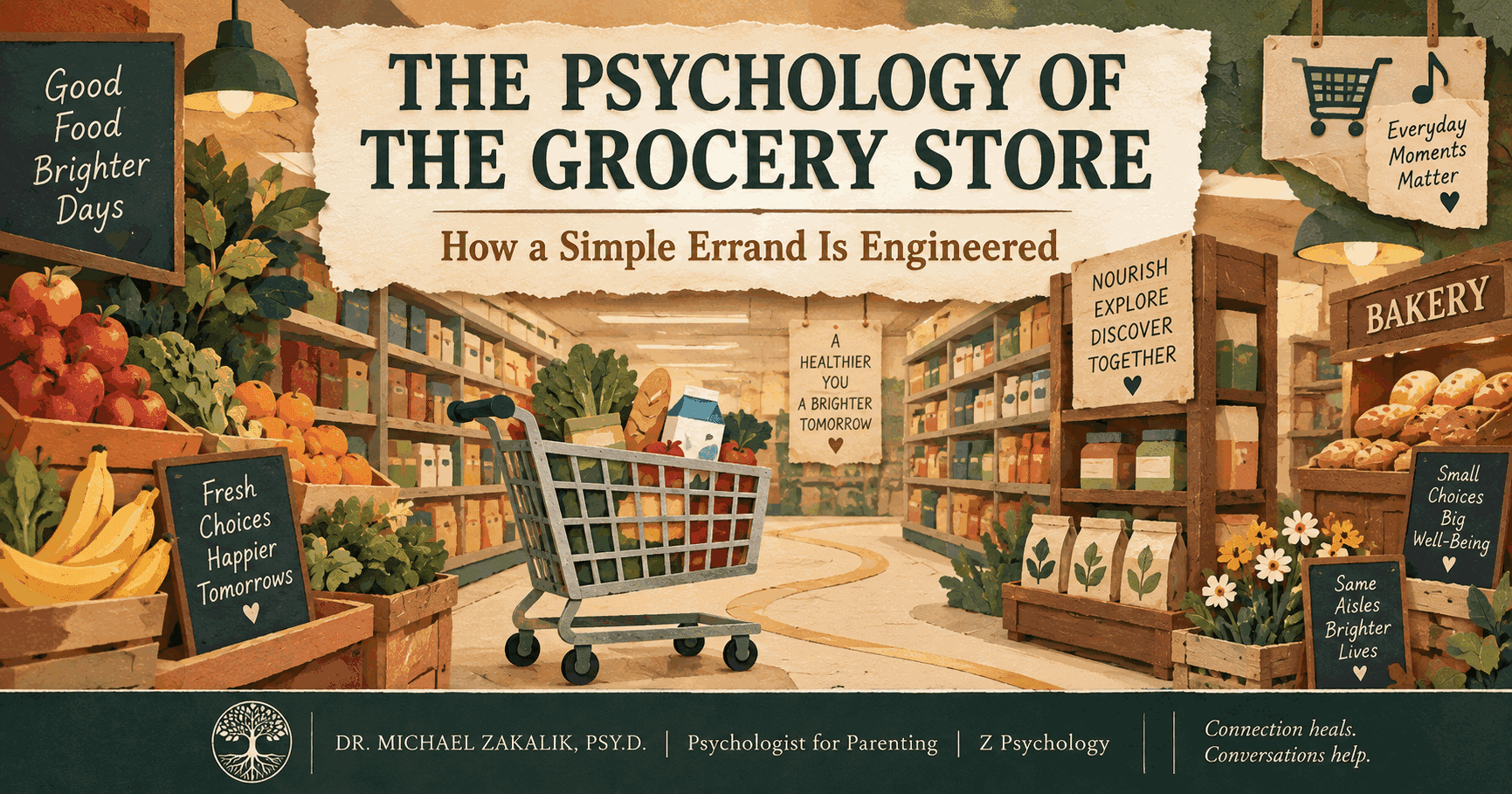
One of the most carefully engineered rooms you walk into every week.
(Disclaimer: The articles provided on this website are for informational and enhancing mental health awareness purposes only. They are not intended to be clinical interventions or provide medical advice. If you have any concerns about your well-being and/or well-being of others, please seek guidance from a qualified professional, such as a physician, psychologist, or counselor. If you are experiencing a clinical emergency please call 911 or 988 or go to the nearest emergency room. Here are some national and international helplines.)
This article is about the psychology of habits and design, for general interest. It is not nutrition or financial advice.
By Dr. Michael Zakalik, Licensed Clinical Psychologist
The Psychology of the Grocery Store: How a Simple Errand Is Engineered
You went in for milk. You came out with a rotisserie chicken, a candle, two kinds of cheese you did not know you wanted, a magazine, and somehow eighty dollars gone. It happens to careful, frugal, list making people constantly, and it is not because you lack willpower. The grocery store is one of the most psychologically engineered spaces you routinely enter, a room designed, down to the shelf height and the tempo of the music, to keep you in it a little longer and send you home with a little more.
None of this is sinister exactly. It is business, and a lot of it is genuinely clever. But once you can see the design, you stop being quite so moved by it. So let us walk the aisles and notice what is actually happening.
A Store Designed to Slow You Down
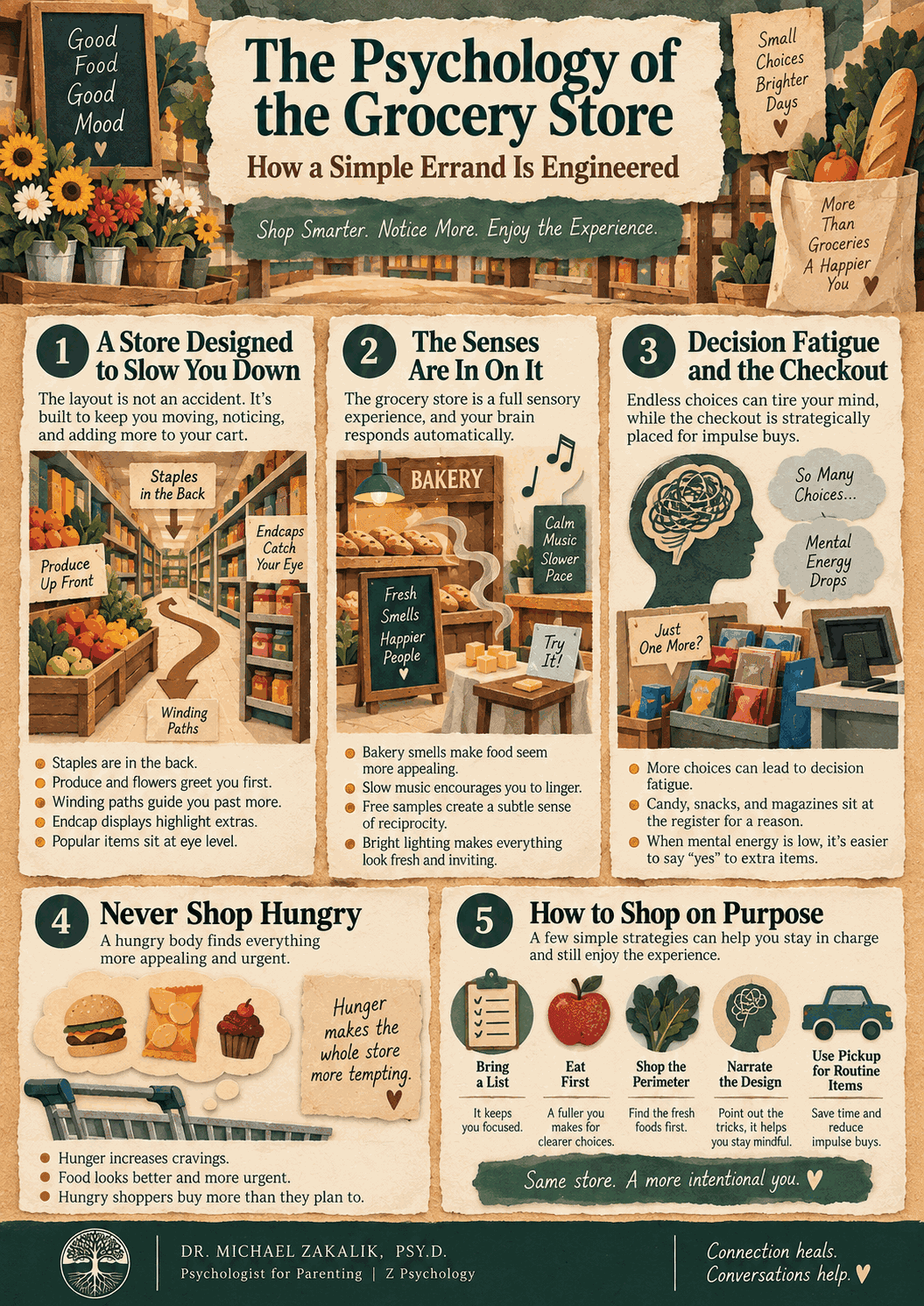
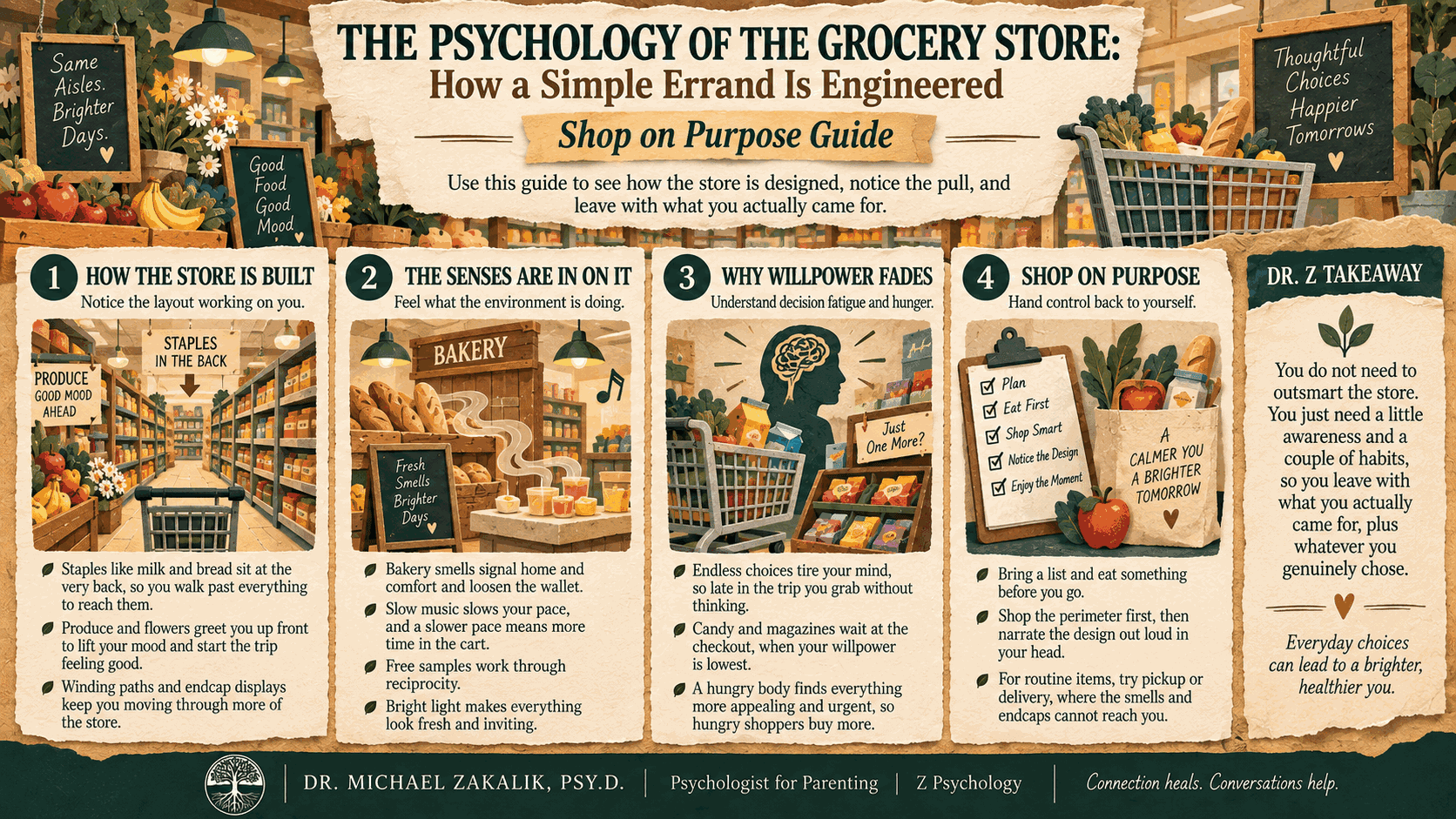
Think about the layout. The milk, the bread, the eggs, the staples almost everyone comes for, are usually pushed to the very back, so that getting them means walking past everything else. The produce and flowers are often right at the entrance, because fresh color and abundance put you in a good, generous mood and let you start the trip feeling virtuous. The path tends to wind rather than run straight, which keeps you moving through more of the store. Endcaps, those displays at the end of each aisle, are prime real estate for things you were not looking for. And the shelves themselves are mapped: the products the store most wants you to buy sit at adult eye level, while the cereal and candy aimed at children sit conveniently at child eye level. Very little about where a thing sits is an accident.
The Senses Are In On It
The design is not only spatial, it is sensory. That bakery smell is often pumped out on purpose, because warm bread signals home and comfort and loosens the wallet. The music is frequently slow, because a slower tempo tends to slow your pace, and a slower pace means more time in the store and more in the cart. Free samples work through simple reciprocity, the deep human pull to give back after we have received. Bright, even lighting makes everything look fresh and appealing. You are not weak for responding to any of this. You are a human being in an environment built by people who understand human beings.
The Paradox of Choice and Decision Fatigue
There is also what all that abundance does to your mind. Forty kinds of pasta sauce feel like freedom, but every choice spends a little mental energy, and by the far end of the store your decision making is genuinely tired. That is why, late in a trip, you start grabbing the familiar brand or tossing in the impulse item without much thought. And it is why the single most tempting spot in the whole store, the checkout lane lined with candy and gum and magazines, comes at the very end, when your willpower is at its lowest and you are standing still with nothing to do but look.
Never Shop Hungry
One more state matters enormously, and you already know it in your bones. Hungry shoppers buy more, and they buy more of the rich, calorie dense, immediate stuff, because a hungry body reads everything as more appealing and more urgent. The oldest piece of grocery advice there is, do not shop on an empty stomach, turns out to be solid psychology. The cart is shaped not just by the store, but by the state you walk in with.
"You are not weak for filling the cart. You are a human being in a room built by people who understand human beings."
It Is Also a Human Place
For all the engineering, the grocery store is not only a machine for selling. It is one of the last places many of us move through in public every week, and it carries a surprising amount of feeling. There is nostalgia in it, the particular smell or layout that drops you back into shopping beside a parent as a child. There is ritual and even comfort in the familiar loop of the aisles. There is small, real human contact with the regular cashier who knows your face. And there is quiet grief in it too, for the person learning to shop for one after a loss, standing in front of a portion size that no longer fits their life. The same ordinary room can be a chore, a comfort, and an ache, sometimes in the same trip.
How to Shop on Purpose
You do not need to outsmart the store. You just need a little awareness and a couple of habits. Bring a list and largely hold to it, because a list is a decision you made while calm, spending on your behalf the willpower you will not have at the checkout. Do not shop hungry. Shop the perimeter first, where the fresh and staple foods tend to live, before you wander the center. Notice the design out loud in your head, because simply naming "that endcap is here to catch me" hands a surprising amount of control back to you. And for the routine, repetitive items, consider ordering online or doing pickup, where the smells and the music and the endcaps cannot reach you. The goal is not to never enjoy the store. It is to leave with what you actually came for, plus whatever you genuinely chose.
Frequently asked questions
- Why do I always overspend at the grocery store?
- Because the store is designed to keep you there and to tempt you, and because decision fatigue and hunger quietly lower your resistance as you go. It is the environment, not a character flaw.
- Does store layout really affect what I buy?
- Yes. Staples in the back, produce and flowers up front, eye-level placement, winding paths, and checkout impulse items are all deliberate and well studied.
- Why should I never shop hungry?
- A hungry body finds food more appealing and more urgent, so hungry shoppers reliably buy more, especially rich and impulse foods. Eating first is one of the simplest ways to shop with a clearer head.
- What is the easiest way to spend less?
- A written list plus not shopping hungry, and using pickup or delivery for routine items so the in-store design has fewer chances to work on you.