
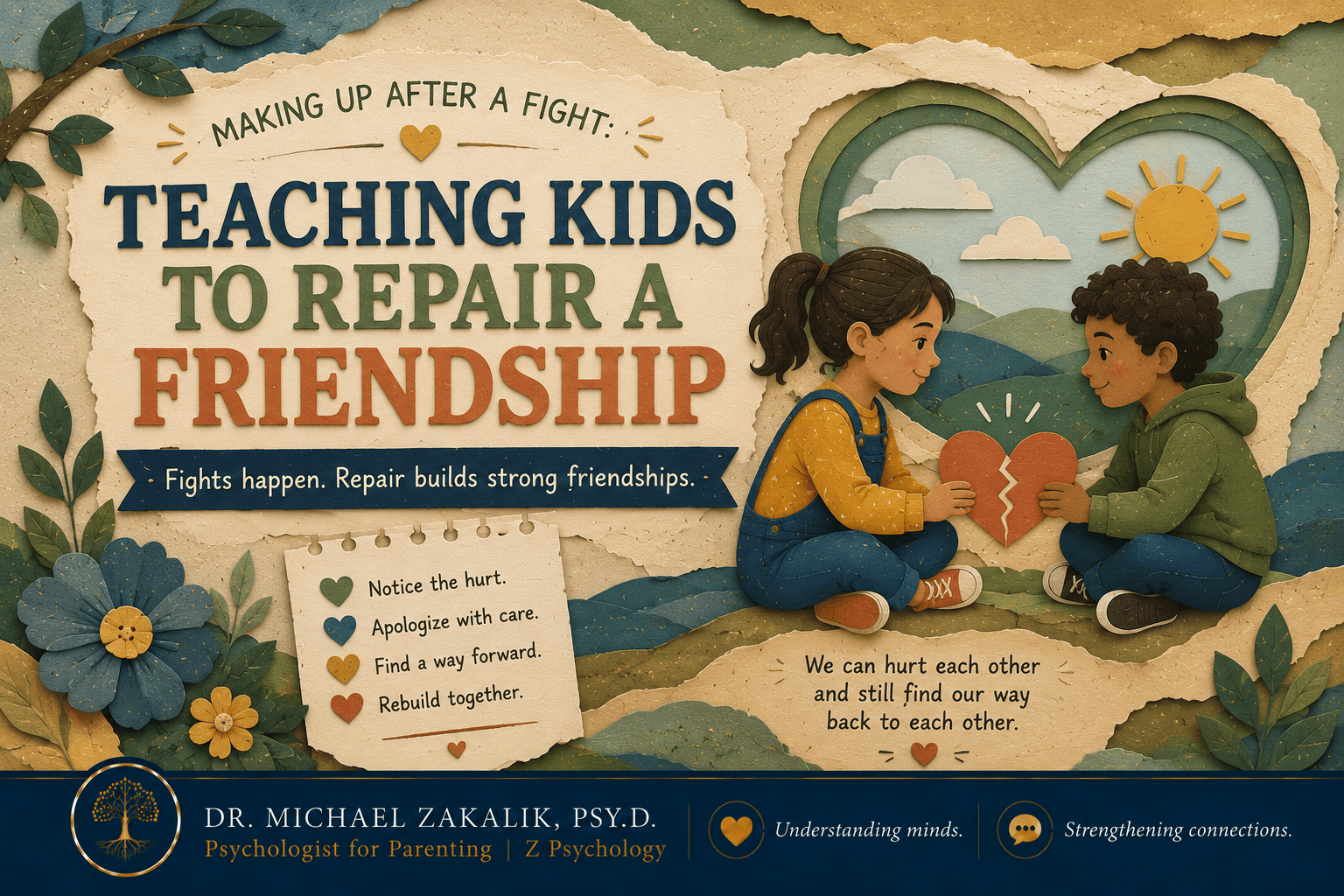
The skill that matters is not avoiding fights. It is knowing how to come back together afterward.
(Disclaimer: The articles provided on this website are for informational and enhancing mental health awareness purposes only. They are not intended to be clinical interventions or provide medical advice. If you have any concerns about your well-being and/or well-being of others, please seek guidance from a qualified professional, such as a physician, psychologist, or counselor. If you are experiencing a clinical emergency please call 911 or 988 or go to the nearest emergency room. Here are some national and international helplines.)
By Dr. Michael Zakalik, Licensed Clinical Psychologist
Part of Dr. Z's Toolbox.
Teaching Kids to Repair a Friendship After a Fight
Two best friends, inseparable on Monday, declaring eternal enemyhood on Tuesday over who got the blue marker. Friendship conflict is not a sign something has gone wrong. It is a sign two humans are sharing space. The skill that matters is not avoiding fights, which is impossible, but repairing them afterward, and repair is something most kids have to be taught.
Many children believe a fight ends a friendship, that once it is broken it stays broken. Teaching them that friendships bend and mend, that you can hurt someone and still find your way back, is one of the most freeing lessons of childhood, and a cornerstone of what makes a good friend.
What is friendship repair?
Friendship repair is the set of skills for fixing a relationship after conflict: noticing the other person was hurt, taking responsibility, making a genuine apology, and finding a way forward. It is not about deciding who won. It is about valuing the friendship more than the fight.
Why it matters
Conflict is unavoidable, so the children who thrive socially are not the ones who never fight. They are the ones who know how to come back together afterward. A child without repair skills may lose friends over fixable moments, or learn to avoid closeness altogether to dodge conflict. Repair is what keeps friendships durable.
How to explain it to your child
Even the best friends in the world have fights sometimes. A fight does not have to be the end. Think of a friendship like a tower of blocks. When a fight knocks some blocks down, you do not throw the whole tower away. You pick the blocks up and build it back together. Saying sorry and meaning it is how you start rebuilding.
"A good apology has three parts: what I did, that I am sorry, and what I will do now."
What it looks like in real life
Your son grabbed a toy and his friend went home upset. The instinct is to march him to a forced "sorry," but a hollow apology teaches performance, not repair. The same idea applies at home between siblings, where forced apologies rarely stick. Slow it down: help him see the other child's feeling first ("How do you think she felt when you grabbed it?"), then build a real apology that names what happened and offers to make it better. A good apology has three parts: what I did, that I am sorry, and what I will do now.
Try it together: activities by age
Build the skill in small, everyday moments. By age:
- Ages 3 to 5. Name the hurt: help them notice when a friend is sad and connect it to what just happened, since seeing the hurt is the first step toward wanting to fix it. Simple sorry: practice a basic apology in calm moments, with words and a kind action like a gentle pat, because young kids do better with apology as something they do, not only say.
- Ages 6 to 8. The three part apology: teach the formula, what I did, I am sorry, here is how I will make it better, since practicing it when calm makes it reachable when upset. Cool down first: teach that you repair after the big feeling settles, not in the middle of it, because trying to make up while still furious rarely works.
- Ages 9 to 12. Hear their side: coach them to actually listen to the friend's view before defending their own, since repair speeds up enormously when the other person feels heard. Repair, not win: talk about the goal being the friendship, not proving who was right, because older kids can grasp that you can lose the argument and keep the friend.
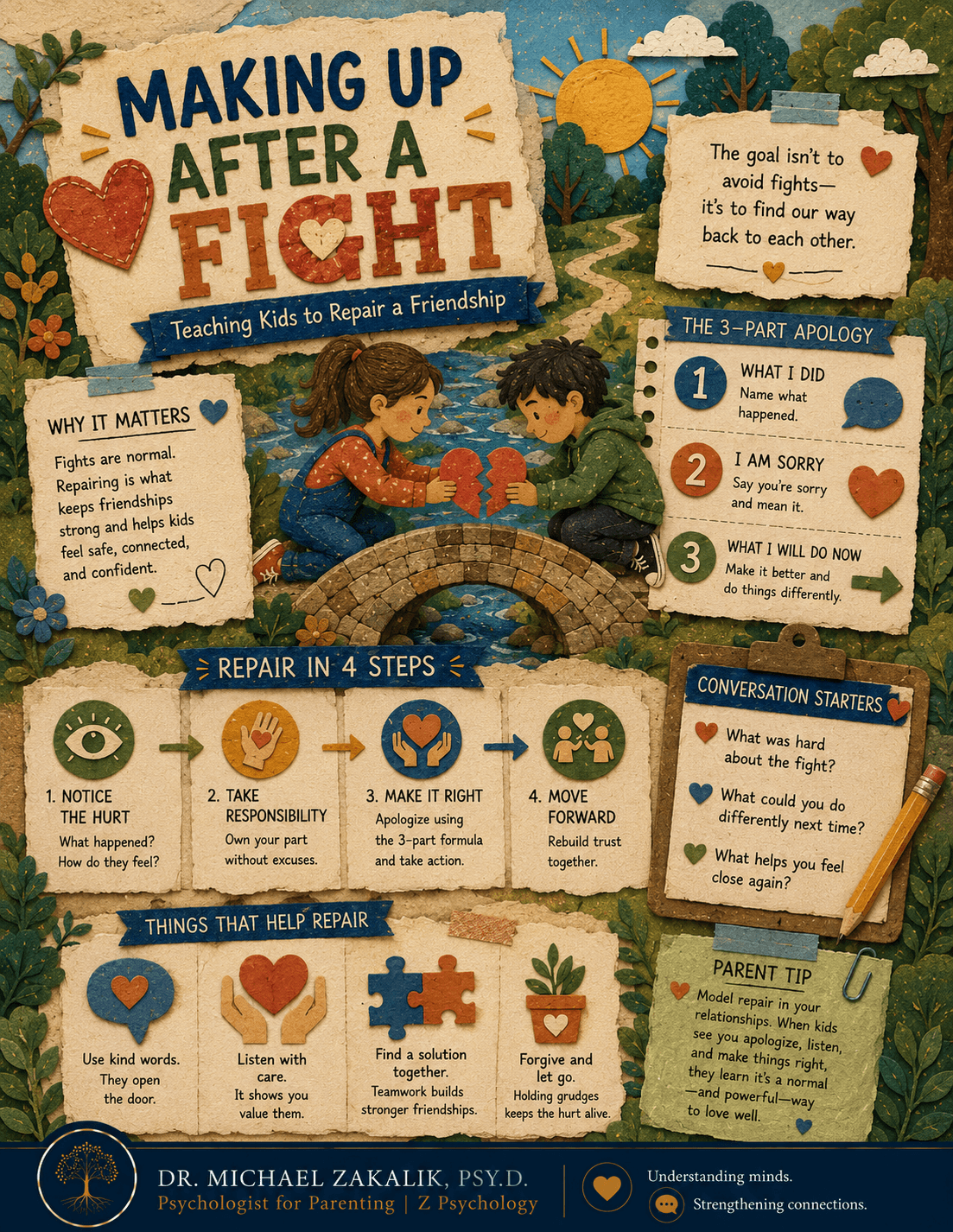
Try this: in a calm moment, practice the three-part apology together so it is ready when it is needed, what I did, I am sorry, and here is how I will make it better. Rehearsing it when nobody is upset makes it reachable when feelings run high.
Frequently asked questions
Should I make my child apologize?
Forced apologies tend to teach performance rather than genuine repair. It is more powerful to help your child understand the other person's feelings first, then guide them toward an apology they actually mean. The understanding is what makes the sorry real.
My kids fight constantly. Is that normal?
Frequent conflict, especially among siblings and close friends, is very normal, and staying calm rather than getting pulled into the yelling helps everyone reset. What matters most is what happens afterward. If they are learning to repair and reconnect, the fighting becomes a training ground rather than a problem.
What makes a good apology for a child?
A genuine apology usually has three parts: naming what they did, expressing real regret, and offering to make it better. Teaching this simple structure gives kids a reliable path back to a friend they have hurt.
Free download: The Three Part Sorry Family Discussion Guide
A simple, age-by-age guide to helping kids cool down, apologize, and rebuild a friendship after a fight.
Download the guide (PDF)Enjoyed this? Explore more of Dr. Z's Toolbox