
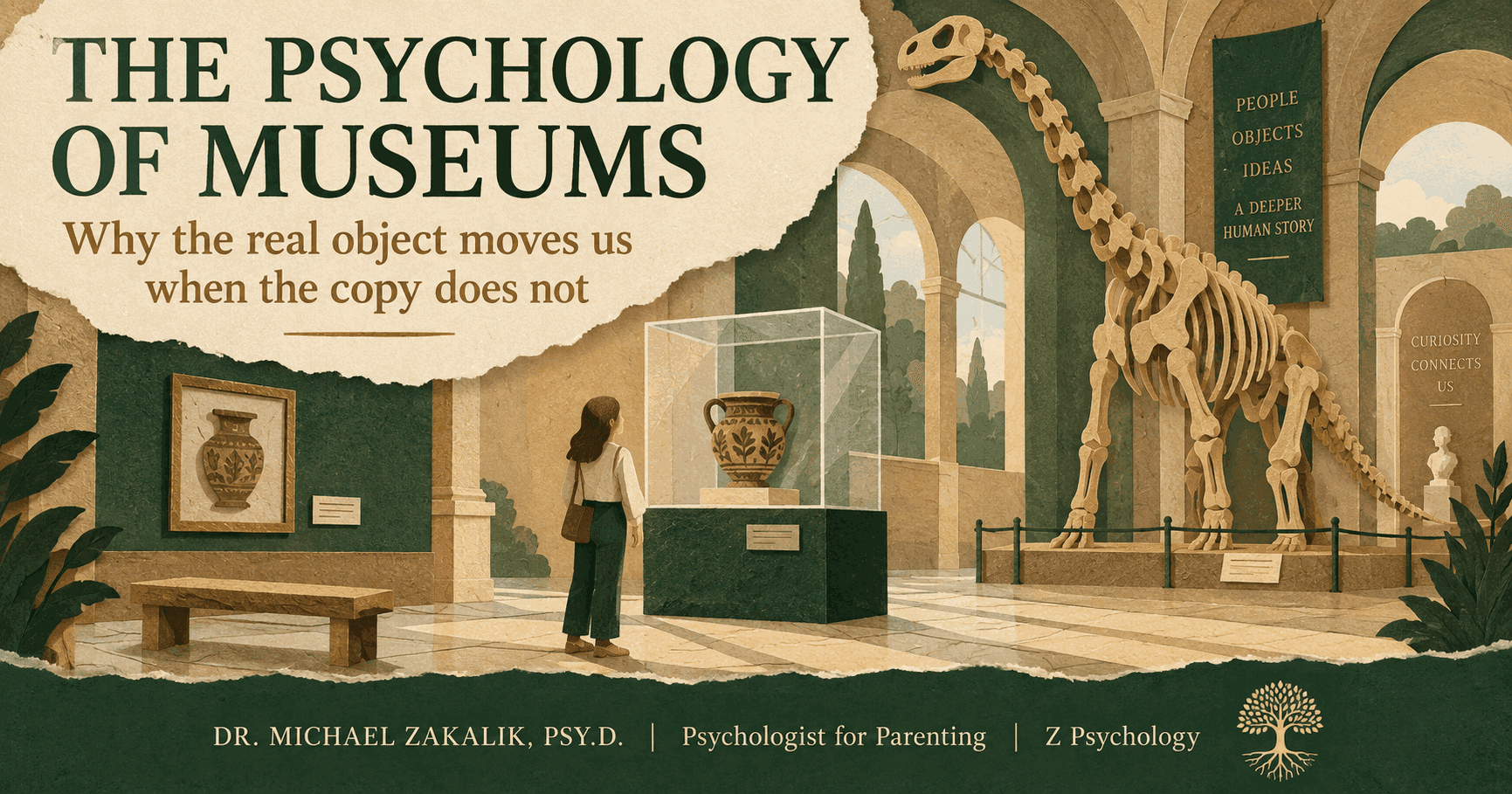
A room built for the rare pleasure of unhurried attention to one real thing.
(Disclaimer: The articles provided on this website are for informational and enhancing mental health awareness purposes only. They are not intended to be clinical interventions or provide medical advice. If you have any concerns about your well-being and/or well-being of others, please seek guidance from a qualified professional, such as a physician, psychologist, or counselor. If you are experiencing a clinical emergency please call 911 or 988 or go to the nearest emergency room. Here are some national and international helplines.)
This article is about the psychology of everyday experiences, for education and general interest. It is not therapy or advice.
By Dr. Michael Zakalik, Licensed Clinical Psychologist
The Psychology of Museums
Standing Before the Real Thing: Awe, Attention, and the Psychology of Museums
Museums ask something unusual of their visitors. They invite people to walk slowly through quiet rooms, looking at objects behind glass, reading small placards, and thinking. This is a strange proposition in an environment of abundant and more immediately engaging entertainment, and yet museums remain enormously popular, drawing enormous numbers of visitors who frequently describe the experience in terms of genuine meaning rather than mere diversion. This essay examines the psychology of museums, the pull of authentic objects, the experience of awe they can produce, the restorative quality of the museum environment, the fatigue that afflicts visitors, and what these institutions provide that reproduction and information cannot.
The museum's persistence is particularly interesting given that the information museums contain is now freely available, and images of nearly every object they hold can be viewed at higher resolution than the display case permits. That people continue to travel and pay to stand in front of the actual objects suggests that what museums provide is not information about the objects but something available only in their presence.
The Pull of the Real Thing
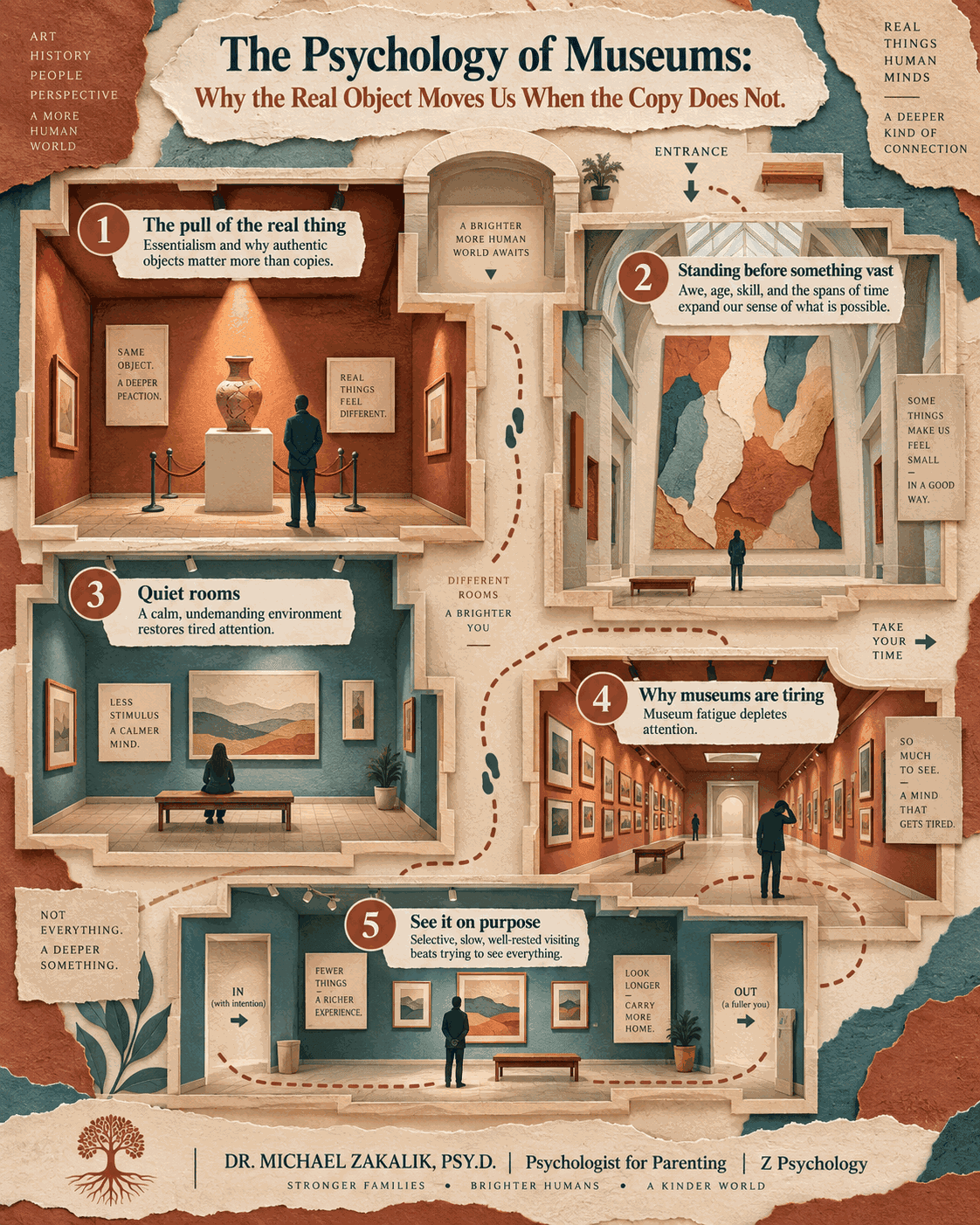
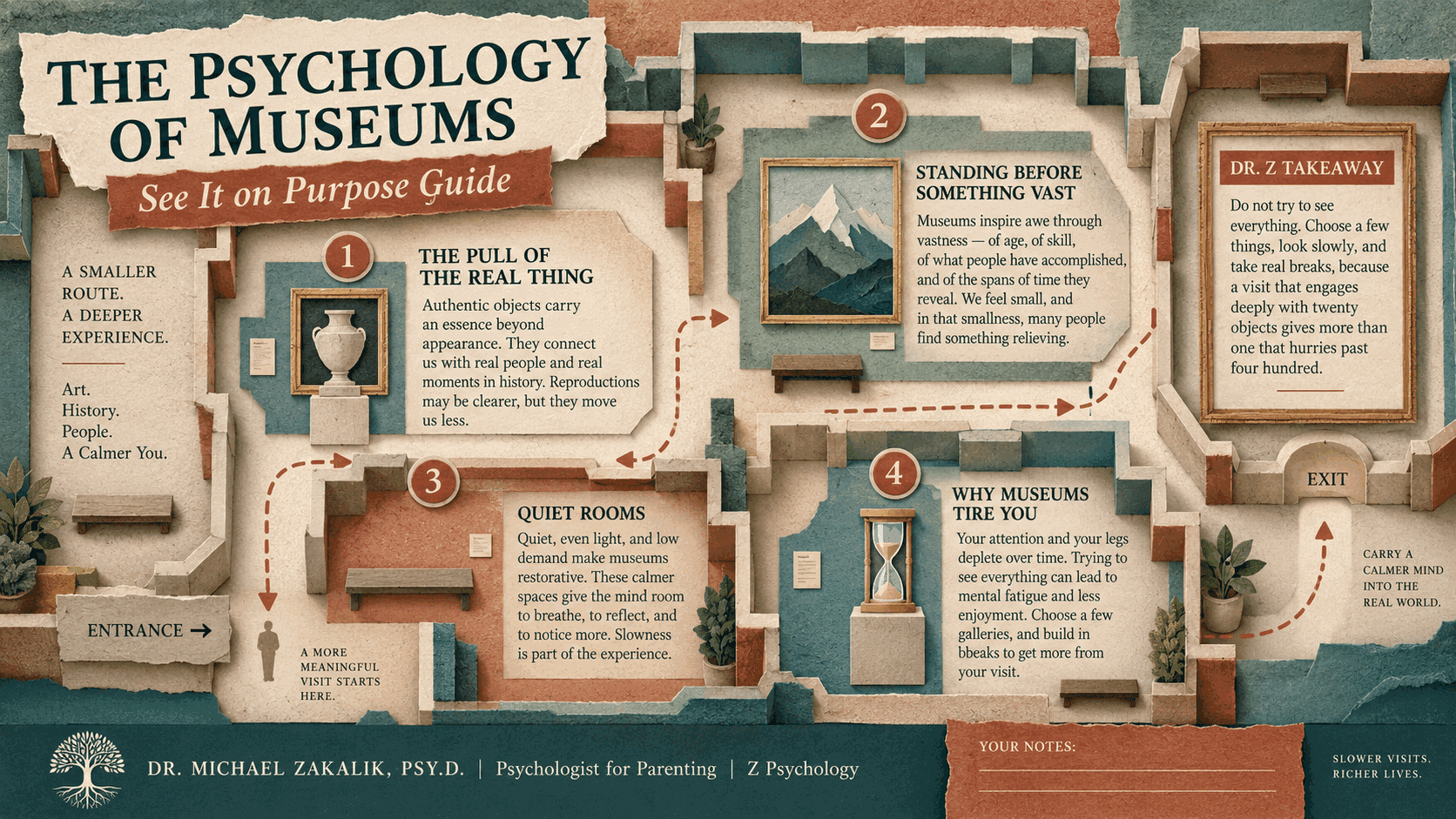
The central psychological fact about museums is that authentic objects affect people differently than reproductions, even when the reproduction is visually superior, and this difference is substantial and reasonably well documented.
People travel considerable distances and wait in long lines to see original works they could view in perfect reproduction at no cost. The reproduction may be clearer, better lit, and viewable without crowds, and yet the original commands an attention and produces a response that the reproduction does not. This is not a small effect; visitors frequently report powerful reactions to objects whose images they had seen many times without any such response.
Psychological research on what has been called essentialism offers one account. People appear to intuitively believe that objects possess an underlying essence beyond their perceptible properties, and that this essence can be transferred through physical contact and history. This intuition produces measurable effects: people value objects that belonged to admired figures far beyond their material worth, feel discomfort at objects associated with wrongdoers, and place enormous value on originality even when copies are indistinguishable. The original artifact is experienced as containing something the copy lacks.
This intuition, whatever its philosophical status, produces real psychological effects. Standing before an object that a particular person made, that survived particular events, that has existed continuously since a distant moment, produces an experience of connection to that history that no reproduction supplies. The object functions as a physical link, and the sense of contact with the past that it provides is the museum's distinctive offering.
Walter Benjamin's discussion of aura, the quality attaching to a unique object in its particular place and history, captures the intuition even for those unconvinced by his theoretical framework. Museums are institutions organized around aura, and their entire function depends on the persistence of the human sense that the real thing matters.
Standing Before Something Vast
Museums reliably produce experiences of awe, and this emotion has become a substantial subject of psychological research with findings that illuminate what the museum encounter provides.
Psychologists Dacher Keltner and Jonathan Haidt characterized awe as involving two components: perceived vastness, an encounter with something that exceeds one's ordinary frame of reference, and a need for accommodation, the requirement to adjust one's mental structures to make sense of it. Museums produce both regularly, through objects of extraordinary age, achievements of extraordinary skill, and scales of time or scope that exceed ordinary comprehension.
The vastness museums offer is frequently temporal. Standing before an object made thousands of years ago produces an encounter with a span of time that ordinary experience does not accommodate, and the recognition that a human hand shaped this object across such a distance collapses and expands time simultaneously. Natural history museums extend this further, presenting spans that exceed comprehension entirely, and the experience of standing before a skeleton that lived before humanity existed produces a characteristic vertigo.
Research has associated awe with a range of effects, including a diminished sense of self-importance, increased feelings of connection to others, and a subjective expansion of available time. Some of this literature has faced the replication questions affecting social psychology broadly, and individual findings warrant provisional acceptance, but the general characterization of awe as involving self-diminishment and connection appears reasonably robust. The experience of feeling small before something vast is one that museum visitors report frequently and value highly.
This self-diminishment appears to be experienced positively rather than as threat, which is worth noting. The reduction of self-focus that awe produces seems to relieve rather than distress, offering a temporary release from the preoccupation with one's own concerns that ordinary consciousness involves.
Quiet Rooms
The museum environment itself, apart from its contents, provides conditions that research on attention and restoration identifies as psychologically beneficial.
Attention restoration theory, developed by Rachel and Stephen Kaplan, distinguishes between directed attention, the effortful focus that demanding tasks require and that depletes with use, and fascination, an effortless attention that engaging environments elicit without expenditure. The theory holds that directed attention fatigues and requires restoration, and that environments permitting fascination allow this restoration to occur.
The Kaplans identified several features of restorative environments: being away, a sense of removal from ordinary demands; extent, sufficient scope to permit exploration; fascination, contents that hold attention effortlessly; and compatibility, alignment between the environment and one's inclinations. Museums satisfy each. They are removed from ordinary demands, sufficiently extensive to explore, filled with objects that hold attention without effort, and entered voluntarily by people inclined toward what they contain.
The sensory environment contributes. Museums are characteristically quiet, evenly lit, uncluttered, and free of the notifications and interruptions that saturate ordinary environments. This absence of demand is itself restorative, and visitors frequently describe the museum atmosphere in terms of calm and relief that the objects alone would not explain. The building provides a rare thing: permission to attend slowly to one thing at a time.
There is also the matter of pace. Museums license slowness, an unhurried movement and extended looking that other environments discourage. This slowness may be among the more valuable things the institution offers, providing a socially sanctioned occasion for the unhurried attention that contemporary life otherwise crowds out.
"What museums provide is not information about the objects but something available only in their presence."
Why Museums Are Tiring
Museum visitors experience a characteristic exhaustion that has been recognized and studied for over a century, and understanding it has practical value for how visits are conducted.
The phenomenon was named museum fatigue by Benjamin Ives Gilman in 1916, and subsequent research has confirmed and characterized it. Visitors attend carefully to early exhibits and progressively less to later ones, with time spent per object declining substantially across a visit and comprehension declining alongside it. By the latter portion of a museum visit, most visitors are moving through rooms with minimal engagement, having exhausted their capacity for the attention the objects require.
Several factors contribute. Museum viewing demands directed attention, which depletes; the standing and walking produce genuine physical fatigue; the volume of information exceeds processing capacity; and the sheer number of objects produces a decision burden about what to attend to. Research has also identified physical design contributions, including the tendency of visitors to orient toward exits and to reduce engagement as they approach them.
The practical implication is substantial: attempting to see an entire large museum is self-defeating, since the latter portion will be experienced with little attention or retention. Museum professionals commonly recommend visiting selectively, choosing a limited number of galleries and attending to them properly, and taking genuine breaks. A visit that engages deeply with twenty objects will produce more than one that passes hurriedly by four hundred.
This connects to a broader tension in museum experience between comprehensiveness and depth. The institution presents itself as containing everything, which invites the attempt to see everything, which guarantees that most of it will be seen badly. The visitor who accepts that they will not see it all, and chooses accordingly, has a substantially better experience than the one who tries.
Keeping What We Have Been
Museums serve functions of collective memory and identity that operate beyond the individual visitor's experience, and these functions carry both value and contest.
Museums preserve and present the material record of human activity, functioning as a form of collective memory. What is preserved and displayed constitutes a society's account of what has mattered, and encountering this account connects individuals to a history and a community extending beyond their own experience. This connection appears to serve genuine psychological functions related to meaning and continuity, providing a sense of location within something larger and longer than one's own life.
This function is not neutral. What museums contain, how they present it, and whose stories are told reflect decisions that have historically encoded substantial bias, and many collections were assembled under circumstances of colonial extraction that contemporary institutions are still reckoning with. Questions of repatriation, of whose objects these are, and of who has the authority to interpret them are live and genuine, and a visitor's experience of connection to a preserved past is complicated by the recognition that the preservation was frequently a taking.
This complication does not negate the value of what museums provide, but it does mean that the encounter with these institutions is more ethically layered than the quiet rooms suggest. The object that produces a visitor's awe may have been removed from people for whom it meant considerably more, and holding both the genuine experience and its problematic provenance is the more honest engagement.
Reflections for the Visitor
Museums offer the encounter with authentic objects that human intuitions about essence make irreplaceable, experiences of awe produced by vastness that exceeds ordinary frames of reference, an environment that research on attention identifies as genuinely restorative, and a connection to collective memory whose history warrants examination.
For visitors, the research on museum fatigue offers the most immediately practical guidance. The impulse toward comprehensiveness defeats itself, and a selective visit conducted at an unhurried pace with genuine breaks will produce more than an exhaustive one. Choosing a small number of objects and attending to them properly is not a compromise but the better strategy.
The restorative dimension is also worth using deliberately. Museums provide conditions that contemporary environments rarely permit: quiet, slowness, unhurried attention to single things, and removal from ordinary demand. A visit undertaken for these qualities, rather than for the acquisition of information about the collection, may be the more valuable use of the institution.
In the end, the museum offers what neither reproduction nor information can supply. Human intuitions about the essences of objects make the authentic thing irreplaceable, so that standing before what a particular hand made, and what survived particular centuries, produces a contact with the past that images cannot. The vastness such objects present, temporal spans and skills and scales exceeding ordinary comprehension, produces the awe that research characterizes as self-diminishing and connecting, a relief from self-preoccupation that visitors value highly. The environment itself, quiet and undemanding and permitting slowness, satisfies the conditions that attention restoration theory identifies, offering a rare license for unhurried attention to one thing at a time. Its characteristic fatigue is real and is best answered by selectivity rather than persistence. And its function as collective memory, genuinely valuable, carries a history of acquisition that honest engagement holds alongside the wonder.
Frequently Asked Questions
- Why see the original when a reproduction is clearer?
- Because people intuitively feel authentic objects carry an essence beyond their appearance, a tendency researchers call essentialism. Standing before the real thing produces a sense of contact with history that no copy supplies.
- Why do museums feel so tiring?
- The phenomenon, named museum fatigue in 1916, comes from the depletion of directed attention along with physical fatigue and information overload. Careful attention to early exhibits gives way to minimal engagement later on.
- What is the best way to visit a large museum?
- Selectively. Trying to see everything guarantees most of it is seen badly. Choosing a limited number of galleries, attending to them properly, and taking genuine breaks produces far more.
- What can a museum give that a screen cannot?
- The presence of authentic objects, the awe of vastness that exceeds ordinary comprehension, and a genuinely restorative environment of quiet, slowness, and unhurried attention to one thing at a time.