
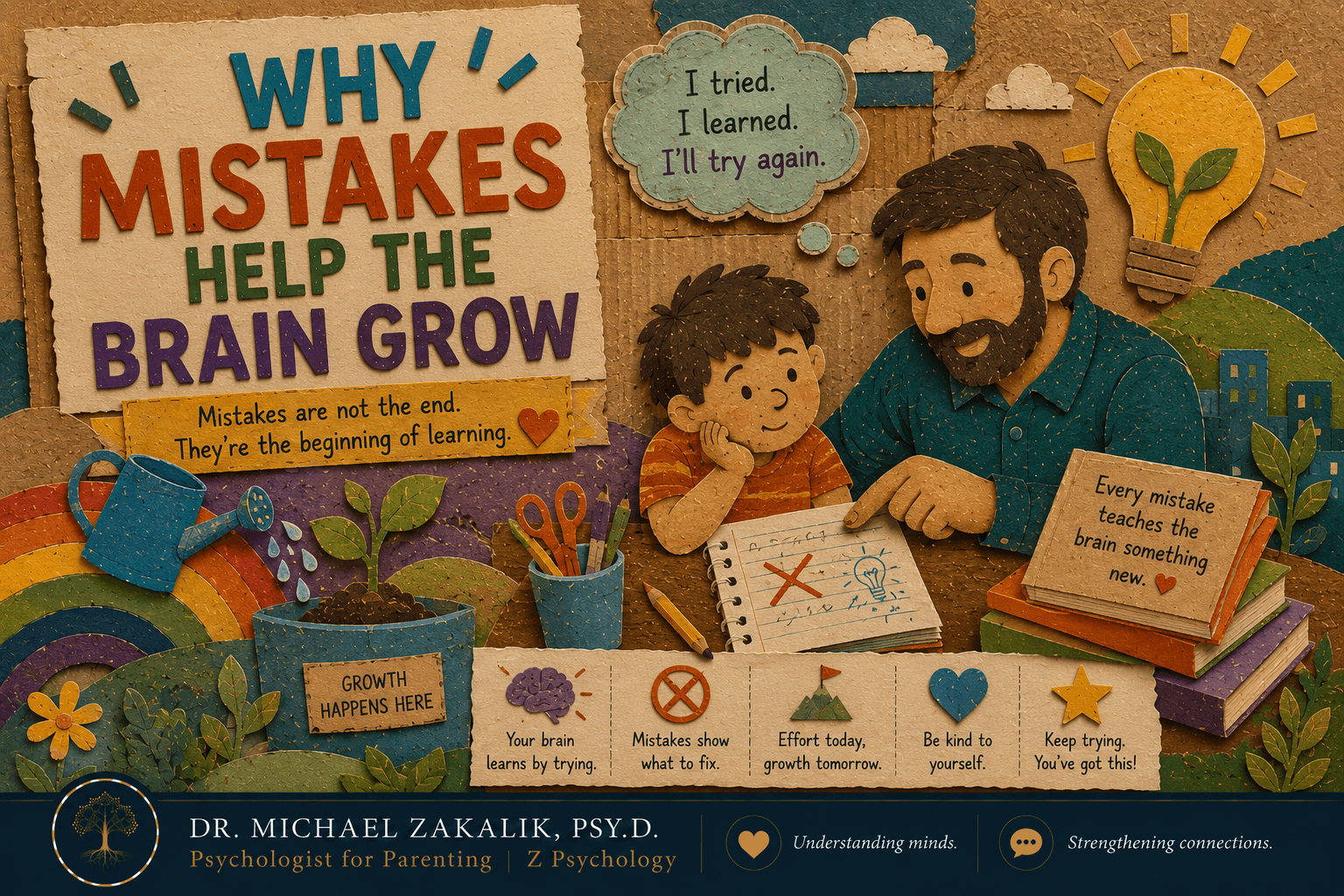
A mistake is not proof your child is failing. It is the moment their brain is growing.
(Disclaimer: The articles provided on this website are for informational and enhancing mental health awareness purposes only. They are not intended to be clinical interventions or provide medical advice. If you have any concerns about your well-being and/or well-being of others, please seek guidance from a qualified professional, such as a physician, psychologist, or counselor. If you are experiencing a clinical emergency please call 911 or 988 or go to the nearest emergency room. Here are some national and international helplines.)
By Dr. Michael Zakalik, Licensed Clinical Psychologist
Part of Dr. Z's Toolbox.
Why Mistakes Help the Brain Grow
For a lot of kids, a mistake feels like a verdict: I got it wrong, therefore I am bad at this, therefore I should stop. That single belief shuts down more learning than any lack of ability ever could. The truth is almost the exact opposite of how it feels. Mistakes are not evidence that the brain is failing. They are the very moment the brain is growing.
Helping a child make peace with mistakes is one of the highest value lessons of childhood, because a child who is not terrified of getting it wrong will try more, learn more, and quit less. This is the engine room of a growth mindset.
Why do mistakes help us learn?
Mistakes help us learn because they show the brain exactly what to adjust. When a child tries something and it does not work, the brain notices the gap and tunes itself, which is literally how new skills are built. A mistake is not the opposite of learning. It is a necessary part of it. No one has ever learned to ride a bike without wobbling first.
Why it matters
How a child reacts to mistakes decides how much they are willing to attempt. A child who fears mistakes plays it safe, dodges challenge, and hides errors, which quietly caps their growth. A child who sees mistakes as useful information keeps trying harder things, and over time pulls far ahead. Their relationship with failure shapes their entire path as a learner, and it is closely tied to their confidence.
"The only real way to fail is to stop trying, because then your brain stops growing."
How to explain it to your child
Try it in your own words, like a secret you are letting them in on. Here is a secret about your brain: every time you make a mistake and figure out what went wrong, your brain actually gets a little stronger, like a muscle after exercise. So a mistake is not proof that you are bad at something. It is proof that you are learning. The only real way to fail is to stop trying, because then your brain stops growing.
What it looks like in real life
Your daughter makes an error on her homework and crumples the page in frustration, calling herself dumb. The rescue reflex says "it's fine, everyone makes mistakes," which is true but lands as a platitude. Try getting curious with her instead: "Interesting. What does this mistake tell us? What is the part your brain is still figuring out?" You are modeling that a mistake is information to examine, not a shame to bury. The way you talk about it also shapes the voice she uses on herself. And watch your own mistakes too, because how you treat your spilled coffee teaches more than any speech.
Try it together: activities by age
Build the skill in small, everyday moments. By age:
- Ages 3 to 5. Oops is okay: when small mistakes happen, respond lightly, "Oops! That's okay, let's try again," so your calm teaches that a mistake is no big deal. Watch grown-ups try: let them see you attempt something, get it wrong, and keep going cheerfully, because modeling is the most powerful lesson here.
- Ages 6 to 8. Mistake of the day: at dinner, each person shares a mistake and what it taught them, which makes mistakes a normal topic and strips away their shame. What did it teach: when a mistake happens, ask what it showed rather than who is to blame, and the question reframes the whole event.
- Ages 9 to 12. Famous flops: look up how inventors, athletes, and authors failed many times before succeeding, so seeing that success is built on mistakes reframes their own. The learning journal: try jotting down a mistake and its lesson now and then, because writing it down turns a bad moment into captured learning.
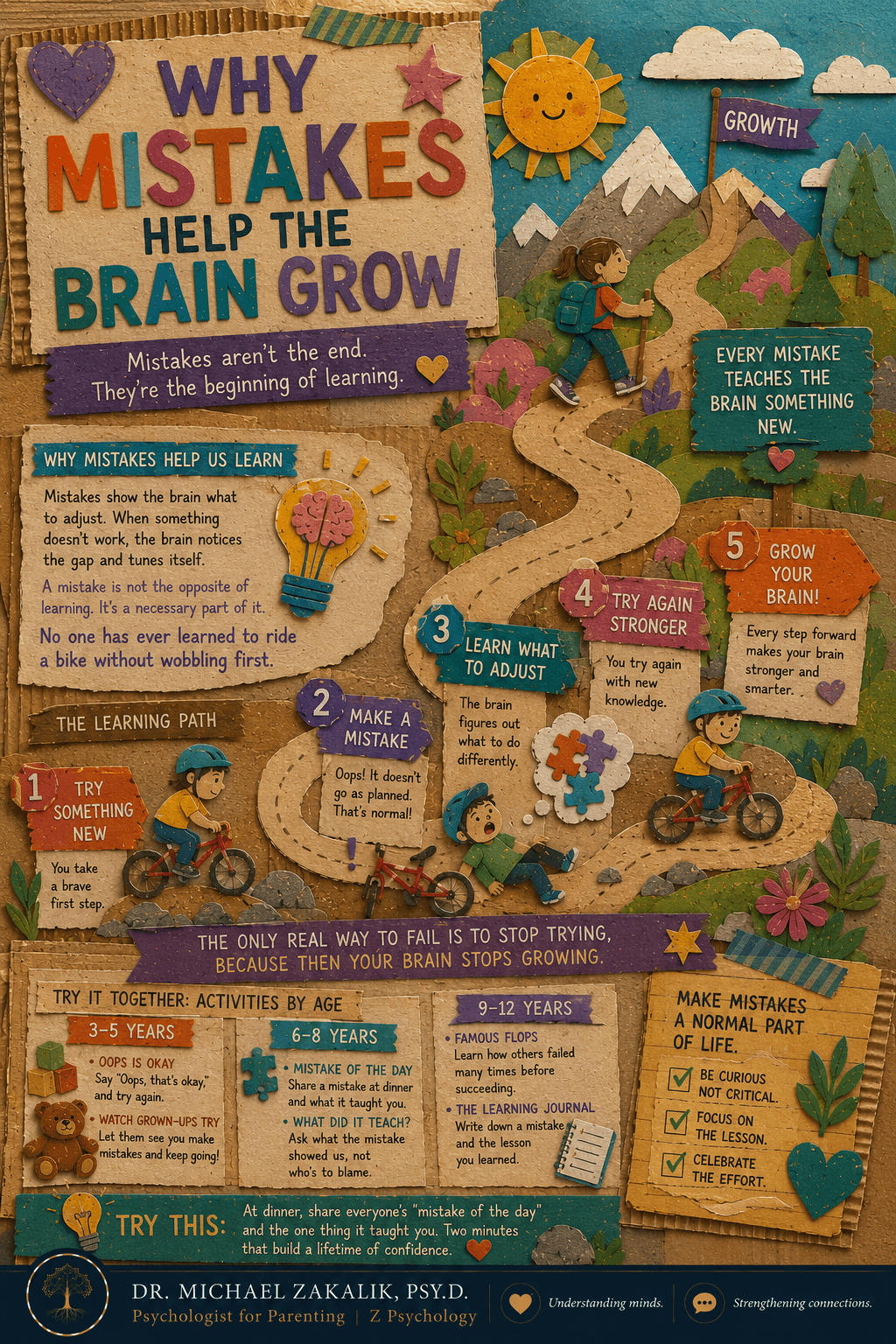
Try this: Tonight at dinner, make it "mistake of the day." Everyone, grown-ups included, shares one mistake from their day and the one thing it taught them. Two minutes, and your child learns that errors are a normal, even welcome, part of getting better.
Frequently asked questions
How do I help my child not fear making mistakes?
Treat mistakes calmly and curiously rather than with disappointment, model your own mistakes openly, and focus on what an error teaches rather than on blame. When children see that mistakes are safe and useful at home, they grow far more willing to try hard things.
My child falls apart over small errors. What can I do?
Start by normalizing mistakes as a routine, even welcome, part of learning, and avoid praising only perfect results. Praising effort and strategy instead of correctness takes the pressure off. If perfectionism is intense and causes real distress, a conversation with a professional can help.
Should I point out my child's mistakes?
Gently, and with a learning focus rather than criticism. The aim is to help them notice and learn from an error, not to make them feel bad about it. Framing it as "what can we learn here" keeps the mistake useful instead of shameful.
Free download: Why Mistakes Help Family Discussion Guide
Simple, age-by-age conversation starters to help your child see mistakes as the way the brain grows.
Download the guide (PDF)Enjoyed this? Explore more of Dr. Z's Toolbox