
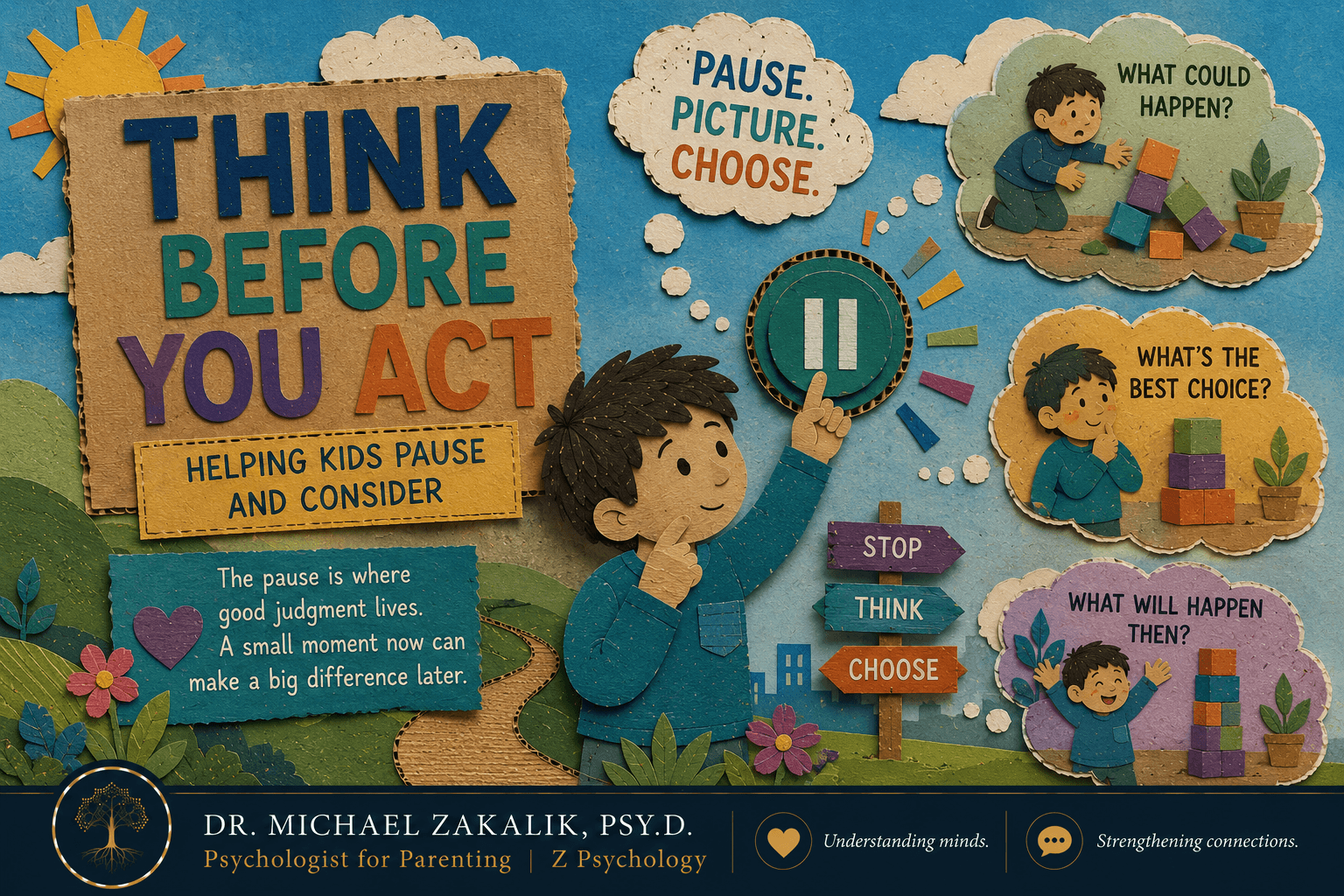
The pause between an urge and an action is a real skill, and it is one your child can practice.
(Disclaimer: The articles provided on this website are for informational and enhancing mental health awareness purposes only. They are not intended to be clinical interventions or provide medical advice. If you have any concerns about your well-being and/or well-being of others, please seek guidance from a qualified professional, such as a physician, psychologist, or counselor. If you are experiencing a clinical emergency please call 911 or 988 or go to the nearest emergency room. Here are some national and international helplines.)
By Dr. Michael Zakalik, Licensed Clinical Psychologist
Part of Dr. Z's Toolbox.
Teaching Kids to Think Before Acting: A Parent Guide
"What were you thinking?" we ask, standing over the spilled paint or the shoved sibling. The honest answer is usually that they were not thinking, not because they are careless, but because the pause that lets thinking happen is a skill still under construction. "Think before you act" is one of the most common things parents say and one of the least often taught as an actual skill.
This is the forethought half of thoughtfulness, the inner pause between an urge and an action. It overlaps with impulse control, but here the focus is specifically on considering consequences, picturing what might happen next before you leap.
What does thinking before acting mean?
Thinking before acting is the ability to pause and consider what might happen before doing something. For kids it is the difference between grabbing and asking, between blurting and waiting, between acting on the first idea and picturing where it leads. It is a small mental pause with a big payoff.
Why it matters
The pause is where good judgment lives. A child who can briefly imagine consequences makes safer, kinder, smarter choices, and avoids a lot of the regret that follows impulsive action. As kids grow into bigger decisions and, eventually, the teen years, this habit of pausing to consider becomes one of the most protective skills they own.
How to explain it to your child
Before you do something, your brain can take a quick peek into the future and ask, what might happen if I do this? It is like a tiny pause button. Pressing it only takes a second, but that second is enough to catch a not-so-great idea before it turns into a not-so-great day. The more you practice pressing pause, the easier it gets.
What it looks like in real life
Your son is about to launch a ball in the living room, inches from a lamp. In the calm afterward, not the heat of the moment, replay it together: "Before you threw it, what might have happened? What could you do differently next time?" You are rehearsing the peek into the future for next time. Trying to teach in the heated moment rarely sticks, because a good review happens after the storm. The lesson lands once everyone is calm.
"Pressing pause only takes a second, but that second is enough to catch a not-so-great idea before it turns into a not-so-great day."
Try it together: activities by age
Practice the pause in small, everyday moments. By age:
- Ages 3 to 5. What happens next: read stories and pause to guess what might happen if a character does something, since predicting consequences in a story is safe practice for real life. Stop and go games: freeze games and Simon Says build the basic pause that thinking before acting depends on, because the brake comes first.
- Ages 6 to 8. Press pause: make a playful pause-button gesture you both use as a reminder to stop and think, since a physical cue makes the invisible pause concrete. If, then: play with consequences out loud, asking "if you do that, then what might happen?", which wires the link between action and outcome.
- Ages 9 to 12. Play it forward: before a choice, coach them to imagine how it plays out a step or two ahead, since thinking forward is exactly what good decision-making requires. Replay and rewind: after an impulsive moment, calmly replay it and rewind to find a better choice, because the calm review is where the real learning happens.
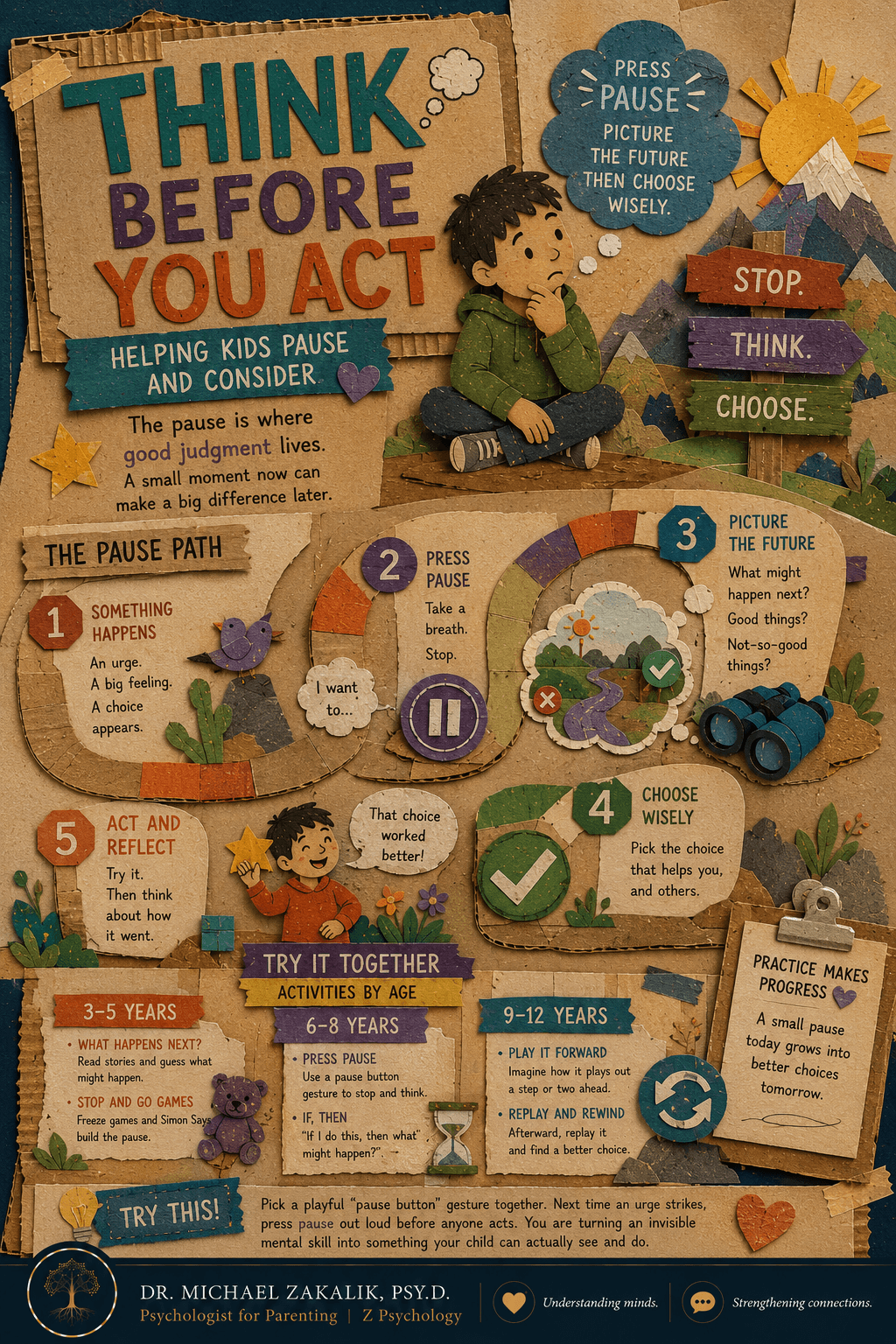
Try this: pick a playful pause button gesture together, like tapping your nose or pressing the air. Next time an urge strikes, press pause out loud before anyone acts. You are turning an invisible mental skill into something your child can actually see and do.
Frequently asked questions
Why does my child act without thinking?
Because the pause that allows thinking is an executive function skill that is still developing, and it tends to vanish when feelings run high. Acting before thinking is developmentally normal in children, not a sign of a careless or bad kid. It strengthens with age and practice.
How can I teach my child to think before acting?
Practice the pause through games when calm, use a shared cue like a pause button, and replay impulsive moments afterward to rehearse a better choice. Avoid lecturing in the heated moment, since a flooded brain cannot learn. The calm review is where it sinks in.
Is acting without thinking the same as misbehaving?
Usually not. It is more often an undeveloped skill than a deliberate choice. Treating it as a skill to build rather than purely as misbehavior to punish tends to help the child improve faster, while still holding the limit on the behavior itself.
Free download: Think Before You Act Family Discussion Guide
A simple pause cue and age-by-age practice to help your child catch an idea before it becomes an action.
Download the guide (PDF)Enjoyed this? Explore more of Dr. Z's Toolbox