
Why the arcade is built to keep you playing, and how to walk in with a plan.
(Disclaimer: The articles provided on this website are for informational and enhancing mental health awareness purposes only. They are not intended to be clinical interventions or provide medical advice. If you have any concerns about your well-being and/or well-being of others, please seek guidance from a qualified professional, such as a physician, psychologist, or counselor. If you are experiencing a clinical emergency please call 911 or 988 or go to the nearest emergency room. Here are some national and international helplines.)
This article is for education and general parenting support. It is not therapy or medical advice. It describes how reward systems can drive compulsive play. If gambling or gaming has become a problem for someone in your family, help is available; in the United States you can call or text the National Problem Gambling Helpline at 1-800-GAMBLER.
By Dr. Michael Zakalik, Licensed Clinical Psychologist
The Psychology of the Arcade: The Point Chase, the Cashless Card, and How to Handle It as a Parent
You know the scene. The lights, the noise, the swipe card in a small hand, and the wall of prizes glowing at the far end like a finish line. Your child is locked in, the card is draining, and you can already feel the meltdown coming when it hits zero. The arcade is supposed to be a treat, and somehow it keeps turning into a standoff. If you have stood there doing the math and bracing yourself, you are not a pushover and your kid is not spoiled. You are both up against a machine that was carefully designed to be hard to leave.
The arcade is not evil, and none of this means you have to avoid it. But it helps to see what is actually happening under the flashing lights, because the same features that make it so fun are the ones that make it so hard to stop. Once you can name the design, you can walk in with a plan instead of a prayer.
A Machine Built on the Slot-Machine Schedule
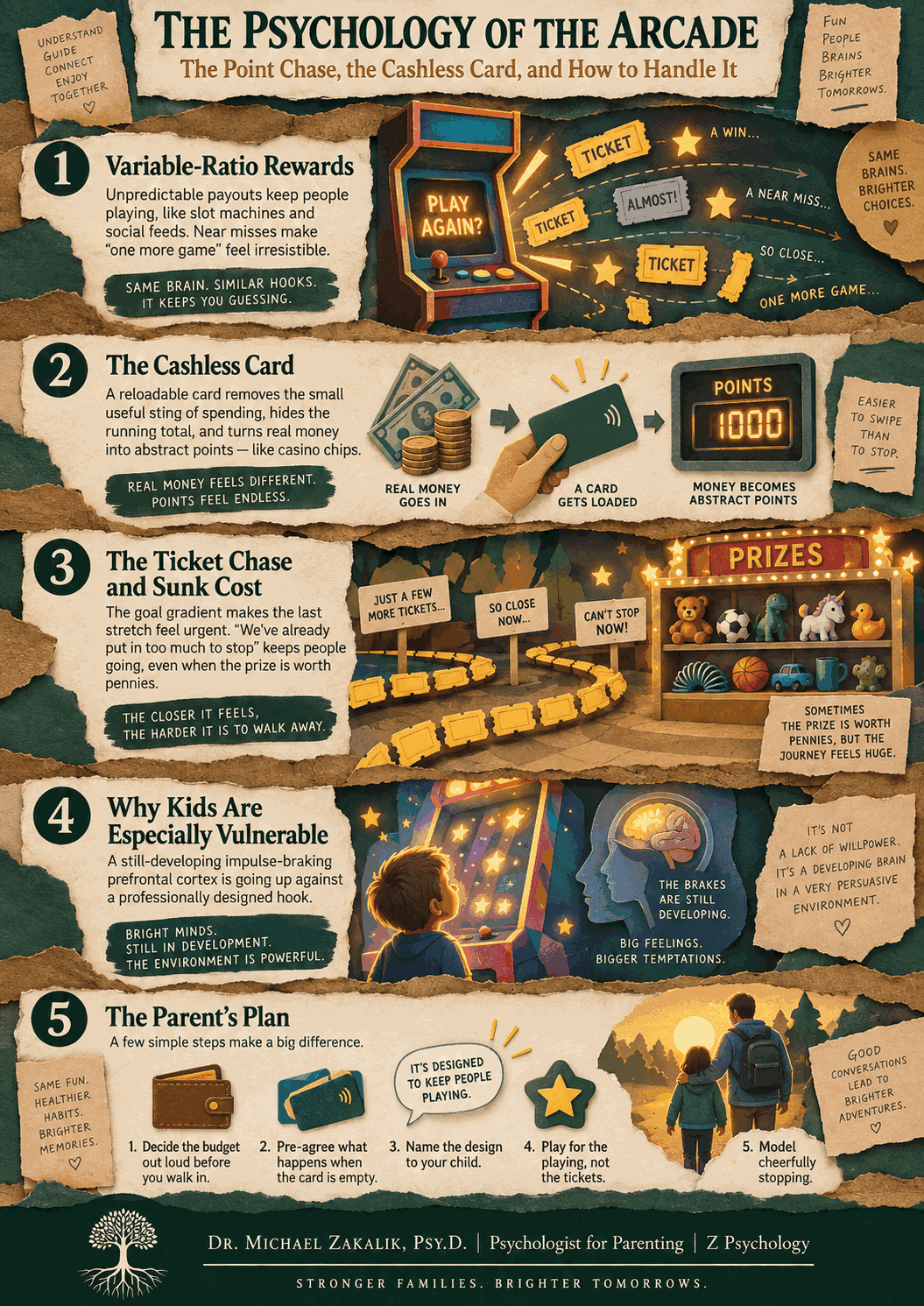
The heart of the arcade is unpredictable reward. You never know exactly when a game will pay out a burst of tickets or points, or how many. Psychologists call this a variable-ratio schedule, and it is the single most powerful pattern for driving repeated behavior. It is the exact same schedule that runs slot machines and social media feeds, and it is far stickier than a steady, predictable reward would be. Add the near miss, the game that stops just short of the jackpot, and the brain lights up almost as much as it would for a win. "One more game" is not weak willpower. It is the design working precisely as intended.
From Tokens to a Card: Why Cashless Spends More
There is a reason arcades moved from coins and tokens to a reloadable swipe card, and it is not only convenience. Handing over physical money, or watching your tokens disappear, creates what researchers call the pain of paying, a small useful sting that helps us stop. A card erases that sting. Just like casino chips, a reloadable card turns real money into abstract points, so the spending stops feeling like spending. The running total is hidden, each swipe is painless, and by the time the balance is gone, far more has been spent than anyone intended. The technology did not just make the arcade easier. It quietly turned off the brake.
The Ticket Chase and the Sunk Cost
Then there is the chase for tickets or points toward a prize. Two forces make this powerful. The first is the goal gradient: the closer you get to a reward, the harder you push for it, which is why the last stretch toward a prize feels the most urgent. The second is sunk cost, the very human sense that "we have already put so much in, we cannot stop now." The quiet joke is that the prize at the counter is usually worth pennies. The plush toy is not the point. The chase is the point, and the redemption counter, where tickets become a treasure, delivers one more hit of reward to seal the memory and pull you back next time.
Why Kids Are Especially Hooked
It is worth saying plainly: children are not simply less disciplined than adults here. The part of the brain that manages impulses, weighs long-term costs, and puts on the brakes, the prefrontal cortex, is still years from finished. The arcade's design targets exactly the skill kids have the least of, which is why impulse control is something children are still building rather than something they already own. Expecting a seven-year-old to regulate against a machine engineered to defeat grown adults is not fair to them or to you. This is not a character flaw in your child. It is a mismatch between a developing brain and a professionally built hook.
"The prize at the counter is worth pennies. The chase is the point, and the card was designed to make sure the chase never quite ends."
The Parent's Predicament
All of this lands on you, usually in the middle of a loud, bright room. You want your child to have fun, so you say yes. Then the card runs dry, the disappointment erupts, and you are stuck choosing between a public meltdown and reloading "just five more dollars," which teaches the exact lesson you did not want to teach. Layer on the comparison to the kid nearby with the giant stack of tickets, and it is a genuine bind. Naming the trap does not make it disappear, but it does move you from reacting in the moment to deciding in advance, which is where all your power actually is.
How to Handle the Arcade
The goal is not to ban the arcade. It is to enjoy it without getting played. A few moves that work. Decide the budget before you walk in, out loud, and make it fixed: load the card once, tell your child that is the whole amount, and mean it. Pre-agree what happens when the card is empty, so the ending is a plan you both knew about rather than an ambush. Name the design to your kid, in age-appropriate words, because "these games are built to make us want to keep going" turns a trap into a genuinely useful life lesson about how businesses are designed to hold our attention, the same lesson that makes screen time limits easier to hold at home. Play for the playing, not the tickets, and say so, so the fun is the games themselves rather than the pile at the end. Consider a simple redemption rule before you start, such as "we cash out our tickets and pick one thing," to short-circuit the counter. And model it yourself, because a parent who can cheerfully stop is teaching more than any speech. Handled this way, the arcade stops being a battle and quietly becomes one of the better places to practice limits, delayed gratification, and emotional regulation, while seeing how the hook works.
Try this on your next arcade trip. Before you go in, agree on the exact amount and say the plan out loud together: "We are loading the card with this much, we play until it is gone, then we cash out our tickets, pick one thing, and head home happy." Then, while you are playing, point out the design once, lightly: "Notice how it almost gave us the jackpot? That is on purpose, to make us want to keep going." You will be having fun and quietly teaching media literacy at the same time.
Frequently asked questions
Why is the arcade so hard for my kid to leave?
Because it runs on unpredictable rewards, the same pattern that powers slot machines, and the cashless card hides how much is being spent. It is engineered to be hard to stop, and children have the least developed brakes of anyone.
Is the swipe card really worse than tokens?
Psychologically, yes. Physical tokens create a small "pain of paying" that helps us stop. A reloadable card removes that friction, so more gets spent without it feeling like spending, much like casino chips.
Are the prizes a rip-off?
The prizes are usually worth far less than what was spent to win them. But the prize was never really the product. The chase is, and the redemption counter is designed to keep you coming back.
How do I set a limit without a meltdown?
Decide the amount before you walk in, say the whole plan out loud together including what happens when the card is empty, and hold it kindly. The meltdown usually comes from an ending that feels like an ambush, not from the limit itself.
Should I just avoid arcades?
You do not have to. Handled with a set budget and a plan, the arcade can be a fun outing and a great teaching moment about how these systems are built. The problem is not the arcade. It is walking in without a plan.
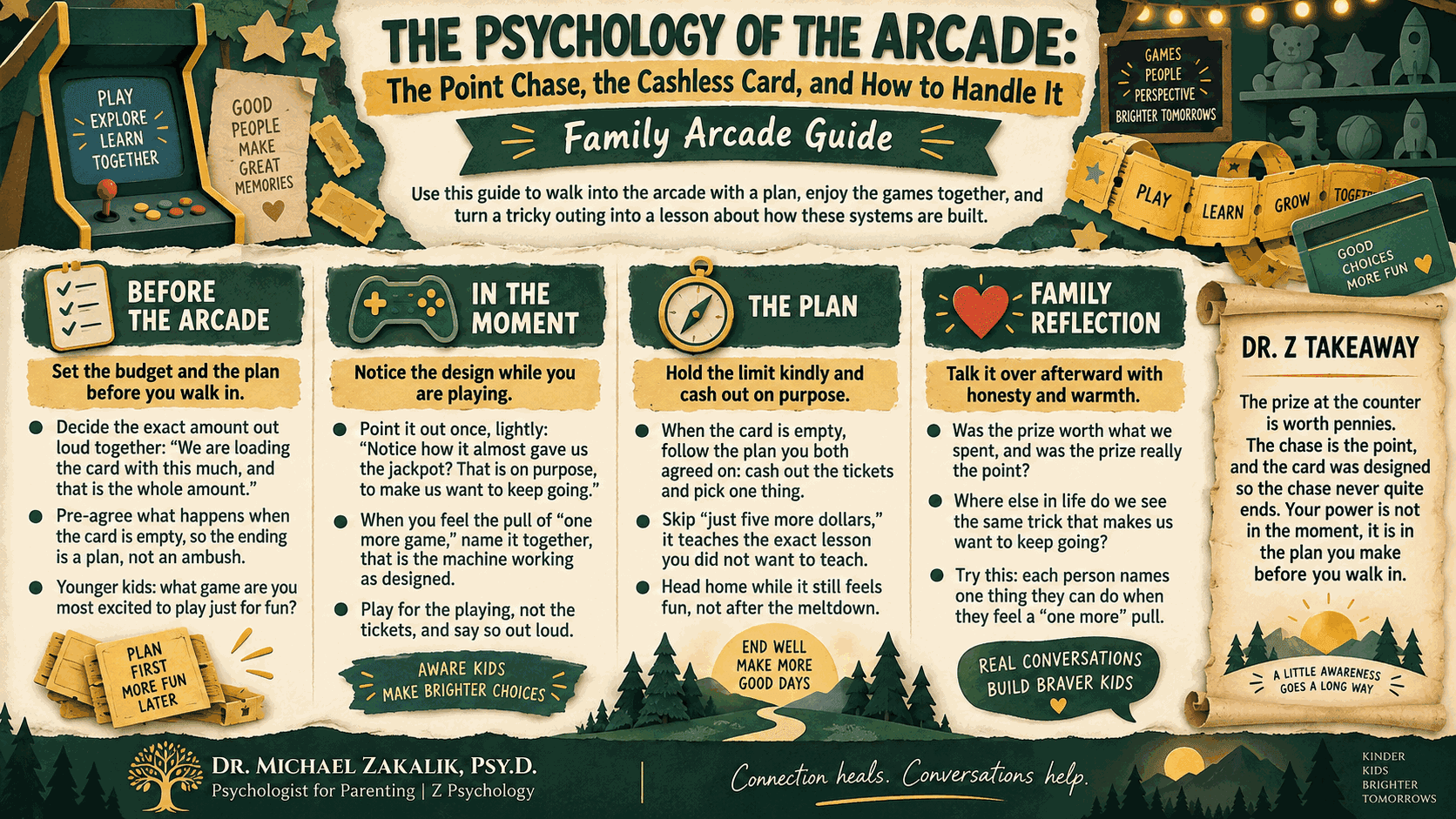
Free download: The Family Arcade Guide
A one-page guide to walk into the arcade with a plan: what to decide before you go, what to notice while you play, how to hold the limit kindly, and what to talk about afterward.
Download the guide (PDF)About the author: Dr. Michael Zakalik is a licensed clinical psychologist (Illinois and Washington, PSYPACT provider) with 20+ years helping children, parents, and families. Find more of his work at psychologistforparenting.com and zpsychology.com.
Enjoyed this? Explore more parenting articles