
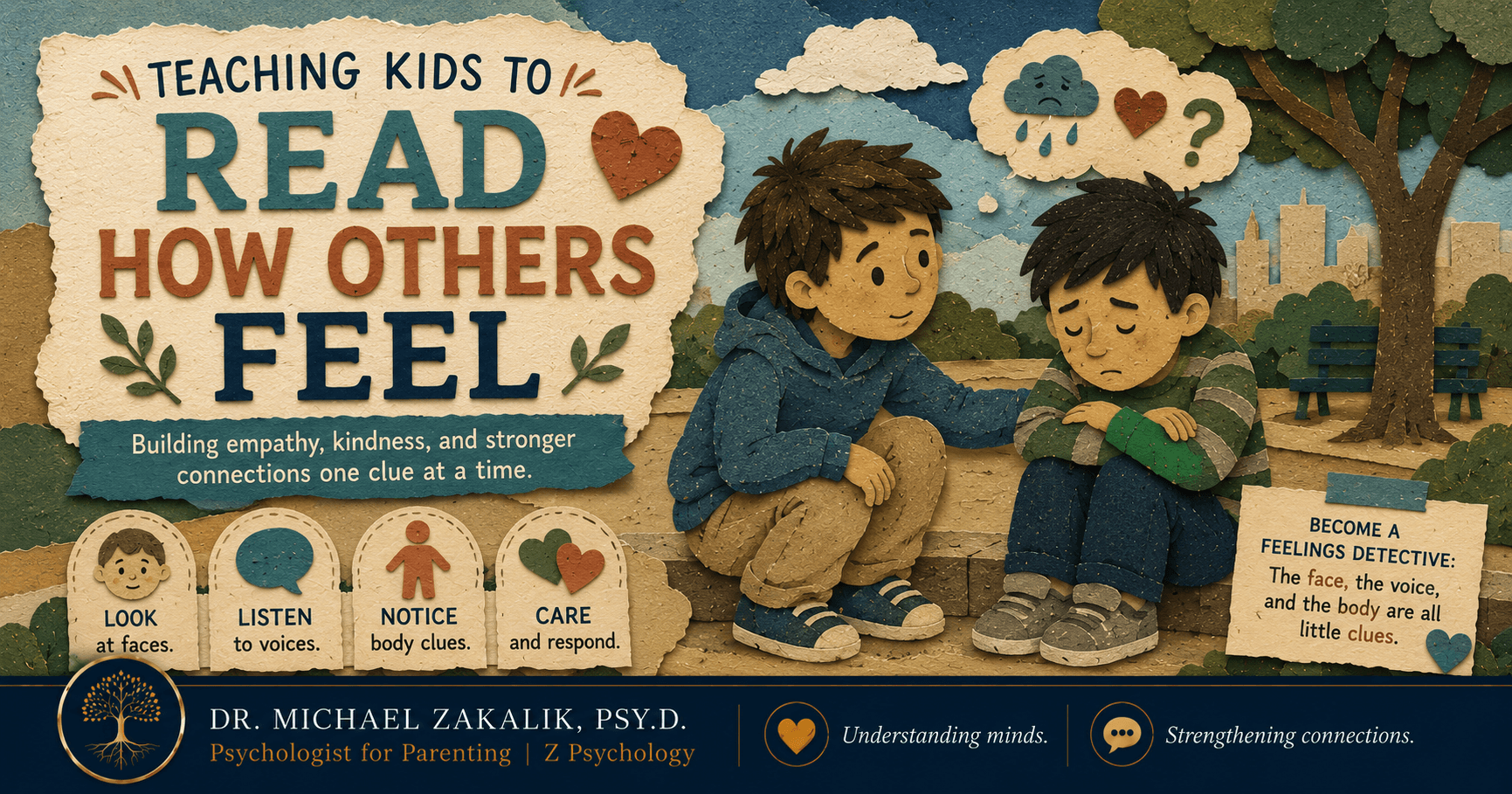
Reading how others feel is the doorway to empathy, friendship, and getting along.
(Disclaimer: The articles provided on this website are for informational and enhancing mental health awareness purposes only. They are not intended to be clinical interventions or provide medical advice. If you have any concerns about your well-being and/or well-being of others, please seek guidance from a qualified professional, such as a physician, psychologist, or counselor. If you are experiencing a clinical emergency please call 911 or 988 or go to the nearest emergency room. Here are some national and international helplines.)
By Dr. Michael Zakalik, Licensed Clinical Psychologist
Part of Dr. Z's Toolbox.
Teaching Kids Empathy: Read How Others Feel
Some children seem to notice instantly when a friend is sad. Others can stand right next to a crying classmate and have no idea anything is wrong. That difference is not kindness or coldness. It is a skill called social awareness, the ability to read how other people feel, and it can be taught to the child who does not pick it up on their own.
This is the outward-facing half of emotional intelligence. The first half is knowing your own feelings. This half is tuning in to everyone else's, and it is the doorway to empathy, friendship, and getting along in a world full of other people.
What is reading feelings?
Reading feelings is the ability to pick up on how someone else is doing from their face, voice, body, and the situation around them. For kids, it shows up as noticing a friend looks left out, hearing that a parent sounds tired, or sensing that a joke landed badly. It is the raw material of empathy.
Why it matters
A child who can read the room handles friendships, family, and the classroom far more smoothly. They sense when to back off, when to help, when to share. A child who misses these cues is often well-meaning but keeps stepping on social landmines, which can quietly cost them friendships they very much want.
"People are always showing how they feel, even when they do not say it out loud. Become a feelings detective and look for the clues."
How to explain it to your child
People are always showing how they feel, even when they do not say it out loud. Their face, their voice, and the way they are standing are like little clues. If you become a feelings detective and look for the clues, you can figure out how someone feels, and then you know how to be a good friend to them.
What it looks like in real life
You are at the park and your son keeps trying to get a kid to play who clearly wants to be left alone, arms crossed, looking away. Rather than "leave him alone," turn it into detective work: "Look at his face and his arms. What do you think he is feeling right now? What might he want?" You are teaching him to gather the clues himself instead of just handing him the answer.
Try it together: activities by age
Build the skill in small, everyday moments. By age:
- Ages 3 to 5. Feelings detective in books: while reading, point to a character and ask how they feel and how you can tell, since pictures make the clues easy to spot. Match the face: play at making and guessing feeling faces, because linking expressions to feelings is the very first clue to read.
- Ages 6 to 8. Watch with the sound off: watch a moment of a show with the volume down and guess what everyone feels from faces and bodies alone, which turns reading cues into a fun puzzle. What might they want? When someone is upset, go past the feeling to the need, "She looks sad. I wonder what would help her feel better," because reading feelings becomes useful when it leads to action.
- Ages 9 to 12. Read the tone: talk about how the same words can mean very different things depending on tone of voice, since older kids are ready for the subtler cues beyond the face. Perspective swap: after a conflict, ask them to tell the story from the other person's point of view, because stepping into someone else's shoes is empathy at its most muscular.
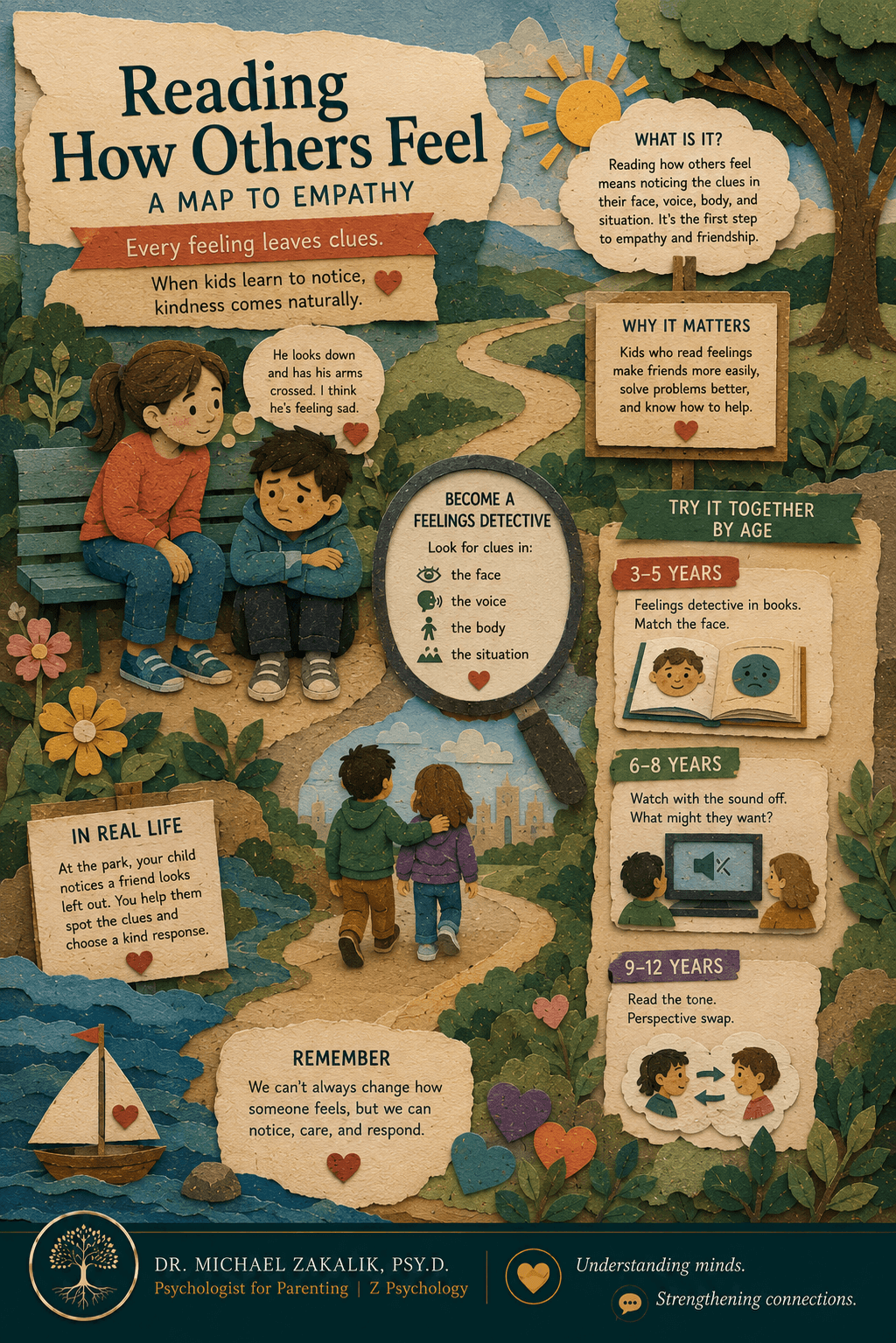
Try this: watch one minute of a show together with the sound off and guess what each character feels from their face and body alone. It turns reading cues into a game your child will want to play again.
Frequently asked questions
Can empathy be taught, or are kids just born with it?
Both play a role. Children vary in how naturally they notice others, but the skill of reading and responding to feelings can absolutely be strengthened through practice and coaching. Even a child who tends to miss cues can be taught to look for them.
My child does not seem to notice when others are upset. Is something wrong?
Often it is simply an underdeveloped skill, and the activities here help. Children also develop this at different rates. If you have broader concerns about your child's social connection or development, a conversation with your pediatrician can offer reassurance or direction.
What is the difference between reading feelings and empathy?
Reading feelings is noticing how someone feels. Empathy is caring about it and often doing something in response. Reading the cues comes first, which is why it is where teaching empathy usually begins.
Free download: Read How Others Feel Family Discussion Guide
Feelings-detective games and age-by-age ways to help your child read other people's cues.
Download the guide (PDF)Enjoyed this? Explore more of Dr. Z's Toolbox