
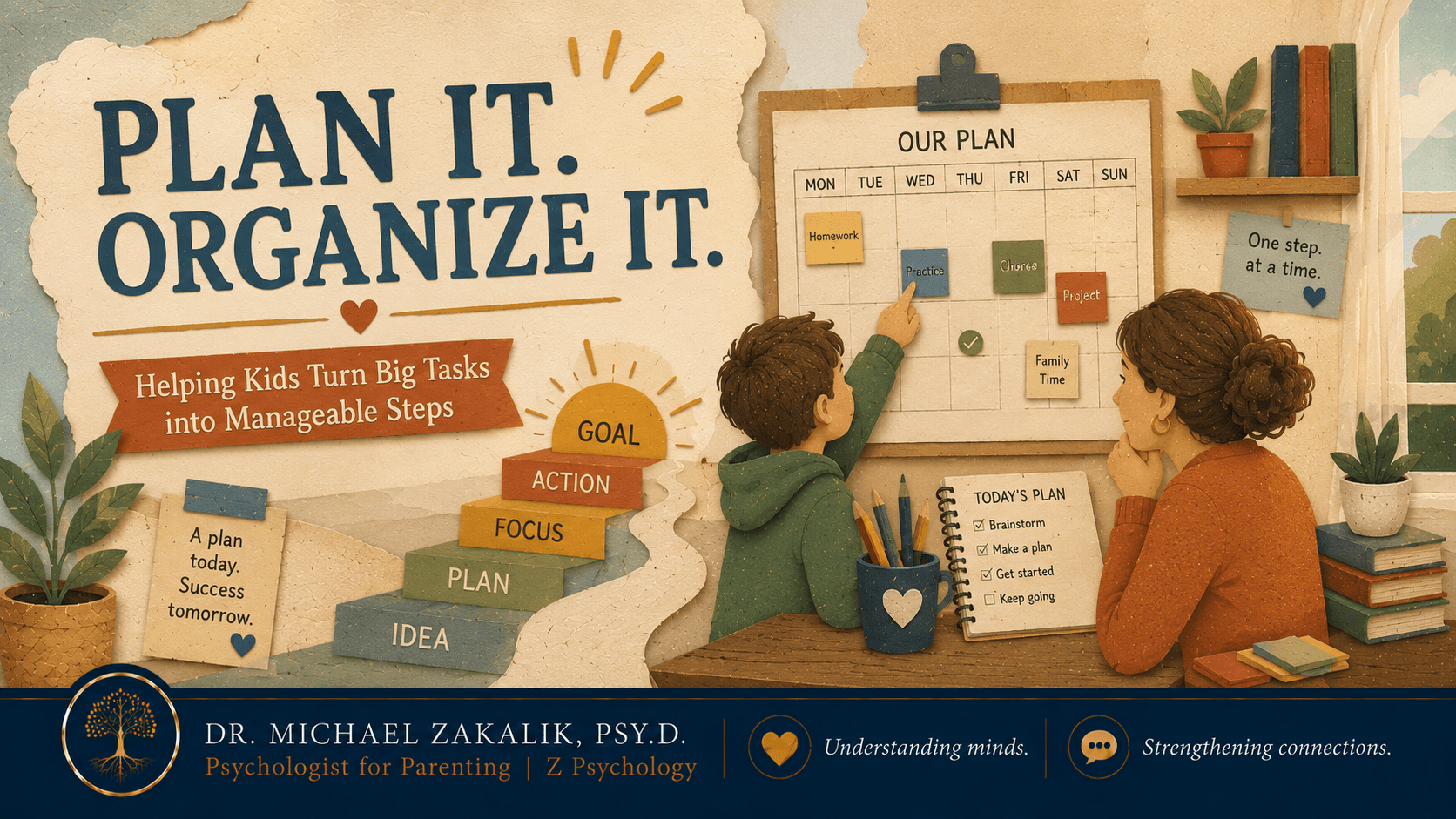
If you look at the whole staircase at once, it feels too tall to climb. But find the first step, then the next, and you can get all the way to the top.
(Disclaimer: The articles provided on this website are for informational and enhancing mental health awareness purposes only. They are not intended to be clinical interventions or provide medical advice. If you have any concerns about your well-being and/or well-being of others, please seek guidance from a qualified professional, such as a physician, psychologist, or counselor. If you are experiencing a clinical emergency please call 911 or 988 or go to the nearest emergency room. Here are some national and international helplines.)
By Dr. Michael Zakalik, Licensed Clinical Psychologist
Part of Dr. Z's Toolbox.
Teaching Kids Organization & Planning Skills
Some kids seem born with a tidy mental filing system. Others lose the same library book three times in a month and treat their backpack as a black hole.
The difference is rarely about caring. It is about planning and organization, executive function skills that, like all the others, are built rather than handed out at birth.
What is planning and organizing?
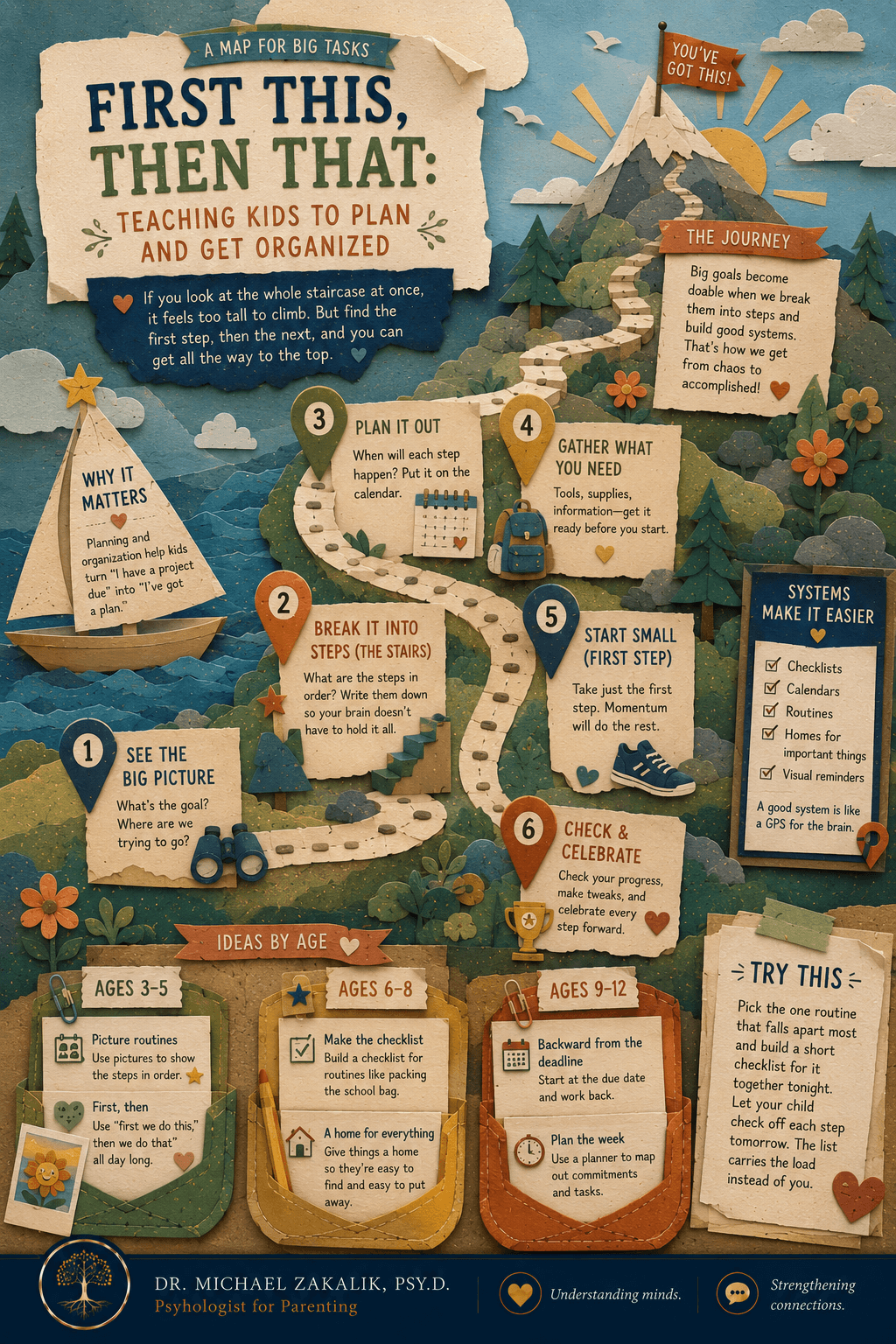
Planning is figuring out the steps to reach a goal and the order to do them in. Organizing is keeping track of your things and your information so you can find them when you need them. Together they let a child move from "I have a project due" to actually getting it done, and from chaos to a backpack they can navigate.
Why it matters
As kids get older, school and life ask for more independent planning: longer projects, remembering what to bring, breaking big tasks into steps. A child who struggles here can be bright and hardworking and still drown, not for lack of ability but for lack of a system. This is also the skill that quietly fuels getting started in the first place. Teaching the system changes everything.
How to explain it to your child
A big job is like a staircase. If you look at the whole staircase at once, it feels too tall to climb. But if you just find the first step, and then the next one, you can get all the way to the top. Planning is breaking the big thing into steps. Organizing is keeping your stuff where you can find it, so you are not searching when you should be climbing.
What it looks like in real life
Your daughter has a book report due and is paralyzed, because "write a book report" is not a task, it is a mountain. Sit with her and break it into stairs: pick the book, read it, jot three ideas, write the first paragraph. Suddenly there is a first step small enough to take. You are teaching the move of turning a mountain into stairs, which is most of what planning is.
Try it together: activities by age
Build the skill in small, everyday moments. By age:
- Ages 3 to 5. Picture routines: make a simple picture sequence for a routine like bedtime, because seeing the steps in order is planning made visible. First, then: use "first we do this, then we do that" language all day long, since the order of steps is the seed of planning.
- Ages 6 to 8. Make the checklist: build a checklist together for a routine that keeps falling apart, like packing the school bag, because checking off steps is deeply satisfying and teaches the habit. A home for everything: set up clear spots for the things that always go missing, like shoes and homework, since organization is mostly deciding where things live.
- Ages 9 to 12. Backward from the deadline: for a project, start at the due date and work back to today, naming what happens when, which is planning in its purest form. Plan the week: use a simple calendar or planner together to map out the week's commitments, because owning a planner is a skill that pays off for decades.
"A child can be bright and hardworking and still drown, not for lack of ability, but for lack of a system."
Try this: pick the one routine that falls apart most, the morning scramble or the school-bag hunt, and build a short checklist for it together tonight. Let your child check off each step tomorrow. The list carries the load instead of you.
Frequently asked questions
At what age should kids be able to organize themselves?
Later than most parents hope. Real independent planning and organization keep developing through the teen years, because they rely on executive function that matures slowly. Younger kids need the systems built with them and plenty of support running them.
My child is smart but completely disorganized. Why?
Intelligence and organization are different brain systems. A child can reason brilliantly and still struggle to plan steps or track belongings. It is not laziness or a character flaw. It is an executive function skill that needs to be taught directly, usually with visible systems. This pattern is also common in the signs of ADHD in children.
How do I help without nagging or doing it all for them?
Build external systems together: checklists, calendars, homes for important items. The system carries the load instead of you, which is the goal. You scaffold the system, then gradually hand it over as they can run it themselves. Keeping the tone collaborative is part of discipline without yelling.
Free download: Planning and Organizing Family Discussion Guide
Simple, age-by-age ways to turn the mountain into stairs and build systems your child can actually run.
Download the guide (PDF)Enjoyed this? Explore more of Dr. Z's Toolbox