
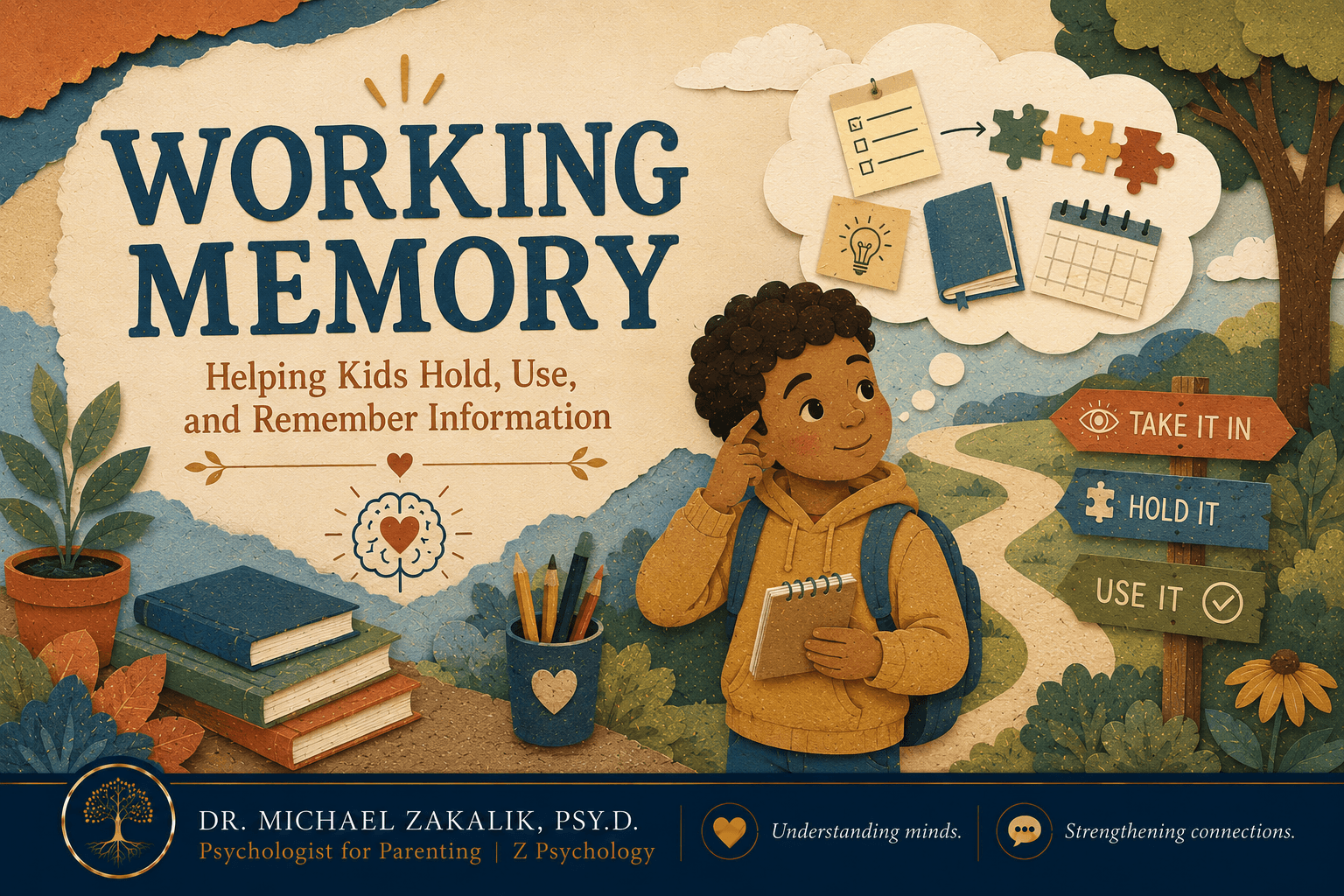
A child with a smaller mental workspace is not less smart. They simply have a smaller desk to work on.
(Disclaimer: The articles provided on this website are for informational and enhancing mental health awareness purposes only. They are not intended to be clinical interventions or provide medical advice. If you have any concerns about your well-being and/or well-being of others, please seek guidance from a qualified professional, such as a physician, psychologist, or counselor. If you are experiencing a clinical emergency please call 911 or 988 or go to the nearest emergency room. Here are some national and international helplines.)
By Dr. Michael Zakalik, Licensed Clinical Psychologist
Part of Dr. Z's Toolbox.
Working Memory Activities for Kids: A Parent's Guide
Have you ever sent your child upstairs for socks and a hairbrush, only to have them return with neither, having genuinely forgotten the mission halfway up the stairs? That is not carelessness.
That is working memory, the brain's sticky note, running out of room. And it is a skill you can both strengthen and support.
What is working memory?
Working memory is the ability to hold information in your mind and use it while you are doing something else. In kids it is what lets them follow a two step instruction, keep the rules of a game in mind, or remember the start of a sentence long enough to finish it. It is one of the three core executive functions, the brain's mental workspace.
Why it matters
So much of school and daily life runs on working memory: following directions, doing mental math, reading a sentence and remembering its beginning, and keeping track of a plan. A child with a smaller mental workspace is not less smart. They simply have a smaller desk to work on, and they benefit enormously when we help them keep that desk clear.
"A child with a smaller mental workspace is not less smart. They simply have a smaller desk to work on."
How to explain it to your child
Your brain has a little notepad inside it where you write down what you are doing right now, like the steps to a game or what someone just asked you to get. The notepad is small, so sometimes things slip off it. We can practice making your notepad stronger, and we can also write big things down so your brain does not have to hold them all by itself.
What it looks like in real life
You give a three part instruction and your son does the first part and stalls. Rather than you never listen, shrink the load: give one step at a time, or have him repeat the steps back before he starts. Repeating it back loads it onto the notepad more firmly. You are not lowering expectations. You are matching the task to the size of the desk.
Try it together: activities by age
Build the skill in small, everyday moments. By age:
- Ages 3 to 5. Two step missions: give playful directions with two parts and build up slowly, because holding the second step while doing the first is working memory exercising. Memory games: simple matching and what is missing games are working memory at play, and kids love them and never notice the workout.
- Ages 6 to 8. Say it back: have them repeat an instruction before starting, because repeating loads it more firmly onto the mental notepad. Cook together: following a simple recipe holds several steps and ingredients in mind at once, with a delicious reason to remember.
- Ages 9 to 12. Mental math and games: card games, chess, and quick mental math all stretch the mental workspace, and games make the practice feel like fun, not drill. Write it down: teach them to offload big things onto lists and notes, the way capable adults do, because knowing what to write down is itself a working memory skill.
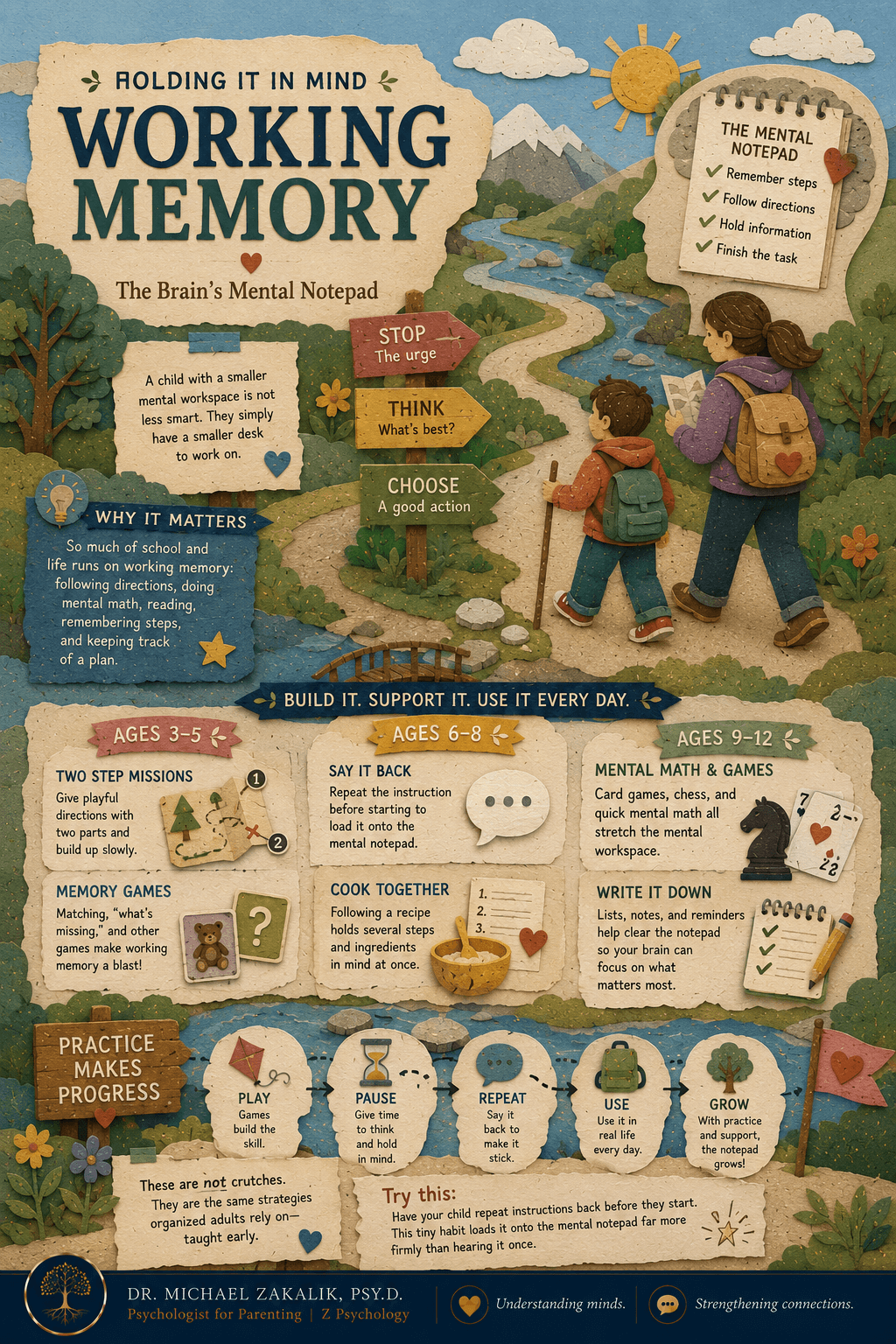
Try this: next time you need your child to do something with more than one step, have them say it back to you before they start. Repeating the instruction out loud loads it onto the mental notepad far more firmly than hearing it once, a tiny habit that prevents a lot of wait, what was I doing?
Frequently asked questions
Can working memory be improved in children?
It can be strengthened through practice with games and routines, and just as importantly, it can be supported by offloading information onto lists, pictures, and reminders. Both the building and the supporting matter, and the underlying capacity also grows naturally with age.
My child forgets instructions constantly. What helps?
Give one step at a time, have them repeat it back, and make plans visible with a checklist or pictures. These are not crutches. They are exactly the strategies organized adults rely on, taught early.
Is a poor working memory the same as not paying attention?
They look similar but are different. A child may pay attention and still lose the information because their mental workspace is small. Supporting the workspace, rather than scolding the attention, is usually what helps.
Free download: Working Memory Family Discussion Guide
The brain notepad explainer plus simple, age-by-age activities to strengthen and support your child's working memory at home.
Download the guide (PDF)Enjoyed this? Explore more of Dr. Z's Toolbox